SHINE is a look backward from the present to Salem's 1860 charter. In each year we have four sections: glimpses of what was happening around the world, a special event in Salem, what you see when you visit that site today, and other Salem events of interest that year.


Thursday, June 10, 2010

Salem in 1959

World Events 
  • The Tibetan government is abolished by China's Zhou Enlai. A puppet ruler replaces the Dalai Lama who granted asylum in India.
  •  Fidel Castro's new, revolutionary Communist government in Cuba is recognized by the US and the Soviet Union.
  • Alaska and Hawaii  become states this year.
  • NASA selects seven military pilots as the first US  astronauts. Two monkeys are first living beings to successfully return to earth from space flight. Explorer 6 sends back first pictures of earth from orbit.
  • The St. Lawrence Seaway, linking the Great Lakes to the Atlantic,  is opened by President Eisenhower and Queen Elizabeth II.
  • Buddy Holly, the musician considered a creator of  rock-and-roll and who influenced many other pop artists, died in the crash of a chartered plane. 
  • Frank Lloyd Wright's eye-catching, cylindrical building, the Solomon R. Guggenheim Museum, opens to the public in NYC.
  • Mattel's Barbie doll and the Xerox copier are both introduced.
  • "The Twilight Zone" premieres on TV. Academy Awards: "Ben Hur" (US), "Black Orpheus" (France). Prize-winning Books: The Magic Barrel, Bernard Malamud and The Travels of Jaimie McPheeters, Robert Lewis Taylor.
In Salem
Mark Hatfield has been elected as governor, but his High Street residence, purchased the year before, has to be renovated before he can move in. [Meanwhile he and family are living at the Royal Court Apartments on Chemeketa Street.] In the photograph above, the view of his property is from Kearney Street looking toward High Street with Bush's Pasture Park in the background.
It is a sign of the times that extensive electronic networks and a bomb shelter must be added in the basement. J. Warren Carkin designed a large kitchen and servants' wing that was added at the rear. The Oregon Centennial of 1959 was celebrated with many social engagements at this house and during the Legislative sessions of the Governor Hatfield's two terms, the governor's wife, Antoinette, held weekly open houses. Thousands of residents and visitors attended these events. Both Governor Hatfield and his wife posed for photographs inside the house. All four of the Hatfield children were born here.

When you visit
This house was built c. 1880 for Virgil Pringle (1804-1887) and was occupied by him until his death in 1887 and by his widow, Pherne, until her death in until 1891. His obituary recalls, "Mr. and Mrs. Pringle lived to a ripe old age and died at their home near Salem where shortly before they had celebrated their sixtieth wedding anniversary, surrounded by children, grandchildren and great-grandchildren. This was a happy reunion". The nearby Pringle Creek was named for this Salem pioneer of 1848. Note: Mission Street was the southern border of Salem city limits at the time of his death.
Even after the Mark Hatfield sold the house in 1968, it remained as a private residence. This SCAN neighborhood residence is in the Gaiety Hill/Bush's Pasture Park Historical District. It is featured on the SHINE Gaiety Hill/Bush's Pasture Park Walking Tour.

Other events
  • Russell F. Bonesteele is elected mayor. The house associated with Russell and Valerie Bonesteele is at 396 18th Street in the NEN neighborhood. Mr. Bonestelle's family was in the automobile business. He served on the hospital board and the Salem City Council before his election as mayor.
  • The Thomas Kay Woolen Mill announces it will close. The advent of synthetic fabrics and advances in manufacturing technology left the traditional methods of the Kay Wooden Mill unable to compete. The property has served as a non-profit entity since then. Originally known as Mission Mill Museum, it is now Willamette Heritage Center. Four pioneer structures have been moved onto the property and the institution is preserving the city's history as well as providing tours of the former mill.
Vice President Nixon and Oregon dignitaries at Centennial Celebration in Salem
  • In February, the Vice President of the United States, Richard Nixon, attends the Oregon Centennial Celebration at the Capitol. From a second floor balcony, the dignitaries listen as the Portland Symphony concert opens the ceremonies. The governor was still living at the Royal Court Apartments that February and the Vice President visited the Hatfields there. In this year, less security is required for our Vice President: the tenants, aware that Mr. Nixon would be visiting, lined the railings of the lobby balcony and applauded when he entered.
  • On June 9, the Capital Journal publishes a 116-page issue, entitled Oregon Centennial. Four special sections feature the 100-year history of the Willamette Valley. It is edited by William Mainwaring, son of the late publisher, Bernard Mainwaring, and is his first "major assignment" since returning from military service.
  • The much-debated use of a bequest by Carroll Moores, is finally resolved with a 12-foot statuary group entitled "Guidance of Youth". An earlier suggestion that a Renoir nude be purchased with the $34,000 had been met with indignant local protest. Avard Fairbanks of Salt Lake City created a more suitable statue that was accepted by Salem public vote. It presents a pioneer father with a hoe, a pioneer mother properly attired with skirt sweeping the ground and a pioneer youth. This group statue is sited in Bush Park’s southeast corner overlooking a playing field to the east.
Lancaster Area of Salem
State Street as "Four Corners"
  • An aerial photograph of the Four Corners area of Salem (State and Lancaster intersection) taken this year shows a residential suburb of homes on generous lots surrounding this business corner. The street level view shows the small businesses on the unpaved State Street in this unincorporated section of Salem.

Capitol Funeral of Douglas McKay
  • The funeral of former governor Douglas McKay, later US Secretary of the Interior, is held in the Capitol. It had been the intention of the family to hold the funeral in his church, First Presbyterian, but that structure was in the middle of Winter Street, still on its journey to its new location. Governor Hatfield led the procession out of the Capitol.

Wednesday, June 9, 2010

Salem in 1958

World Events 
  • Drought, weather conditions and the political policies of Mao Zedong cause the "Great Famine" in China,  starving 20 million people.
  • Van Cliborn wins Tchaikovsky international piano competition in Moscow easing Cold War tensions. Nikita Khrushchev becomes premier in USSR.
  • Queen Elizabeth gives her son Charles the title Prince of Wales.
  • Eisenhower sends Marines sent to Lebanon, citing United Arab Republic as responsible for violence.
  • The word Aerospace comes into use. NASA (National Aeronautics and Space Administration) is created by Congress. Authority for all aviation in the US is transferred to the new Federal Aviation Administration.
  • Hoola Hoops become popular. Plastic Logo bricks are patented. The first House of Pancakes opens in California, the first Carrefour store in France.
  • Elvis Presley is inducted into the Army. Roy Campanella of baseball fame is paralyzed by an automobile accident. 
  • Academy Awards: "Gigi" (US), "My Uncle" (France). Prize-winning books: The Wapshot Chronicle, John Cheever and A Death in the Family, James Agee.
In Salem
The plan for constructing the fourth state structure on the North Capital Mall, the Labor and Industries Building, is well underway. The fourth section of Piety Hill, the houses on the block east of Winter Street between Chemeketa and Center Streets will be demolished or moved. This will be the enterprise that captures the most public attention as it requires the Presbyterian Church, then on the northeast corner of Chemeketa and Winter Streets facing Chemeketa Street, to be put on rollers and moved diagonally across Winter Street to face east. The move began in the winter of 1958 and continues for many weeks, the progress intentionally slow so as not to damage the sanctuary.
A number of houses on the west side of Winter and north side of Court Street have been purchased by the church and demolished. This included structures prominent in Salem history for the families who lived in them:
299 N. Winter Street, W. T. and Mattie Rigdon, son Lloyd (1890-1947)
267 N. Winter Street, George Pearce and daughters Helen and Dorothy (1892-1955)
245 N. Winter Street, Joseph and Josephine Albert (dates of house unknown)
785 Court Street, Otto Krause and earlier Robert Fleming (1870s-1954)
745 Court Street, Max Buren and earlier residence of Charles and Fannie Bishop, J. J. Murphy that had been moved to Willamette University to be the president's residence. (1880-1955)
 The Pearce sisters had moved out of their family home in 1955, after purchasing a residence at 490 Oak Street on Fry Hill. One confessed to a friend that she wondered what her late father, George Pearce, would think of them moving to such a large house. The sisters had a sentimental affection for their "auto house", one of Salem's first garages, and brought it with them to be placed in the rear of the house. It is a tradition among parishioners of the church that after the church moved, the sisters sat in the pew that was directly above the location where their house had been.

The last section of Piety Hill is demolished,
When you visit
The church is located on the southwest corner of Chemeketa and Winter Streets, above the former site of the Rigdon and Pearce houses. To the south there are other buildings replacing the Albert/Fleming houses and, around the corner on Court Street, another wing of the church where the Bishop and Buren (1907-1966) houses were located. The house on Oak Street where the Pearce sisters moved, has been the home of the Kohne family for thirty years, but has retained its historic name. Although it has had alterations, the Kohnes honor the history of the house.
The Colonial style manse of the church was also moved. Built in 1926, the first pastor to occupy the manse was the Rev. Ward Willis Long and his wife, Evangeline. Their daughter was born there. The house is now a private residence located at the northeast corner of 18th and Court Streets. It is a contributing property in the Court-Chemeketa Historic District of the NEN Neighborhood and can be seen on the SHINE walking tour of the district.

Other events
  • Mark Hatfield is elected governor of Oregon.
  • The early parsonage of the Methodist Mission is moved from its original location for the construction of the water tower at the Kay Mill complex. It will be permanently located on the Mission Mill property, now Willamette Heritage Center.
This Lincoln store survives, but in a new building
  • The community of Lincoln was once a busy port transit center for wheat being shipped to other landings. In 1958 the town has almost disappeared, but an old house serves as a store at the crossroads where Wallace Road meets Zena Road. A few miles west in Spring Valley, the Presbyterian Church celebrates its 100th anniversary.
  • Eola School, also established in the 1850s, celebrates its 100th graduating class. Eight students pose for a photograph with their teacher.
  • Our Southern Pacific Freight Station, located in a building predating the 1918 station itself, is still doing business this year. In 2010, fifty years later, the structure is in poor shape although the roof has been repaired through the generosity of the local roofing industry. The freight station was included in the recent nomination of this railroad property for the National Register of Historic Places. In 2015, the building will find a new use as the Salem Greyhound Bus Station due to a generous private donation for its renovation.
  • Donut Daze, a product of the Salvation Army sold at a shop near the Gilbert House on the riverfront, is popular with residents and especially state employees.
  • Walton House, a property bequeathed by William S. Walton to St. Paul's Episcopal Church, becomes the rectory. It has since become a hospitality guesthouse for out-of-town patients, family or loved ones of hospital patients.

Monday, June 7, 2010

Salem in 1957

World Events 
  • The European Economic Market (Common Market), created by the Treaty of Rome this year, is an important part of the economic union among France, West Germany, Italy, Netherlands, Belgium and Luxembourg.
  • Gov. Orval Faubus calls out the National Guard to prevent nine African-American students from enrolling in Little Rock High Central School. President Eisenhower sends federal troops give them safe passage.
  • The Soviets launch Sputnik 1, the first satellite to orbit the globe. The International Atomic Energy Agency is created.
  • The floodgates of the Dalles Dam are closed, flooding Cello Falls and the ancient Indian fishing grounds on the Columbia River.
  • Wham-O company produces the Frisbee, Ford introduces the "Edsel", Brooklyn Dodgers baseball team move to L.A.
  • Both "The Music Man" and "West Side Story" premiere on Broadway. Academy Awards: "Bridge On the River Kwai" (US), "Nights of Cabiria" (Italy). National Book Award: The Field of Vision, Wright Morris.
In Salem

From Cliff Smith, retired Extension Director of the Salem Public Library:
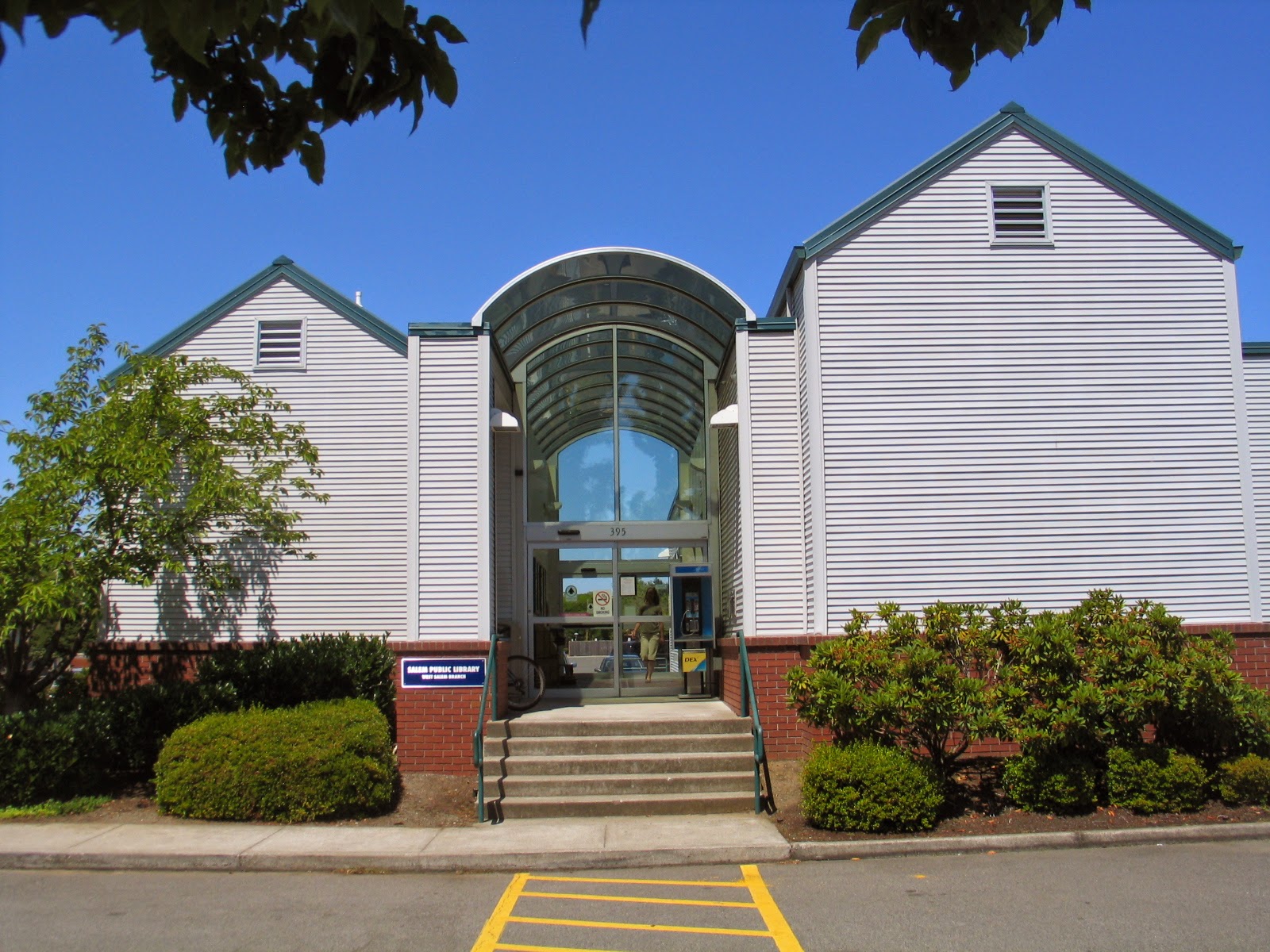
"On Oct. 17, 1957 the doors were opened and the West Salem Library was born. It began in 3 small rooms on the 1st floor of the old West Salem City Hall when the Salem City Council appropriated $6,450 to cover cost of salaries, furniture, and redecorating. An additional $4,000 to cover the cost of books had to come from private sources. Members of the Salem Jaycee's built the book shelves and did the painting, West Salem PTA members built tables, and the West Salem Lions Club installed new floor tile. The first opening hours were 27 hours per week and stayed about the same for the first 30 years. The first year, 12,564 books were checked out--half of that by children. That was an interesting building, with the old West Salem Jail and Fire Department water well located in the basement and a stage and open floor upstairs on the second floor, which was said to be used for occasional dances in years gone by. In addition, Chemeketa Community College--then called Salem Technical/Vocational School--started some of its first classes upstairs when they found their first location to be too small. So Chemeketa Community College shared its humble beginnings with the West Salem Library."

When you visit
Today you visit our branch library in its own building. In 1995 Orville Roth (1934-2013) donated land immediately behind and adjacent to the West Salem Roth’s IGA grocery store upon which to build a new library. With large donations from West Salem residents, a federal grant through the Oregon State Library, and City of Salem general fund money, the new 6,000 square foot building was built. On September 25, 1995 the new branch library celebrated its grand opening ceremony and doors opened the next day for business. The West Salem citizens have been active in defending their branch library whenever city budget cuts have threatened to curtail services or make significant cuts in hours of operation. This happened in the 2012 Budget Committee session when hours were slated to be cut from 30 hours to 6 a week. West Salem residents crowded the Council Chambers to protest. A compromise was reached so the Branch Library could be open 16 hours a week.
For more information about our West Salem Branch Library and what hours it is open, call 503-588-6052 or click here.

Other events

  • Ed Ritter's construction company participates in the final razing of Camp Adair structures. Under caretakers for many years, the final demolition wipes out any trace of the World War II army camp on Highway 99 north of Corvallis. Salem photographer Ben Maxwell's series of 85 pictures of the last buildings is available in the Salem Public Library Historical Photograph Collections.

The Derby Building: Senator Hotel and Greyhound Bus Station
  • The Derby Building at the southeast corner of Court and High Street is a busy downtown location. It contains, among other businesses, the Senator Hotel and the Greyhound Bus Station. It was leased to the State of Oregon in 1973 for office space and later demolished. The Courthouse Square Transit Center is located on this property.
  • Two senior citizens are celebrated this year. Sister Anna Hayward Duerksen, aged 71, was one of the founders of the Deaconess Hospital in 1916. This year, the Oregon Nurses Association honored her with a life membership for her long leadership in health care. Mr. C. D. Frazer, Oregon's first purchasing agent under Governor West in 1914, was honored on the occasion of his 97th birthday.
  • St. Mark's Lutheran Church is constructed on the SW corner of Marion and Winter streets. The congregation previously worshiped at the Lutheran American Church at Chemeketa and Church streets, but now undertook construction of the present modern stone building. 
  • Pleasant Grove Church in original Location
    In other church news: The Pleasant Grove Presbyterian Church, built in 1854 and located in Mount Pleasant between Stayton and Scio, was photographed as seen in June 1956. The church was built by Cyrenius and Silvanus Condit in 1857 with lumber from Oregon City. The construction of the church was planned on the job. The sign next to the church reads ""Presbyterian church began with the arrival of the Reverend Philip Condit in September 1854. The congregation was organized January 1, 1855. The building was completed in 1858. It is the oldest church building erected by Presbyterians on the Pacific Coast."The church has since been moved to Willamette Heritage Center (then known as Mission Mill Museum) and restored. It is used for meetings and weddings. This is one of four historic structures that have been moved to this property and restored due to the outstanding volunteer fund raising efforts and enterprise of the members of the former Marion County Historical Society and Mission Mill Museum. The other buildings are the Jason Lee House, The Mission Parsonage and the John Boon House. All are listed on the National Register of Historic Places. Willamette Heritage Center tours are available.


Sunday, June 6, 2010

Salem in 1956

World Events
  • Gamal Abdul Nassar nationalizes the British and French controlled Suez Canal, hoping to use tolls to pay for dam on the Nile. Israel invaded Egypt, but due to international pressure the Israeli forces left in March, 1957. The Canal reopened under Egyptian control.
  • The Hungarians revolt against the Warsaw Pact. Soviet forces agreed to negotiate, but then moved to crush the rebellion resulting in mass executions and arrests. 200,000 refugees fled the country.
  • Dwight Eisenhower and Richard Nixon re-elected as President and Vice President for second terms.
  • Negroes in Montgomery with Rev. Martin Luther King, Jr. as a leader, begin boycott after Rosa Parks is arrested for sitting in the front section of a city bus.
  • The Andrea Doria sinks off Nantucket Island.
  • Interstate Highways approved as important to national defense.
  • "Rock and Roll" takes over popular music with Elvis Presley becoming a star attraction.
  • "Around the World in Eighty Days" was this year's film that won the Academy Award (1957). National Book Award (Fiction): Ten North Frederick, John O'Hara.
In Salem

Paul Wallace leaves 24 acres of prime riverfront land in a bequest to the citizens of Salem. Subsequent purchases and gifts have increased the size of Wallace Marine Park to 68 acres. Although it quickly became a popular place for riverfront recreation during the basic development of the park, it was not designed or constructed to resist the high waters of the Willamette River: the Christmas flood of 1964 swept away the two boat launching ramps, roadways and picnic facilities that had been developed. New facilities were constructed in 1967.

When you visit
Many recreational opportunities are available in our largest park with softball tournaments especially popular and well attended. There is a boat launching dock, places for individuals who like to fish, picnic benches and walking trails. In 2009, the Union Street Railroad Bridge and Trestle was renovated as a pedestrian and bicycle path, connecting our two parks, Waterfront Park on the east side of the Willamette River and Wallace Marine Park on the west side. New sidewalks, including one leading to a river-viewing platform, have been constructed by the city in 2012. New paved walk/biking trails are completed around the sports fields and between the Union Street Trestle and Glen Creek Road are completed in 2014.
In 1969, a Parks and Recreation Advisory Board was established. Anyone interested in the development of Salem public parks and playgrounds is invited to apply. All residents are invited to become volunteers: The Salem Parks Foundation is a 501(c)(3) non-profit organization whose purpose is to promote, develop, facilitate, and sustain stewardship dedicated to the enhancement of the parks of our city. It is also affiliated with the Oregon Cultural Trust. Their public meetings are 1st Thursdays, 6 p.m., Parks Operation Building #14, on 22nd. Street.

Other events
  • His political supporters convinced Douglas McKay to leave his appointment as US Secretary of the Interior to run against Wayne Morse for the United States Senate. This was the first election McKay lost. He then served President Eisenhower on the International Waterways Commission.
  • A five year effort by the YMCA is completed. In 1951, the Nelson property on Court Street, adjoining the Y had been purchased, and a Capital Fund drive organized. By 1954, funds were raised and the new Youth Wing was completed in 1956.
  • St. Timothy's Episcopal Church is established with temporary locations. It would be twelve years before their sanctuary on Ladd Avenue would be completed.
  • Business events include the opening of the American Can Company and the closing of Hunt Brothers cannery with their location acquired by the Keith Brown Lumber Company.
  • The Chamber of Commerce moves into new headquarters on Cottage Street. This Colonial style residence had been the home of George Rodgers, a former mayor and president of the Salem Paper Company. The property, on the northeast corner of Cottage and Court Streets, had originally been the location of the property of Joseph Holman, outstanding pioneer merchant at the founding of the city. The Chamber occupied this building until 1995 when it moved and the YMCA bought the property. The building burned in 1997.
  • The 1952 Turner Reservoir is in full operation this year when J. L. Fransen retires as our first City Manager. The reservoir is named for him. Kent Mathewson receives an enhanced salary of $14,000 a year, compared to Fransen's $11,500.
  • A photograph taken at the entrance of Lipman, Wolfe and Company store in downtown Salem shows mature ladies in dresses, most also in hats. Another catches a younger woman in full "poodle" skirt. Trousers on females would have been very unusual. The men appear to be dressed informally much as they are today.
  • During the winter of 1956, the Capitol and the Elsinore operate only at night, except for Saturday and Sunday afternoon matinees. The Hollywood remains open as usual. A general lack of patronage, due to the popularity of TV home entertainment is the reason for closure.
  • The L. H. McMahon home at 891 Front Street is still a charming cottage in 1956. Built by David McCully in 1864, it will continue to survive into the present (2010), although in a new location at 1365 John Street. The residence was purchased by Judge Leonard H. McMahan and his wife (the former Bertha Byrd) in 1919. After his death, she continued to live there until the house was severely damaged by a falling tree during the windstorm of 1962. The house was moved and became the residence of David Duniway. Mr. Duniway, Oregon State Archivist, was prominent in the promotion of Salem historic properties.

Thursday, June 3, 2010

Salem in 1955

World Events 
  • American Advisers are sent to aid South Vietnam government.
  •  West Germany becomes a democratic Federal Republic, separate from German Democratic Republic in the east, which is a Communist dictatorship.
  • Protests against racial segregation lead to federal law forbidding it on interstate trains and busses. Rosa Parks is arrested in Montgomery, Alabama for not giving up her seat in the "colored section" to a white woman. Montgomery Bus Boycott follows.
  • American labor unions merge into AFL-CIO. General Motors is the first American corporation to make profits over a billion dollars in one year.
  • Actor James Dean is killed in an auto crash near Cholame, California.
  • Disneyland opens in Anaheim, California. "Gun Smoke" and "Mickey Mouse Club" debut on TV. Bill Haley introduces "rock 'n' roll" music blending country and blues.
  • Ray Kroc opens his first McDonald's in partnership with the McDonald brothers in Des Plains, Illinois.
  • Academy Awards: "Marty" (US), Samurai, "The Legend of Musashi" (Japan). Prize-winning book: A Fable, William Faulkner.
In Salem
Salem shoppers are excited about the opening of a local branch of Portland's Meier and Frank department store. The business enterprise is built on the traditional site of Salem schools: the 1906 Salem High School and the earlier Central School. Gerry Frank, owner and manager, became a well-known political and business leader in Salem and was a prominent member of Governor Hatfield's staff. This is a photograph of the familiar entrance on the southwest corner of Center and High Streets N.E. The view includes the southeast corner of the building's parking structure at Center and Church Streets N.E. It shows Salem's use of parking meters downtown at that time and the grid of one-way streets.

When you visit
This department store chain has been sold to Macy's, but the local branch continues to operate at this location. Information about Gerry Frank's Konditorei was published in 1999 by SalemHistory website. This specialty restaurant currently (2014) operates at the southeast corner of Kearny and Commercial Streets.
The iconic Meier and Frank lobby clock, famed as a local meeting spot, was given to the Salvation Army Kroc Center by Frank in 2008. The gilt-encrusted clock had been installed in 1955 and is the work of Welton Beckett Architects in Los Angeles. It was removed from Meier and Frank in summer 2006, when the May Co. remodeled the building.

Other Events
  • A Christmas parade for children is inaugurated this year. It continues as the 'Festival of Lights." However, due to the city's inability to aid in the financing, the parade moved to Keizer in 2011.
  • The former President of the United States, Herbert Hoover, visits Salem where he lived for three years in his youth. The Newberg home of his uncle, Henry Minthorn, is renovated beyond recognition this year.
  • The foreground of this aerial view of the 1955 Salem downtown shows the availability of land on the hill south of Pringle Creek that will later house the new Civic Center (left foreground of the photograph). In the left center, the area of the three bridges that cross the Willamette River (back to front) the railroad bridge, Marion Street Bridge and Center Street Bridge. The dark tall evergreens at the end of the bridges are in Marion Square Park. North-south streets (left to right) are Front Street; Commercial Street with the Columbia River Paper Company at the left edge of picture. The present Civic Center is located in the left foreground.  Up one block is the Marion Motor Hotel and one block further Ladd and Bush Bank; Liberty Street with the tall Capitol Tower building at the State Street intersection; and High Street with Marion County Courthouse (trees and grass in front, far right) and on the other side of the street further along is Salem City Hall with its clock tower.
  • Brush Creek School, established in 1895, still has only a single classroom when the students and their teacher pose for a portrait outside the front porch. Since then, the school buildings have expanded and been renovated several times. The unique quality of this school is that the original bell tower still remains, even with the bell itself. The school celebrated its long service to the community in 2010 with an exhibition of student work and a collection of historical photographs. 
  • Graduates of the 1890 class of East School held a reunion at the home of Dan Fry in August of this year.  This school was one of Salem's architectural gems, but unfortunately the maintenance of the building was too high and the facilities out-of-date. To local historical preservationists, who have little influence in city planning, the three greatest architectural losses have been this school building, the old City Hall on High Street and the Victorian Marion County Courthouse. None of these could have continued in their original functions so these demolitions were logical financially. Whether any one of these could have been transformed into a local historical museum, devoted to the city's heritage, is debatable. We still (2012) have no institution in Salem dedicated to this purpose.
  • The plaque that commemorated the location of Salem's first commercial venture, the Thomas Cox store on the northeast corner of Ferry and Commercial Streets in 1847, was removed this year from the building that stood there. The photograph that was taken is our only record of the plaque which has disappeared. Ed Ritter, wrecker, is pictured on the left.
  • One of Salem's most outstanding local businesses, the Paulus Brothers Packing Company, is sold to Dole Pineapple Company, Ltd. This is a further signal that traditional canning operations have become limited because of the popularity of frozen foods. All the canning facilities south of Trade Street were replaced by parks and other urban uses. This gentrification of the downtown has given it a more attractive appearance and made room for enterprises such as SAIF and a downtown, Pringle Creek condominium, Salmon Run. This loss of industry has been a detriment to the economy of the city 
  • Myra Albert Wiggins, a granddaughter of the pioneer Holman family who left Salem to pursue a successful career as a photographer, dies at her home in Toppenish, Washington at the age of 86. Myra's life as a wife and mother never limited her career. Her love of family, natural beauty, the theme of Native American women and her world travel were all reflected in the art she produced. Her life is profiled on Salem Lifelines.

Wednesday, June 2, 2010

Salem in 1954

World Events
  • In Indochina, a Cease-Fire line between French forces in the south and Vietnamese forces in the north is drawn by a Peace Convention in Geneva with free elections to follow. Failure to keep this agreement led to the wider Vietnam War in which the US  engaged..
  • The Iwo Jima Memorial is erected at Arlington Cemetery. The Air Force Academy established in Colorado Springs, Colorado. The first nuclear-powered submarine, U.S.S. Nautilus is launched.
  • As a result of his public denouncements of prominent Americans as Communists, the US Senate condemns Senator Joseph McCarthy for "conduct that tends to bring the Senate into dishonor and disrepute"
  • Salk polio vaccine given to children. US Supreme Court strikes down "separate but equal" racial segregation in public schools with Brown vs Board of Education, Topeka. (Begun by father of 3rd grader Linda Brown in 1950.).
  •  While Salem's Douglas McKay is Secretary the Interior, the Western Oregon Indian Termination Act ends recognition of the Grand Ronde tribe as a nation.
  • In Los Angles, the 17 Watts Towers (Nuestro Pueblo) of Simon Rodia are completed after 33 years of his naive artistic construction.
  • Ellis Island, the New York Harbor main immigration point, is closed.
  • Academy Awards: "On the Waterfront" (US) "Gate of Hell (Japan). Prize-winning book: The Adventures of Augie Marsh, Saul Bellow.

    In Salem
    Salem residents were getting used to the fact that their 1872 Victorian courthouse, once described as a "wedding cake", had now turned into a "cake box". The austere lines of the new Marion County Courthouse building, dedicated in June, reflect the mid-twentieth century architecture of Peitro Belluschi found in Salem and echo his design of the 1935 State Capitol. The only thing familiar to residents at the time this photograph was taken is the 1924 "Doughboy" statue, still standing on the lawn. The courthouse grounds are awaiting the landscaping to be supplied by the local firm of Lord-Schrvyer.

    When you visit
    In 1991 the "Doughboy" World War I memorial was moved to the new Oregon Department of Veteran Affairs Building on Summer Street. It can be seen there at the south end of the Veterans Memorial Park along Mill Creek. At the Courthouse itself, the entrance has been modified and barriers erected. These were put in place after a driver crashed his car up the front steps and into the building in 2006. The public may attend trials in the Courthouse, but should inquire about scheduling and restrictions. The office of the County Clerk has property records and clerks supply help in looking up specific properties of interest. The Marion County Recorder's Office maintains a website to direct viewers to other services.

    Other events
    • The Grant School building, at Market and Cottage Streets NE, is being prepared for demolition after serving the community for 64 years. It will be replaced by a more modern structure now in use (2014).
    • While Salem High School, on Marion Street between Center and High Streets, is being torn down, a historic Class of 1906 plaque is found. Several houses of the neighborhood are also demolished as the property is prepared for the new Meier and Frank Department Store.
    • The South Salem High School on Church Street is completed this year. Students whose parents lived south of State Street could attend the new three-year high school that was then adjacent to Leslie Middle School.
    • Dr. Dean Brooks, becomes Superintendent of the Oregon State Hospital. He will temporarily become an actor in 1975 when he plays a small part in the Academy Award movie, "One Flew Over the Cookoo's Nest", filmed in that Salem institution. In 1954, a new geriatrics building opens on the north side of Center Street. Dr. Brooks was born in Everett, Washington in 1916. He attended the University of Kansas Medical School in Kansas City, Kansas and graduated from there on the 1st of June 1942. He was first licensed in Oregon to practice Psychiatry on the 21st of January 1950. He retired from the practice of Psychiatric Medicine on the 31st of December 1999. He never had a single complaint filed against him in his long and distinguished career as a Psychiatrist.
    • St. Paul's Episcopal Church moves its parsonage. Another photograph shows it in its original location. Currently, the former rectory is located on Leffelle Street in the Gaiety Hill/Bush's Pasture Park Historic District, directly south of the park. It is seen on the SHINE Court-Chemeketa Walking Tour.
    • A new YWCA of Pietro Belluschi design is built on State Street.  This former YWCA has had various tenants and is used periodically for CERT training purposes.
    The John Carson House on High Street
    • The John Carson house, a landmark of many years at the southwest corner of High and Kearney Streets, is about to be razed for the construction of a church. The original structure may have been constructed about 1860.  By 1889 it was the home of John and Helen F. Carson. They raised a family of two daughters (Ester and Catherine), and three sons (Wallace, John and Allen). Mr. Carson died in 1916, but his widow continued to live there until her death in 1939. The senior Mr. Carson was one of most eminent attorneys in the Northwest and a State Senator. His grandson is Wallace P. Carson, Jr. of Salem who served as Chief Justice of the Oregon Supreme Court for 14 years and was named Citizen of the Year by the Chamber of Commerce in 2010. In 1943, a photograph of the large house with "sleeping porches" was taken from Kearney Street. The family of Evelyn Andrus lived there at that time.
    The John Scott House on Court Street
    • The undated photograph represents the beautiful home of Supreme Court Justice John Scott that occupied the northwest corner of Court and 12th Streets. Judge Scott died in 1952, his widow Maud lived there until her death this year. The couple, married 7 years, is enumerated in the 1910 census with her parents, James and Miranda Martin. This Victorian house may have been their home. What year it disappeared, or if it was moved, it not known.
    • The annual Salem Art Association Art Fair that had moved into Bush House the year before, now becomes a "clothes-line" exhibition and sale on the Bush House grounds. The expanded Art Fair is a major tourist attraction in 2012 providing venues for art sales and family entertainment.

    Tuesday, June 1, 2010

    Salem in 1953

    World Events 
    • The CIA helps restore Shah Mohammad Reza Pahlavi to power in Iran, overthrowing the democratically elected  Mohammad Mossadegh. Vice President Nixon visits Iran causing riots (now an annual commemoration).
    • On TV the world watches the coronation of Queen Elizabeth II, the Eisenhower inauguration, Lucy giving birth on "I Love Lucy". (Color TV sets go on sale for $1,175.)
    • The Korean Armistice Agreement establishes the DMZ between communist North and capitalist south.
    • George C. Marshall is awarded the Nobel Peace Prize (in part) as the originator of the Marshall Plan to rebuild Europe after WW II.
    • Lung cancer first attributed to cigarette smoking, Jonas Salk announces a  polio vaccine. James Watson and Francis Crick discover the structure of DNA molecule.
    • Sir Edmund Hillary and Tenzing Norway are first men to reach summit of Mount Everest. Mickey Mantle hits baseball's longest home run (565-feet).
    • "Mad", "Playboy" (with Marilyn Monroe as centerfold) and 'TV Guide" are popular new magazines. The Academy Award went to "From Here to Eternity"(1954). National Book Award: Invisible Man, Ralph Ellison. Pulitzer Prize: Old Man and the Sea, Ernest Hemingway.
    In Salem
    Returning servicemen, who had only known the Depression as they were growing up, had their first home-owning experience in these look-alike "track houses". Although standing among others like small green tokens in a Monopoly game played on a vast, empty board, they were highly prized. Purchased with a GI loan, a few hundred dollars in a down payment, and small monthly payments, they represented a future of independence and prosperity. This house at 2116 Park Avenue was in one of the first housing developments in the Lansing neighborhood. Then outside the city limit, around it were open fields of the former farmland. Water was provided by privately owned 70 foot deep well which supplied the immediate area of houses. A young teacher was the first owner of this house, followed by Olga and Hilda Ask, sisters who had retired from farming. In 2010 it was still in possession of the third owners.

    When you visit
    It is difficult to find one of these homes that has not been substantially altered. In the case of this house, there is additional front room window, one in the kitchen has been modified and there is a wheelchair ramp. On a quiet suburban street, now with sheltering trees, it has an attractive and welcoming appearance and is testimony to the enduring value of these 60 year-old homes. It is in the Lansing neighborhood, north of Market Street.
    Although it is now common to see large tracts of homes being built by developers (West Salem, for example), and even modified "row houses" (Grant neighborhood), these were limited concepts in Salem until the post-World War II era. An architect might use a similar design for several houses (Jefferson Pooler on Court Street in 1909-11), but the earliest "mass produced" houses were probably the Sears Catalog Home (1908-1940), which a private builder could order by mail (1724 Chemeketa is a local example). Many of these have retained their original exterior appearance and are designated as Local Landmarks or are qualified for the National Register. Professionals in historic preservation are now applying the same standards to 1940-50s "tract houses" that have retained their integrity of design. They are equally worthy of respect and preservation.

    Other Events
    • This is the last year for the Salem High School that is about to be razed for the construction of Meier & Frank Department Store, now Macy's. It was located on Marion Street, between High and Church streets.
    Portland NAACP delegation, Senator Hitchcock and Representative Mark Hatfield.
    • Oregon Assembly Representative, Mark Hatfield, is photographed (above) in a celebration for the Public Accommodations Act, signed this year. He had never forgotten that as a student at Willamette University, his task was to drive Paul Robeson to Portland after a singing engagement at the university. There was no place in Salem for the nationally recognized singer, actor and political activist to sleep that night. The photograph now hangs in the Capitol.
    • Detroit Dam is completed by the U. S. Army Corps of Engineers on the Santiam River between Linn and Marion County in the Cascade Mountains. It was authorized for flood control. power generation, navigation and irrigation. Other uses include fishery, water quality and recreation. It created a 400-foot deep Detroit Lake more than 9 miles long with 32 miles of shoreline. Nearly 200 residents of the town of Detroit were moved; Highway #22 and the Santiam River were realigned.
    • In 1938, Carroll Moores left his lifetime savings of $25,000 as an annuity for a friend and to create a memorial to Oregon pioneers. By this year, the invested sum had reached $34,000. Two art professionals making the selection decided Salem already had enough traditional statuary and suggested Renoir's Venus Victorieuse currently on sale in New York. The citizen uproar that followed was taken up by rival opinions in the newspapers. The Capital Journal newspaper called her "fat and naked". Women’s clubs thought it was undignified. Art teachers tried to get in a few words; so did ex-Governor Sprague. But the uproar grew. Mr. Putnam, publisher of the Capital Journal newspaper, commented that it was "just another art lover sneer at Salem for rejecting an unsuitable memorial to Oregon’s early pioneers." An answering editorial in the rival Salem Oregon Statesman newspaper concludes, "If we want to capitalize on this publicity, perhaps we should set up a base, bearing the label "Venus Unvictorieuse". The Capital Journal newspaper also presents a letter from the Council of National Sculpture Society emphasizing the unsuitability factors." The controversy would not be settled until 1959.
    • Gray House
      The Gray House is constructed at 3251 Bluff Avenue in the Morningside neighborhood. This International style residence was to be a retirement home for builder Paul Gray and his wife. However, Mrs. Gray died two years later and the house was sold to Viola and George Corrigan. Viola, widowed and remarried twice, lived in the house 43 years, walking 2-3 miles a day around the neighborhood. The present owners bought the house from her in 1998.