SHINE is a look backward from the present to Salem's 1860 charter. In each year we have four sections: glimpses of what was happening around the world, a special event in Salem, what you see when you visit that site today, and other Salem events of interest that year.


Showing posts with label Thomas Kay Woolen Mill. Show all posts

Tuesday, June 15, 2010

Salem in 1962

World Events
  • In October, a two-week Cuban Missile Crisis ends as Kennedy announces that Khrushchev will remove Soviet missiles in Cuba. Linus Pauling is awarded the Nobel Peace Prize for his campaign against nuclear weapons testing.
  • John Glenn orbits the earth in Friendship 7. Walter Schirra and Scott  Carpenter complete pioneer space flights. The U. S. Navy SEALS, elite special forces are commissioned for both the Atlantic and Pacific fleets.
  • Two world-famous American women die: August 5, Marilyn Monroe; November 7, Eleanor Roosevelt. First Lady Jacqueline Kennedy takes TV viewers on a tour of the White House.
  • Rachel Carson warns of eco-danger. Her book, Silent Spring, gives rise to the modern environmental  movement.
  • The term "personal computer" is coined.  AT&T's commercial communications satellite is launched into orbit. "Big Box" stores are created: Kmart, Target and Wal-Mart. Taco Bell opens its doors.
  • Wilt Chamberlain scores a record-breaking 100 points in a NBA game.
  • Andy Warhol premieres his "Campbell's Soup Cans" art exhibition. The Century 21 Exposition World's Fair, with Space Needle, opens in Seattle.
  • Academy Award:"Lawrence of Arabia" (US), "Sundays and Cybele" (France). Prize-winning Books: The Moviegoer, Walker Percy and The Edge of Sadness, Edwin O'Conner.
    In Salem
    If the 1935 fire that destroyed the State Capitol building is the most remembered event in the city's history, the windstorm of 1962 probably ranks as the second.
    The majority of structures in Salem experienced damage during that calamitous storm on Columbus Day. At its peak, between 4 p.m. and 7 p.m. that Friday, it brought gusts of 90 M.P.H. and sustained winds of over 70 M.P.H. The $4 million total damages to Salem were higher than for any disaster the City had yet seen. The storm came with little warning and hit hard. It crossed the Oregon-California border on Friday, October 12, at noon, moving north at 48 M.P.H., reaching Salem at mid-afternoon. The ferocity of the winds as they roared through Salem shocked residents. Downtown, pedestrians were hit by glass from shattering windows, and dodged flying debris. Shoppers trying to get home were knocked to the ground. Cars were blown onto sidewalks and yards. The large sign on the roof of the Elsinore Theater was battered and crumpled by the wind and part of a wall at the Capitol Press Building fell onto two cars; rain then poured into the building. The steeple was torn from the Christ Lutheran Church at 18th and State Streets and dropped onto the sidewalk. Trees were blown over and uprooted. On the Capitol grounds, a falling tree knocked over the 3 1/2 ton statue of The Circuit Rider. (The photo seen here is from the Hugh Stryker Collection.)

    When you visit
    A few months later, the statue was repaired and replaced on its plinth.
    The Circuit Rider statue was sculpted by A. Phimister Proctor to honor Oregon's circuit-riding ministers. Robert A. Booth, whose father was a Methodist Episcopal circuit rider, presented the statue to the state as a gift in 1924. It was originally placed in an imposing location in front of the 1876 State House. When the Capitol was rebuilt in 1937, facing north instead of west, the Circuit Rider was repositioned among other statuary in a wooded area. The imposing memorial can be seen to the east of the Capitol on the path leading to Waverly Street.

    Other Events
    Purification ponds on Minto Brown Island, 1965
    • Boise Cascade purchases Oregon Pulp and Paper Company, a lumber company that began production at the same site in 1920. (The gabled roof of the Oregon Pulp and Paper Company building was still visible as part of the Boise Cascade plant when it was demolished in 2009.) After 1962 purchase, a yeast plant was added to convert byproducts of paper making into a food additive. In 1964 a container facility supplied cartons for food processing plants. Several improvements were made under Boise both to expand production and to meet air and water quality standards; purification lagoons were built on Minto Brown Island across the slough. Today these lagoons are both a protection from further water contamination and a hindrance to development of that section Minto Brown Island for public use. The industrial abuse of both the Willamette Slough and the island beyond makes urban development adjoining Riverfront Park's south border especially difficult. The plan for a pedestrian bridge from the park (beginning near the Eco Ball) must avoid disturbing the soil beneath the slough and the users of the bridge will have limited access to the island on the other side. A path will lead users to the now public section of the Minto Brown Park.
    • The Chemeketa Street property of the Church of Christ Scientist is sold in September, providing space for the future development of the Nordstrom Mall. Meanwhile, church members have purchased property at High and Kearney Streets from Willamette University for the purpose of constructing a new church. This was the site of the 1860 John Carson house. (See 1954)
    • Migrant Hispanic workers are employed in Marion County fields, but in Salem itself, the Latino population is small. Isabella Varela Ott moved to Salem in the 1950s to live with her daughter, Mary Varela Martinez, and her husband Pablo Martinez, a native of Peru. Mrs. Ott had a strong work ethic and wanted her children and grandchildren to have the same. She would take them out into the fields in the summers to pick beans, hops, and string beans. She also worked in local canneries. She was proud to be an American citizen and considered it a privilege to be able to vote and would do so at every opportunity. She also respected the people and culture of Mexico and stayed in contact with her son Luis who lived with his wife and family in Guadalajara. As the wife of a railway worker, she had access to a Southern Pacific pass that authorized her to travel free to Mexico. These trips continued every other year until her last one in 1971 at the age of seventy-six, twice taking her grandson David. She made it very clear that the American family should never forget their Mexican relatives. That grandson, Dr. David Martinez of Portland, recalls that theirs was one of only four Latino families in Salem in the 1960s and his social life as a high school teenager was difficult. 
    Thomas Kay Mill in last years of operation
    • Thomas Kay Woolen Mill closes due to loss of business in a changing market. The mill had been under continuous ownership and management of three generations of the Kay family until it was sold to the Mission Mill Museum Association for $160,000 in 1965, after having been closed for three years. The Mission Mill Association restored it to show authentic manufacturing processes from the time, and to depict the industrialization of America. Its buildings, exhibits and tours are now the centerpiece of the Willamette Heritage Center. The Kay family home on Court Street, only a few blocks away from the mill itself, had been demolished in 1937 when the State of Oregon had appropriated the property for the first building of the North Capitol Mall. The Oregon State Library stands on the former residence site.

    Thursday, June 10, 2010

    Salem in 1959

    World Events 
    • The Tibetan government is abolished by China's Zhou Enlai. A puppet ruler replaces the Dalai Lama who granted asylum in India.
    •  Fidel Castro's new, revolutionary Communist government in Cuba is recognized by the US and the Soviet Union.
    • Alaska and Hawaii  become states this year.
    • NASA selects seven military pilots as the first US  astronauts. Two monkeys are first living beings to successfully return to earth from space flight. Explorer 6 sends back first pictures of earth from orbit.
    • The St. Lawrence Seaway, linking the Great Lakes to the Atlantic,  is opened by President Eisenhower and Queen Elizabeth II.
    • Buddy Holly, the musician considered a creator of  rock-and-roll and who influenced many other pop artists, died in the crash of a chartered plane. 
    • Frank Lloyd Wright's eye-catching, cylindrical building, the Solomon R. Guggenheim Museum, opens to the public in NYC.
    • Mattel's Barbie doll and the Xerox copier are both introduced.
    • "The Twilight Zone" premieres on TV. Academy Awards: "Ben Hur" (US), "Black Orpheus" (France). Prize-winning Books: The Magic Barrel, Bernard Malamud and The Travels of Jaimie McPheeters, Robert Lewis Taylor.
    In Salem
    Mark Hatfield has been elected as governor, but his High Street residence, purchased the year before, has to be renovated before he can move in. [Meanwhile he and family are living at the Royal Court Apartments on Chemeketa Street.] In the photograph above, the view of his property is from Kearney Street looking toward High Street with Bush's Pasture Park in the background.
    It is a sign of the times that extensive electronic networks and a bomb shelter must be added in the basement. J. Warren Carkin designed a large kitchen and servants' wing that was added at the rear. The Oregon Centennial of 1959 was celebrated with many social engagements at this house and during the Legislative sessions of the Governor Hatfield's two terms, the governor's wife, Antoinette, held weekly open houses. Thousands of residents and visitors attended these events. Both Governor Hatfield and his wife posed for photographs inside the house. All four of the Hatfield children were born here.

    When you visit
    This house was built c. 1880 for Virgil Pringle (1804-1887) and was occupied by him until his death in 1887 and by his widow, Pherne, until her death in until 1891. His obituary recalls, "Mr. and Mrs. Pringle lived to a ripe old age and died at their home near Salem where shortly before they had celebrated their sixtieth wedding anniversary, surrounded by children, grandchildren and great-grandchildren. This was a happy reunion". The nearby Pringle Creek was named for this Salem pioneer of 1848. Note: Mission Street was the southern border of Salem city limits at the time of his death.
    Even after the Mark Hatfield sold the house in 1968, it remained as a private residence. This SCAN neighborhood residence is in the Gaiety Hill/Bush's Pasture Park Historical District. It is featured on the SHINE Gaiety Hill/Bush's Pasture Park Walking Tour.

    Other events
    • Russell F. Bonesteele is elected mayor. The house associated with Russell and Valerie Bonesteele is at 396 18th Street in the NEN neighborhood. Mr. Bonestelle's family was in the automobile business. He served on the hospital board and the Salem City Council before his election as mayor.
    • The Thomas Kay Woolen Mill announces it will close. The advent of synthetic fabrics and advances in manufacturing technology left the traditional methods of the Kay Wooden Mill unable to compete. The property has served as a non-profit entity since then. Originally known as Mission Mill Museum, it is now Willamette Heritage Center. Four pioneer structures have been moved onto the property and the institution is preserving the city's history as well as providing tours of the former mill.
    Vice President Nixon and Oregon dignitaries at Centennial Celebration in Salem
    • In February, the Vice President of the United States, Richard Nixon, attends the Oregon Centennial Celebration at the Capitol. From a second floor balcony, the dignitaries listen as the Portland Symphony concert opens the ceremonies. The governor was still living at the Royal Court Apartments that February and the Vice President visited the Hatfields there. In this year, less security is required for our Vice President: the tenants, aware that Mr. Nixon would be visiting, lined the railings of the lobby balcony and applauded when he entered.
    • On June 9, the Capital Journal publishes a 116-page issue, entitled Oregon Centennial. Four special sections feature the 100-year history of the Willamette Valley. It is edited by William Mainwaring, son of the late publisher, Bernard Mainwaring, and is his first "major assignment" since returning from military service.
    • The much-debated use of a bequest by Carroll Moores, is finally resolved with a 12-foot statuary group entitled "Guidance of Youth". An earlier suggestion that a Renoir nude be purchased with the $34,000 had been met with indignant local protest. Avard Fairbanks of Salt Lake City created a more suitable statue that was accepted by Salem public vote. It presents a pioneer father with a hoe, a pioneer mother properly attired with skirt sweeping the ground and a pioneer youth. This group statue is sited in Bush Park’s southeast corner overlooking a playing field to the east.
    Lancaster Area of Salem
    State Street as "Four Corners"
    • An aerial photograph of the Four Corners area of Salem (State and Lancaster intersection) taken this year shows a residential suburb of homes on generous lots surrounding this business corner. The street level view shows the small businesses on the unpaved State Street in this unincorporated section of Salem.

    Capitol Funeral of Douglas McKay
    • The funeral of former governor Douglas McKay, later US Secretary of the Interior, is held in the Capitol. It had been the intention of the family to hold the funeral in his church, First Presbyterian, but that structure was in the middle of Winter Street, still on its journey to its new location. Governor Hatfield led the procession out of the Capitol.

    Wednesday, March 17, 2010

    Salem in 1898

    World Events
    • The British government makes a 99 year rental agreement with China for occupation and control of Hong Kong.
    • "Remember the Maine!" is the rallying call in the Hearst newspapers, a major element in America declaring war with Spain over Cuba. The Battle of San Jun Hill brings fame to the Buffalo Soldiers (black enlistees) and Teddy Roosevelt's Rough Riders.
    • Annie Oakley promotes the service of "50 lady sharp-shooters" who would furnish their own arms. The earliest political action toward women's rights in the military.
    • The U. S. captures Guam, making it the first overseas territory. The Hawaiian Islands are annexed. By the Treaty of Paris, which ends the war, the U. S. also acquires the Philippines, Cuba and Puerto Rico.
    • Henry James publishes Turn of the Screw.
    • Caleb Bradham names his carbonated drink: Pepsi-Cola.
    • New American Book: The Turn of the Screw, Henry James, World of the Worlds by H.G. Wells. and The Ballad of Reading Goal by Oscar Wilde.
      In Salem
      Our entrance into a war with Spain over their possessions in Cuba, Puerto Rico, Guam and the Philippine Islands still effects national policy and world opinion. Here is a parade of local troops, perhaps the Oregon Second Company of Volunteers, proceeding west on State Street.
      Paving the streets of Salem will not begin until 1907, so we hope these marchers had the advantage of a day without rain. Spectators have not ducked under the generous store awning, but mist diffuses the signs and store fronts. In the background (behind the flag) we see a streetcar, but beyond that the other landmarks are lost. We can just make out the old Marion County Courthouse rising a block away.
      On a sunnier day, the troops lined up in front of the State House. They are dressed in full and hats, bedrolls over their shoulders and rifles held at their sides. Three company officers are standing in front of their troop.
      One imagines this is their last formal photograph before they leave Salem. This is from the Cronise studio and reflects the outstanding artistic quality of Thomas Cronise photography.

      When you visit
      The State Street store on the corner (where Dr. Pearce's Favorite is advertised) was replaced by the Masonic Temple a few years later. Today, more than architecture has changed on State Street. Beginning in 1907, our downtown streets became paved. The streetcars disappeared in 1927, replaced buses. The automobile was firmly established by that time. Today, a horse would have a difficult time maneuvering in our downtown traffic. American troops, leaving for an overseas war no longer parade on State Street.

      Other events
      • Charles A. Bishop, one of Salem's outstanding citizens and prominent businessmen, becomes mayor and will serve 4 years. His wife Fannie, is the daughter of Thomas Kay, local woolen mill owner of that time. Mr. Bishop was the owner of a successful men's clothing store. He was a founder and served as Vice President of the Pendleton Woolen Mill, still operating successfully. Their imposing home was at 765 Court Street, the former residence of the Murphy and Rose families.

      • The photograph above, taken this year, shows the facade of the Capitol Brewery at 174 Commercial Street. The brewery is located in a handsome, two-story stone building. Two wagons in the street are for ice delivery and transport of barrels. On the sidewalk are a group of men, perhaps employees, posing for the photographer. Perhaps a few are just passers-by, enjoying the moment. The Salem Convention Center occupies this site today.
      • The original Territorial Library, housed in the State House, is damaged when a storm blows off part of the roof. A stereoscopic view is found in the Oregon Historical Photographs Collections. These books and documents are now housed primarily in the State Law Library.
      • Among the many stern-wheelers using Salem's Willamette River piers, is the Altona. These steamboats transported flour from the Willamette Flouring Mill on Front Street. The boat dock just north was always busy as inland farm crops were loaded for export. By this year, steamboats at the foot of Trade Street were graced by affectionate names such as Ramona, Gypsy, and Ruth.
        Steamboats were also enjoying the attention of Salem citizens as they took excursions to Albany and Corvallis. In 1885, a gingerbread-decorated City of Salem entertained riders with music from the local Masonic Band. However, the Altona was part of a vanishing fleet. By 1898 Salem was moving east, away from the river as the railroad supplied the transportation need of the farm co-ops and fruit processors.
      From the Capitol Journal:
      About a hundred and fifty persons marched in the T. T. Geer ratification jubilee from the Willamette Hotel to Reed's Opera House. Several American flags floated in the breeze, but the effect was made somewhat ridiculous by the number of banners extolling Ko-Da, "It drives out rheumatism" and Mexican Worm Lozenges, "They are the best."
      The newspaper complained that the habit of spitting on downtown sidewalks had become universal among residents of Salem. This was a filthy habit which no gentleman would be found guilty of. There were sections of Salem's business district, the paper said, completely covered with tobacco spit making it impossible for ladies to pass over those walks without having their skirts saturated.
      In May, a memorial service for brave sailors who went down with the Maine in Havana harbor the previous February was held at the First Methodist Church. A large picture of the Maine, draped in crepe, was displayed above the altar.
      (See Ben Maxwell's Salem, Oregon, edited by Scott McArthur, 2006.

      Tuesday, March 16, 2010

      Salem in 1897

      World Events
      • A cyclone in Australia devastates the small city of Darwin, destroying almost every building. Many "coloured people" working in the pearl industry in the harbor were drowned.
      • Tate gallery opens in London. In France, Claude Monet begins his water lilies series of paintings that he will continue until the end of his life.
      • Excavations for wealth: Drillers in Oklahoma strike oil on land leased from Osage Indians, leading to a population boom. The Klondike Gold Rush begins as first successful prospectors arrive in Seattle. Jack London sails to Alaska where he writes his first successful stories.
      • "The Stars and Stripes Forever", a patriotic march, is performed for the first time.
      • "Katzenjammer Kids" is the first American comic.
      • The Bayer pharmaceutical company markets their new product: Aspirin.
      • Notable new books: Captains Courageous by Rudyard Kipling, The Invisible Man by H.G. Wells and Cyrano de Bergerac by Edmond Rostand.
        In Salem
        This photo is of the pickle and cider factory established in 1897 by Gideon Stolz on Summer Street between Mill & Bellevue. He had started Salem's first cider and vinegar works in 1879, then entered into partnership with two Portland businessmen. They incorporated as the Pacific Cider, Vinegar, and Fruit Preserving Company that relocated to Portland. Stolz later sold his interest in it and returned to Salem to begin this company. He operated under the G.S. label. In addition to his former products, plus mincemeat, catsup, mustard, Worcestershire sauce, horseradish, and sauerkraut, he had a bottling line for soda beverages. He operated as Gideon Stolz Company under the "G.S." label. In the 1930's & 40's many of the products were discontinued as more emphasis was placed on beer and wine.

        When you visit
        The factory site was purchased by Willamette University in 1965 and is now occupied by campus housing and tennis courts. Looking north as you travel on Bellevue, you can see the former industrial site where these facilities are now. The last owner of the factory was Willard Marshall, mayor in that year, who was married to the granddaughter of Gideon Stolz.

        Other events
        • J. A. Richardson is elected mayor.
        • The construction of the Minto Island water filtration system is started by Salem Water Company, forcing river water in a suction pipe to pass through subsurface sand and rocks.
        • The Kay Woolen Mill has manufactured the first bolt of worsted goods manufactured west of the Mississippi. The Kay mill would be a leading employer of Salem workers for the next three generations. The site is now listed on the National Register of Historic Places and comprises the complex of buildings now known as the Willamette Heritage Center.
        • On November 29, F. R. Anson, agent for the Salem Electric Railway notified the public that the streetcars (above) would have the following routes: leave Willamette Hotel (later the Marion) for the Southern Pacific depot via the State House; for the Insane Asylum with a transfer to Garden Road available; and to South Salem. In addition, street cars left the Methodist Church on State Street going south to Morningside or north to the Fairgrounds. The Capital City line used one carriage as a hearse. The casket was placed crosswise on a seat and pallbearers accompanied the casket to Rural Cemetery. From the car they carried the casket uphill to the gravesite.
        • The Civil War soldier memorial statue is erected in City View Cemetery.
        • Edward M. ("Pap") Waite, a beloved citizen, died on July 13 while participating in a celebration for a baseball game between two local teams. The Waite Fountain would be erected in his memory by his widow, Louisa, the sister of Eugene and Werner Breyman. The couple lived in a fine, Italianate residence on the southwest corner of State and Winter streets, the later site of our Carnegie Library. At her death in 1907, the newspaper reported, " Her husband, E M Waite, went some years ago, almost without warning. They were for years probably the most joyful old couple in Salem. They were the life of any company. They were always young in spirit, although well along in years."


      • The Salem Sentinel newspaper reports on December 11, "Several States are already making efforts to prevent the murderous institution of football. Modern football is too brutal for civilized Oregon." Willamette University records show that it had ventured into the rough sport officially in 1894 with no recognized coach or schedule. It played Pacific College (Newberg, which became George Fox University in 1949), winning 18-4 on Nov. 17, 1894, and met the Salem YMCA five times, losing four of them. Then, with a little more prestige, WU was able to play in 1895 against the University of Oregon, Oregon Normal (now Western Oregon State University), and Oregon State. The Salem high school had no team until 1904.
      • From a Capitol Journal reporter quoting a Salem alderman: "I am willing the dog tax be collected but I'll see to it my dog is exempt if I have to kill him."To another reporter: "You can tell people who live out in South Salem by their gait. They nearly all step high like a blind horse, having become so used to the walks out there."
        To a reporter from a Newport resident: The city council there is considering an ordinance forbidding Col. Compton and Col. Eddy to lead any more ladies into the surf dressed in India silk bathing suits.
        (See Ben Maxwell's Salem, Oregon, edited by Scott McArthur, 2006.)

        Friday, March 12, 2010

        Salem in 1895

        World Events
        • Between 1894 and 1896, the Hamidian Massacres of Christian Armenians resulted in hundreds of thousands of deaths as the Sultan Abdul Hamid II reasserted Islam as the state ideology. Targeting all ages, the murders were especially brutal. The telegraph spread news of these crimes around the world and the massacres were condemned in Western Europe and America.
        • The Kiel Canal, connecting the North Sea to the Baltic across the base of the Jutland peninsula in Germany, is completed.
        • Wilhelm Roentgen discovers a type of radiation that will be known as X-rays. Sigmund Freud publishes his theories on mental illness.
        • The National Trust for Places of Historic Interest or Natural Beauty s registered in England. This is the fore-runner of our National Register and regional projects to preserve historical properties.
        • The Chicago Times-Herald sponsors the first American auto race and Rudolf Diesel patents his engine in Germany. Mintonette (volleyball) is created in Holyoke, Massachusetts.
        • Gillette invents the safety razor.
        •  The author of "Casey at the Bat" is identified when Ernest Thayer recites it at a Harvard reunion. This baseball poem has become one of the best-known in American literature,
          In Salem 
          The new City Hall, splendid in High Victorian Gothic architecture, is completed after two years of complications: both a national economic recession and local problems with construction contracts and bond funding. The structure would serve to house all the City offices, including the police department (with jail in the basement), until 1972 when the current Civic Center was built on Liberty Street. More photographs and facts are found in the Salemhistory website.

          When you visit 


          The site of the former City Hall is now a quarter-block parking lot on the southwest corner of Chemeketa and High Streets. An interpretive plaque commemorates this historic location. Standing here, looking west toward Liberty Street, you see the rear of the 1947 First National Bank (later the Wells Fargo Bank) designed by Pietro Belluschi. The parking lot and that former bank building constitute a half block area that is proposed for a future mixed-use development. Since the structure is a contributing property in the Salem Downtown Historic District, permission for demolition was requested and obtained from the city's Historic Landmarks Commission. No date for the project has been set.

          Other Events


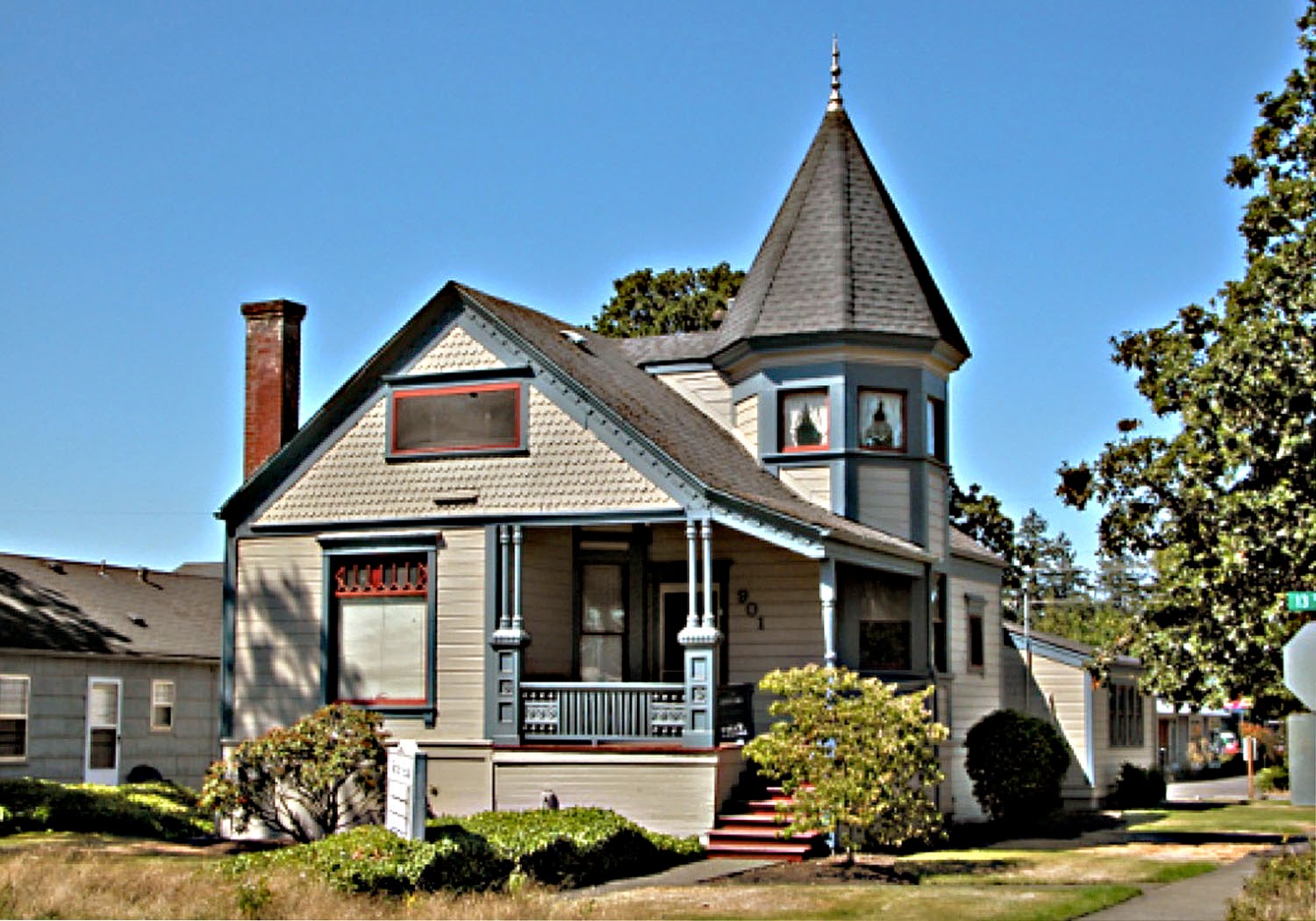
          • As the century of beautifully crafted Victorian homes ended, a few more were being built in Salem. Driving north along 13th. Street, a former residence at 901 (above) is an outstanding example of the houses being built in Salem for the prominent citizens of that time. This Victorian Queen Anne residence was designed by architect Charles Henry Burggraf as his own home. It was later the residence of Judge Daniel Webster, Justice of the Peace in Salem 1905-1918. The third owner was Julia Webster, the Judge’s daughter. It was also the home of Thomas P. Burt, a railroad engineer. This National Register property is an example of a historic home being converted into an office without altering its integrity.
          • Two other Victorian, Queen Anne style houses built this year, both homes of teachers, have been preserved. The Barquist House was originally on Mission Street where, from 1927 to 1967, it was the home of Carmelita Barquist, a popular high school biology teacher. In 1989 it was moved to Court Street. (See it in the SHINE Court-Chemeketa Walking Tour.)  The Hurd House is still in its original location on Marion Street. Originally a rental property, it was purchased by the Hurd family in 1921. Confred Hurd was a teacher at Washington School. These houses are still private residences.
          • More typical of the Colonial Revival or Craftsman style homes to be built at the turn of the century are two Court-Chemeketa Historic District homes. The John and Kate Griffith house is on Court Street, across from a residence owned by their son Lewis and daughter-in-law, Ila Spaulding Griffith.  Her sister and brother also owned homes in this neighborhood (See Spaulding 1909). A grandson, Dr. John Griffith, has lived in his parents home all of his life. A beautiful Japanese maple, designated a Heritage tree in 1982, stands in front of the John Griffith house. The Weller-Schramm House on 17th Street was built in this year on the site of the Supreme Court Building on Waverly Place. It was moved in 1916 for the new owners, the Weller family. In 1944, Pietro Belluschi remodeled the house for Alfred and Lucille Schramm. These are also seen on the SHINE Court-Chemeketa Walking Tour.
          From the Capitol Journal:
          Rev. G. W. Grannis, in a discourse for men only held at the Salem YMCA, said that lust was the sin of Eden, that 999 persons out of 1,000 in the race of mankind were products of lust. He denounced the existing condition of matrimony as little better than legalized licentiousness.
          A new town hall for West Salem with a seating capacity for 300 and costing $500 was dedicated. West Salem people in attendance were told by their speaker that if they behaved themselves and continued to improve morally, then they would someday be annexed.
          These prices prevailed at Strong's restaurant: hot cakes 5 cents, ham sandwich 5 cents, three doughnuts 5 cents, pigs feet 5 cents, fried mush 10 cents, Swiss cheese sandwich 10 cents, eggs any style 10 cents.
          In women's fashions, the newspaper stated: "The refined woman is one who avoids exceedingly bright colors for any garment worn on the street. Her gowns are characterized by texture. Indeed, one of the requisites of all her belongings is that they be of as fine as quality as her own nature."
          (See Ben Maxwell's Salem, Oregon, edited by Scott McArtur, 2006.)

          Thursday, March 4, 2010

          Salem in 1889

           World Events

          • The Dakotas, Montana and Washington become states.
          • The Eiffel Tower, tallest structure in the world, opens for the Paris World's Fair, but critics declare it as "aesthetically displeasing" .
          • The Johnstown flood in Pennsylvania kills over 2,200 residents. Fires rage in both Seattle and Spokane.
          • The Coca-Cola Company is organized as Pemberton Medicine Company in Atlanta, Georgia.
          • The Eiffel Tower, tallest structure in the world, opens for the Paris World's Fair, but critics declare it as "aesthetically displeasing" .
          • "Pizza Margherita, named for the queen, is baked in Naples, introducing that popular dish.
          • New American Book: A Connecticut Yankee in King Arthur's Court, Mark Twain


          In Salem

          Two Queen Anne styled business blocks are constructed this year on the west side of Commercial Street between State and Court. Walter D. Pugh designed both structures, as well as the 1895 Thomas Kay Woolen Mill.
          To the south is the Bush-Breyman Block (top), jointly constructed by Asahel Bush and Werner Breyman. Initially, a store selling drugs occupied the shop on the south while a clothing store occupied the shop on the north; there were offices above. Numerous Salem professional offices have occupied the second floor, including the law offices of former chief justice of the Oregon Supreme Court, Benjamin F. Bonham and both Charles L. McNary and his brother, John McNary. The American Red Cross and the Camp Fire Girls of Marion County also occupied second-floor.
          To the north is the Bush and Brey Block, built by Asahel Bush and Mortiz Brey. Clothing stores were there: Dalrymple's, Krausse, McVoy, The Chicago Store (as above) and others. From 1917 until 1934, Buren's Furniture and Luggage Store occupied the southern-most portion of the block. The first upstairs tenant of the Bush and Brey Block was Myra Sperry, a photographer. Sperry sold her business to Cherrington and then to Tom Cronise who also used the studio. Upstairs businesses included several printers, hemstitchers and dressmakers as well as three savings and loan companies, a dentist, a lawyer, the Salvation Army (1935-1942), the Knights of Columbus (1947-1949), and the Order of the Moose (1953-1955).

          When you visit
           These buildings have changed due to additions and loss by fire.
          The Bush portion of the Bush-Breyman Block was damaged by fire in 1960, and subsequently demolished. The historical photograph shows the section that burned, leaving only the entrance to the upper floor. The contemporary photograph shows the south part of the original building. Also in the contemporary photograph, a red-painted column (behind the red car) marked the original end of the building. Retail businesses still occupy the ground floor with offices above.
          The Bush Brey Block had a three-window addition at the south after 1915, also designed by Walter Pugh, who used the same materials and stylistic treatment to match the existing building. Clothing stores have been consistent tenants in the addition. J. L. Busick & Sons operated a grocery store at the rear two-story location at the Court Street intersection from 1924 until 1970. From 1972 to 1998 it housed the very popular Hindquarter and Night Deposit restaurants: after-hours home to legislators, lobbyists, and professionals, and number one high school prom destination.

          Other events
          • The booming economy in Salem encouraged similar commercial construction downtown.  South Eldridge Block is built on the east side of Commercial in the block between Court and Chemeketa Streets, probably designed by Wilbur F. Boothby. The Italianate business block originally contained 23 bays and extended the length of the city block. It has been historically associated with several generations of the Rostein and Greenbaum families, prominent local merchants. Greenbaum's Quilted Forest continues in business there. The northern portion of the building, containing businesses of two other well-known families, the Barnes Cash Store and Fry's Drug store, was lost to urban renewal and is now the entrance to Chemeketa Parkade.
          • George Williams, a Civil War veteran who lost his leg at Gettysburg, is elected mayor and will serve two years. His father-in-law is Sebastian Adams, creator of a 23-foot, illustrated historical chart being sold nationally at this time. 
          • The Thomas Kay Woolen Mill Company is founded. It was the largest woolen mill in the state with 50 mill workers when, in November of 1895, fire destroyed the mill in an hour and a half. However Kay's ability and reputation brought immediate pledges for funds and the present brick mill was completed in one year. The Kay mill boomed during World War II, but unable to compete with synthetic fabrics, the mill closed in 1959. In 1964, the Mission and Mill Museum, Inc. (later Mission Mill Museum Association, now Willamette Heritage Center), was incorporated. In 1973 the Thomas Kay Woolen Mill was placed on the National Register of Historic Places. It remains one of the few North American mill museums where direct-drive waterpower is demonstrated.


          • Patrick and Margaret Feely puchase land to build this handsome home at 1349 Center Street. The family continued to own this Queen Anne-styled house until 1945. Located in the NEN neighborhood, the Feely House is among the few residences of this era to remain a private residence in this neighborhood for so many years. It has been designated as a Local Landmark.
          Ben Maxwell recalls from the 1889 Capitol Journal:
          Whoever may pass westward toward Front Street at any time the breeze comes from the Willamette must be disgusted by the odor that arises from the decaying vegetable matter dumped over the river bank to faster and breed disease.
          A Salem man, walking along 14th Street between Chemeketa and Court Street, passed two ladies. When he stepped aside, a sidewalk board flew up and struck him in the face. The mishap threw all to the ground and all received bruises.
          The price of cigarettes in Salem advanced to 10 cents a package from a nickel. The increase was a good thing since it will prevent many youngsters from buying them. At 5 cents, the little shaver could indulge in puffing, but at a dime, he would not smoke as many.
          A number of Salemites attended the Mechanic’s Industrial Fair in Portland. A reporter saw a prominent gentleman throwing kisses and winking at a wax female figure on display in a principal booth.
          (See Ben Maxwell’s Salem, Oregon edited by Scott McArthur, 2006)