SHINE is a look backward from the present to Salem's 1860 charter. In each year we have four sections: glimpses of what was happening around the world, a special event in Salem, what you see when you visit that site today, and other Salem events of interest that year.


Friday, April 9, 2010

Salem in 1915

World Events
  • As World War enters its first year, American opinion turns toward Allied sympathy:  German U-Boats begin to target British ships such as the RMS Lusitania, sunk off Ireland with a loss of 1089 American and British passengers. British nurse Edith Cavell is executed for helping Allied soldiers escape from Belgium and combat in France.
  • Rasputin is murdered in Russia and revolution is brewing.
  • The first transcontinental telephone call is successfully completed.
  • The U.S. House of representatives rejects a proposal to give women the right to vote.
  • The Cape Cod Canal opens, shortening the waterway distance between NYC and Boston and making Cape Cod into an island.
  • While working as cook, Mary Mallon infects 51 patients with typhoid fever and is placed under quarantine for life. Such a asymptomatic carrier of disease or misfortune is since referred to as a "Typhoid Mary"
  • Harry Houdini performs a straight-jacket escape performance. Theda Bara becomes an early movie star in "A Fool There Was" and "Birth of a Nation" premieres in Los Angeles.
  • Notable Books: A Spoon River Anthology, Edgar Lee Masters, The Song of the Lark, Willa Cather and The Thirty-nine Steps, John Buchan .
 In Salem
In the Willamette Valley, the talk was about an announcement from San Francisco on July 27, 1915, that the Oregon commissioners to the Panama-Pacific exposition were preparing to celebrate "Loganberry Day" at the fair and that Royal Anne cherries, grown by B. I. Ferguson of Polk County, received a first prize. That year the Salem Brewery Association was reorganized as Northwest Fruit Products Company and began marketing LOJU that year. By the end of the year, jams and jellies became popular once an enameled can was developed. Oregon Fruit Juice Company, H. S. Gile, president, published a six-page folder advertising Pleasant brand of loganberry juice as "Made in Salem" As the demand increased for the loganberries, more fields were planted; however, when inflation and excessively high sugar prices pushed up the price of the berries, customers rebelled.
This photograph illustrates women packaging dehydrated loganberries in a Salem plant: these labor conditions, although appearing informal must have been uncomfortable over long hours!

When you visit
By the late 1920s, the ups and downs of the economy caused many farmers to plant their fields with other crops and, in the late 1930s the loganberry market was further reduced due to the introduction of boysenberries. The Salem canning industry, once a mainstay of our economy, declined after World War II as fresh frozen foods became available. Many of the former berry fields around Salem have disappeared under the new residential developments. Sites of former factories in the downtown area, especially on Trade Street, have now been transformed by urban redevelopment into city parks.

Other events

Dennis Gwenn, whose family owned the Crystal Gardens Ballroom, sent us this photograph of Liberty Street, probably taken this year. Looking north, it shows structures built on rafters to be at street level. As a result, the ballroom had a spacious basement.
  • Harley White is elected as mayor. Accompanied by 6 Aldermen, he visited Eugene to investigate that city's "pay-as-you-go: street car system with a view of adopting it here. 
  • The intersection of State and Commercial Streets this year features Ladd and Bush Bank, the Durbin Building and busy urban traffic. A streetcar dominates the middle of State Street. Only two blocks north at Chemeketa Street, a horse-drawn Cherry Fair float in front of small stores creates a scene more like a rural village.
  • East School is renamed as Washington School. For over sixty years it served as an elementary school for the residential neighborhoods north and east of the State House. As office, commercial and apartment buildings absorbed these properties, the need for a school here diminished: in 1949 it was demolished for the present Safeway store.

McKinley School soon after it was built in 1915.
  • As one residential neighborhood vanishes, another grows: this year McKinley Elementary School is built in South Salem at 466 McGilchrist Street. The three-story school is still in use a hundred years later.
  • Flax is being produced at Oregon State Penitentiary. This labor-intensive production fit in with the effort to give convicts useful employment, mostly in farm work. But by 1950, the demand for fabrics had changed and the market for flax no longer profitable for this institution or for local farmers. 
  • This year the prison's warden, Harry Minto, was shot and killed by Otto Hooker, an escaped convict cornered in Albany. Patrolman A. J. Long of Portland fatally wounded Hooker as he was pulling his gun to fire on the officer.
  • The Olmstead House is built on Shipping Street this year on property originally belonging to the Paulus family. There is a tradition in the neighborhood that this was originally a parsonage for the Jason Lee Memorial Church. The earliest records of ownership are from 1932 through 1945 when James N. and Sarah Olmsted lived here. She continued to reside here as widow until 1954, taking in relatives or boarders. One of these, Leo Weir, owned the property from 1957 until 1972. The house retains what is probably its original appearance with broad front porch typical of bungalows in this time.
  • In June, as a result of two prominent Salem attorneys settling their case out of court, Dr. O. B. Miles, county physician, is getting his front office door measured for a new pane of glass, broken when a fistic encounter arose between the attorneys in the hallway.

The Ratcliff Home
  • On a country road south of Salem, Charles Ratcliff, builds a home within an orchard, possibly family land that bordered the rural Route #4 and is thought to have included land up to Morningside Drive. As early as 1905, two Ratcliff names are found on the tax roles of Marion County, each with considerable property. Charles and Effie Ratcliff are found here in the 1926 City Directory. By 1941 he is listed as a prune grower and as Secretary/Treasurer of the Salem Co-operative Prune Growers. In 1948, his home has the present address. Newer houses now surround this city lot, but one ancient prune tree survives in the rear of the house. This residential street is now named for the family: Ratcliff Drive in the Morningside neighborhood.
From Ben Maxwell:
  • A Dodge touring car, carrying four passengers and several hangers-on, is driven up the monumental front steps of the State House for a demonstration of power ~ how far the driver got up the 30-some steps is unknown.
  • S. P. Bennett is at Skipton's stable, 448 Ferry Street, to buy horses suitable for cavalry and light artillery usage in all colors except light gray. Such horses must stand 15 hands high, be from four to nine years old, and weigh not less than 1,000 pounds. (For anyone who has seen the film, War Horse, the fate of these horses will be familiar.)
  • In December, a Crosley A-C electric Gembox radio was advertised in the Capitol Journal as an appropriate Christmas present, available for $69. A-C, the ad explained, meant that the radio used current you have in your home.
(This information above is printed in Ben Maxwell's Salem, Oregon, edited by Scott McArthur, 2006.)

Thursday, April 8, 2010

Salem in 1914

World Events
  • Diplomatic relations with Mexico break down, U.S. Marines land in Veracruz which they will occupy for 6 months.
  • Archduke Franz Ferdinand of Austria assassinated. As European nations begin World War I, President Wilson promises to keep America out of the conflict. (He signs a Mother's Day Proclamation.)
  • German trips invade Belgium: The British Empire declares war on the German Empire, including Austro-Hungary, which declares war on Russia. China declares neutrality. Japan extends its influence in China and seizes German territories in the Pacific and East Asia.
  • Ford Motor Company establishes an 8-hour day for workers with a minimum $5 a day wage.
  • Panama Canal opens in Panama with the passage of the SS Ancon, a 1901 steamship that had played a major part in ferrying supplies for canal construction. (The Path Between the Seas, David McCullough, 1977)
  • Charlie Chaplin makes his first movie debut with the character of the tramp in "Making A Living". Mary Pickford's name appears above the title of film "Hearts Adrift", beginning the "Star" recognition.
  • New American Books: The Titan, Theodore Dreiser; Penrod, Booth Tarkington, The Congo and Other Stories, Vachel Lindsay.
    In Salem

    William C. Knighton, the official state architect of that time, designed this handsome Supreme Court building costing $320,000. The exterior is finished with cream-colored terra cotta and the interior is marble and tile. At the rear of the ground floor, there is an ornate stairway leading to a handsome columned library. The third floor contains the Court Chambers with a glass skylight that includes a replica of the seal of the state of Oregon.
    Former Oregon Chief Justice Wallace Carson, Jr. was honored as the Salem Citizen of the Year 2010 at the Chamber of Commerce banquet February 11, 2011.

    When you visit
    The building is open to visitors after passing a security officer inside the front door. You will be told whether the upper floors are available for visiting at that time. The beautiful library and courtroom are well worth a visit and you may be able to hear some of the deliberations of the court.
    It is easy to see the impact the Oregon State Government has on the life of the city. It provides stable local employment and helps make Salem a destination for many visitors, but also increasingly occupies properties, particularly in the core of the city, for which the city provides services but receives no tax revenue.

    Other Events
    • B. L. Steeves is elected as mayor. The family's 1926 Dutch Colonial home still stands at 1694 Court Street, however the lawn and trees of the property were lost when 17th Street was widened in the 1960’s. The home was owned and occupied by the family into the second generation. The house next door at 1674 Court Street was built for the Steeves daughter, Muriel. Her family occupied this home until 1960. These properties can be seen on the SHINE Court-Chemeketa Walking Tour.
    • Three blocks, away in this same historic district, is the Buchner House also built this year. It was owned by Walter Buchner and his wife May. Mr. Buchner grew hops on 160 acres he owned south of Salem and established a feed store and mill in town. The family sold the house in 1942. It had long since been converted into rental apartments when it was firebombed in the early 1990s. The neighbors bought the structure, restored it and sold the house to new owners.
    • The Roberts Store is established south of Salem and a farming community (complete with train stop) grew up around it. The store remained open until a recent closure (the photograph was taken in 2008), then opened again. The school was put to other uses and the abandoned church collapsed.
    • The local YWCA is started in the spring of 1914 with Mrs. C.K. Spaulding heading the board. The organization’s headquarters were in the Knight home on North Liberty Street and the Salem Women’s club made the arrangements and gift of money which made the organization possible. An excerpt from the front page of the Daily Oregon Statesman on April 1, 1914 says, “Salem business men have heartily endorsed the organization plan and have promised to assist in any manner possible should the association care to call on them”.
    • Richmond School in its first year, 1914
      Students of the new Richmond School pose for a photograph.
    • Two years after the completion of the new Carnegie Library on State Street, the city takes over financial responsibility for this cultural institution. The Salem Public Library Advisory Board (our first Advisory Board) is created with members appointed by the mayor and councilors. The nine members presently meet at the library with the Director on second Wednesday of each month at 7 pm. The public is welcome.
    • Another public structure, the Mt. Crest Mausoleum, was completed this year. The architect was Ellis Lawrence who designed the Mahonia Hall, Elsinore Theater and other Salem structures. The building has been added to 9 times, have 6 governors interred there and a number of other prominent people of Salem through out the years. It is a part of City View Cemetery, just to the west of Pioneer Cemetery, sharing a fence.
    • April 18 on this year, John Zachary began serving an indeterminate sentence of three to twenty years in the Oregon State Penitentiary.  He did not survive his sentence, dying in the prison hospital on November 27, 1915.  He is buried a short distance from his great-grandmother, Tabitha Brown, in Pioneer Cemetery. His widow, Maud Hill Zachary, moved to Front Street with their five children, making a living as a laundress.
    From the Capitol Journal:
    • Governor Oswald West made an official visit to Washington, D. C. and the round trip cost the state of Oregon just $1.50. In New York, Governor West made a speech for which he was paid $375. This he turned over to Secretary of State Ben Olcott when he filed his expense account. The state's share of $1.50 was the cost for the governor's travel between Salem and Portland.
    • Benjamin S. Via and C. L. Imus, sponsors of the organization of a cavalry troop in Salem to participate in a possible war with Mexico, said they had their quota signed up and were ready for a call by the proper authorities.
    • In December, "Old Tiger", the fire engine that had seen service in Salem for many years, was taken to Willamette Slough to pump water on the ice and make the surface smooth for skaters.
    (See Ben Maxwell's Salem, Oregon, edited by Scott McArthur, 2006.

    Wednesday, April 7, 2010

    Salem in 1913

    World Events
    • The Romanov dynasty celebrates the 300th anniversary of their rule of Russia. Emperor Nicholas II is destined to be the last.
    • Gandhi is arrested in South Africa during peaceful demonstration.
    • Suffragettes continue to campaign for the right to vote. The women of the Social and Political Union in England begin radical response to the imprisonment and forced-feeding imposed on them.
    • Woodrow Wilson is inaugurated as 28th President of the United States.
    • The 16th Amendment to the US Constitution provides for the collection of an income tax.
    • The 17th Amendment to the US Constitution provides for the direct election of Senators by popular vote instead of by state legislators.
    • Henry Ford creates the assembly line for manufacturing.
    • The new "zipper" is popular.
    • Writer Ambrose Bierce, in Mexico to gain first-hand experience of the revolution, disappears. His short story, An Occurrence at Owl Creek (1890) is described as "one of the finest and most anthologized stories in American literature".
    • Marcel Proust publishes (in Paris), Swann's Way, an influential novel noted for the theme of involuntary memory. New American Books:  O Pioneers! by Willa Cather and Pollyanna by Eleanor H. Porter.
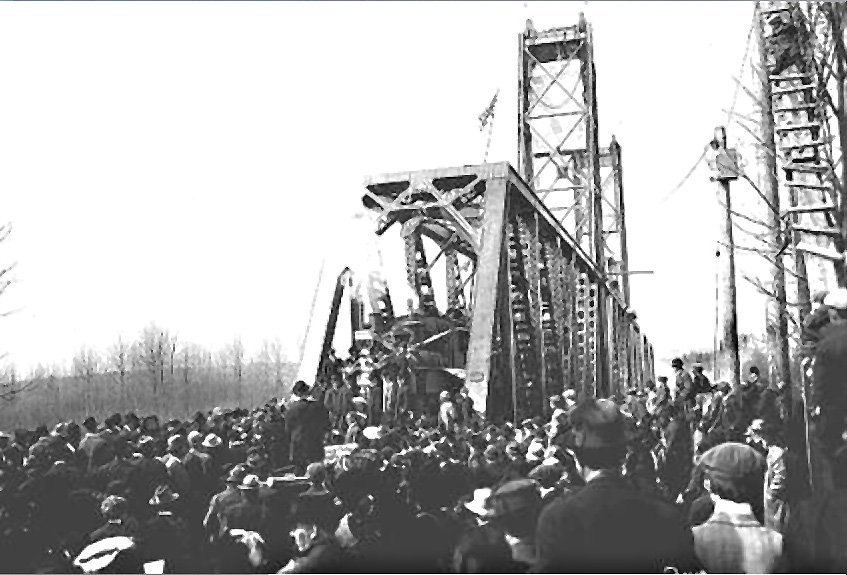
    Opening Day Celebration, 1913
      Opening Day Celebration, 1913

      In Salem
      A new railroad bridge across the Willamette is completed, intended for interurban passenger and freight traffic. The new McKeon gasoline coach made three trips a day between Salem and Black Rock on the Salem, Falls City and Western Railway by way of this new bridge. Forty passengers could be accommodated aboard this coach that traveled 27 miles from terminal to terminal.
      As you travel through Salem on Union Street from the bridge going east,  you will curve south to meet 12th Street. The rail tracks ran along the center of Union Street to the depot. That curve in the street reminds us of the train traffic this street accommodated.
       Between 1850 and 1900, transportation in the Willamette valley had been mainly by steamboats and railroads on each side of the river, but there were no rail crossings, only a highway bridge or ferry. By the time the railroad bridge was built, the future of interurban rail service was in doubt, but it was increasingly used for lumber, freight and canneries. Except in emergency, few passengers used the bridge and even freight use was rare by the 1970s.

      When you visit
       Restoration for pedestrians, 2009

      In 2001, long after the railroad traffic ceased, the bridge was offered it to the city of Salem for $1. The offer was accepted in 2004 and the restoration to pedestrians, bikes, and emergency vehicles was completed for a reopening in April 2009. Stimulus funds from the federal government provided funds for a temporary closing during the winter of 2009-10 in order to encapsulate the lead paint applied many years ago. In May of 2010 the bridge reopened for public use. Three interpretive panels (one on the Union Street side, two at the end of the trestle) highlight the historical uses of this structure. An award for engineering excellence was awarded in January of 2010 and three more since then.

      Other events
      • C. Siegmund became mayor.
      • The new transportation opportunities across the Willamette River accelerated the growth of West Salem in Polk County: it incorporated as a city this year.

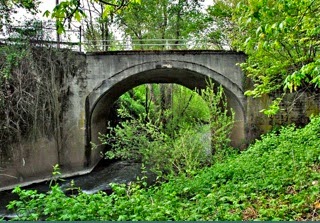
      View of Front Street Viaduct from Mill Creek
      • On Front Street, a bridge is built over Mill Creek to accommodate rail traffic. This is currently the oldest concrete viaduct in Oregon.
      • Salem Cherrians were organized as the group to organize the annual Cherry City Parade. The former mayor, George F. Roger is the first King Bing.
      • The Oregon State Insane Asylum is renamed the Oregon State Hospital.
      • Salem votes to go "dry" and the local Salem Brewery Association moves to Portland.
      • After the death of Asahel Bush this year, his daughter Sally boards a private railway carriage, travels east, and brings her fifty-year old sister, Eugenia, home to Salem. They live here, together again, for the next twenty years.
      • The Boise Building, designed by Fred Legg, is constructed on State Street for Reuben P. Boise, Jr. Over the years it has been leased as a farm machinery store, a garage and automotive center, as steel warehouse and currently as retail store again. Reuben Boise, Jr. was the owner and editor of the Oregon Statesman. He was named for his father, a distinguished Oregon jurist, and married Minnie, the daughter of Eugene Breyman. The building is seen on the SHINE Historic Downtown Walking Tour.
      • The First Church of the Nazarene builds a church 490 19th Street NE. After that congregation left, the Foursquare Church occupied the building during the 1950s. The Unitarians next purchased the property, but also moved to a new location. Since 1997, it has been our local Quaker Meeting House.
      • The Christian Wiedmer house built this year, and later enjoyed as a popular cottage restaurant, has been moved to State Street and now serves as an antique shop.
      • The Jones-Sherman House is built on D Street in the Grant neighborhood. Ralph Jones built this Craftsman residence and lived there until 1926. Charles Sherman, a professor of Philosophy and Psychology at Willamette University, then purchased the house. Professor Sherman died in 1963, but his wife Grace and four children owned the house until her death in 1978. The present owners, Jeanne and Corbey Boatwright, assumed a purchase contract with Sherman heirs in 1984. The property was placed on the National Register of Historic Places in 1989. Jeanne describes their neighborhood: "Encompassing just ninety city blocks, Grant is the smallest of the recognized Salem neighborhoods. Located adjacent to the north end of downtown, it provides the north gateway to the Capitol Mall and is a beautiful, historic part of Salem. Nearly all of the homes and buildings date to between 1900 and 1940. The many tree-lined streets and intimate lot sizes provide a friendly and close-knit neighborhood. Our treasured Grant Park is adjacent to Grant Community School - a dual language immersion school. Since 1976, the vibrant Grant Neighborhood Association has been actively working to protect this jewel of a neighborhood."

      Tuesday, April 6, 2010

      Salem in 1912

      World Events
      • The Manchu Qing dynasty ends after 268 years, the Republic of China is proclaimed and officially led by Sun Yat-Sen's Kuomintang political party. (His wife is one of four Chang sisters educated in U.S.)
      • Emperor Meiji of Japan dies, succeeded by his son , Emperor Taisho. Mayor Yukio Ozaki of Tokyo gives 3,000 cherry trees to be planted in Washington, D.C. as a symbol of friendship.
      • Woodrow Wilson is elected President. Elihu Root is awarded the Nobel Peace Prize "for his strong interest in international arbitration and for his plan for a world court".
      • The Titanic sinks after striking an iceberg in the North Atlantic with a loss of at least 1500 passengers and crew.
      • New Mexico (47) and Arizona (48) become the last contiguous states. Alaska is accepted as a territory.
      • The Girl Scouts is founded by Juliette Gordon Law in Savannah, Georgia.
      • W. C. Handy, known as the Father of the Blues, publishes "The Memphis Blues", giving attention to "southern rag", the "blues" of today.
      • Edgar Rice Burrough's "Tarzan" and Sax Rohmer's "Fu Manchu" both appear in magazines.
      • New American Books: A Dome of Many-Colored Glass, Amy Lowell and Riders of the Purple Sage, Zane Grey.
         In Salem
        In 1912, postcards were all the rage for Salem travelers wishing to share the novelty of new places seen in their adventures. The Patton brothers, Edwin Cooke and Hal had lived in Japan as children when their father was US Consul in Kobe. They knew the value of this business and opened Patton Postcard Hall in 1908. A narrow room filled with cards, it was located between the Patton and Gill Buildings on State Street. In this 1912 photograph, E. Cooke Patton, is working with an unknown lady assistant. Patton postcards were among the finest produced at the time with a German photographer and the colors applied with artistry.
        Local collectors have preserved many of these postcards.

        When you visit
        No architectural traces of this pioneer family remain in Salem. The Postcard Hall disappeared during the expansion of US National Bank east along State Street in the 1960s. The Patton Building, adjacent to the bank, was demolished in the same construction. Their home is also gone. The brothers' grandfather, Edwin Cooke, had built the Cooke-Patton mansion on Court Street, opposite the State House. They lived in the house all their lives, first with their parents and then settling in with their wives after they married. Luella, Cooke Patton's daughter, was born there and lived with her family until she married and moved to 23rd Street. The house became among the first to be demolished for the construction of the state office buildings beginning in 1937.
        (Luella lived to be 109, dying in 2007.)

        Other Events
        • Equal suffrage won voter approval in Oregon; women are allowed to vote for the first time in the December 2 city election. Smoking is therefore not permitted at polling places as the City Council determines a smoke-filled environment is not suitable for women. However, women were declared ineligible to serve on juries.
        • Salem's first Oregon National Guard unit occupies the new Armory on the corner of Ferry and Liberty Streets.

        Carnegie Library now Willamette University Civic Law Center
        • The establishment of a Carnegie Library in Salem, sponsored by a committee of local women, opens on State Street. After the library moved into the Civic Center in 1972, the YWCA used the building. It is now the Civic Law Center of Willamette University.
        • The handsome Masonic Hall is completed on the northwest corner of State and High Streets. It was designed by Ellis Lawrence, founder of the University of Oregon School of Architecture, who was also the architect for the Hubbard Building and the Elsinore Theater.
        • The Jason Lee Memorial Church and the nearby Highland Elementary School are built this year in North Salem. Both are still serving their original purposes one hundred years later and are designated as Local Landmarks.
        The Dome Building of Oregon State Hospital
        • The Dome Building of the Oregon State Hospital is erected on the north side of Center Street. It was designed by Edgar Lazarus who also known for his Vista House on the heights above the Columbia Gorge. The beautiful building, originally used as a receiving ward, has a curved canopy descending over the entrance, fluted cast-iron columns, a flat roof with saucer dome and two-story wings to the north and south. Located on the north side of Center Street, it is not part of the current hospital renovation. It gained recognition in 1975 when used for scenes in the Academy Award winning film, "One Flew Over the Cuckoo's Nest". It is listed on the National Register of Historic Places as part of the Oregon Sate Hospital Historic District.
        • Walter Gerth, an early booster and mayor of West Salem, opens a store. The family home is now a Local Landmark on Gerth Street.
        • Through 37 years, 1920-1957, Louis Olson and his wife Ida lived in a spacious 1912 bungalow at 1490 McCoy Avenue. This beautiful home is in the Grant neighborhood. Mr. Olson had a variety of occupations: packing superintendent at King Foods on Front Street (now Truitt Brothers), patrolman with the Salem Police Department, weightmaster with the State Highway Department, elevator operator and engineer at the Masonic Temple and, finally, caretaker of that institution.
        • The Waller-Chamberlain House is moved to its present site on Court Street. It is considered the oldest residence in the Court-Chemeketa Residential Historic District.
        • Wilbur Boothby dies at his residence, 171 Court Street. His life and many outstanding local achievements are recognized in contemporary newspaper accounts and a lengthy obituary. Born in Maine in 1840, he had come to Oregon in 1864, after various enterprises in California. His first business a sash and door factory. As a contractor and designer, he built the ornate Marion County Courthouse, the State Hospital, South Eldridge Block (now Greenbaum's Quilted Forest), Bush House and many other local buildings. His wife, the former Miss R. A. Dalglsish, died in 1910, leaving a son and daughter. The Rev. P. S. Knight conducted his funeral service at the home and Boothby was buried in the I. O. O. F. Cemetery ~ now Pioneer Cemetery.

        Monday, April 5, 2010

        Salem in 1911

        World Events
        • The Mexican Revolution, led by Madero and Pancho Villa, ends as Porfirio Diaz resigns and flees to France. Political conflict continued until the adoption of a Constitution in 1917 .
        • Physician, writer and philosopher Sun-Tat-Sun (known afterward as the Father of the Nation) is elected Provisional President of a democratic government in China as Manchu dynasty falls.
        • Marie Curie wins Nobel Prize for chemistry.
        • U. S. Supreme Court finds Standard Oil Trust violated Sherman Anti-trust Act. The monopoly broken up and 34 companies established.
        • Triangle Shirtwaist Factory fire in New York City kills 146 immigrant (mostly women) workers unable to escape as the doors were locked by owners to prevent unauthorized work breaks.
        • Hiram Bingham rediscovers Machu Picchu in Peru.
        • Roald Amundsen's Norwegian expedition reaches the South Pole.
        • Bobby Jones wins is first golf title at the age of 9.
        • New American Books: Jennie Gerhardt, Theodore Dreiser; Ethan Frome, Edith Wharton; Canzoni, Ezra Pound.
          In Salem
          • In this photograph, President William Howard Taft stands in an automobile, surrounded by not-so-Secret Service. In the background is the Eugene Breyman house on the northeast corner of Church and Court Streets, now the site of Statesman Journal. The president appears to be facing the Breyman Brothers Spanish American War Memorial at the entrance to Willson Park. Hallie Parrish Hinges (featured in the 1903 entry) leads a chorus of school children as the president gazes down on the group.
          After leaving office, Taft spent his time in seeking world peace through his self-founded "League to Enforce Peace." In 1921, President Warren G. Harding appointed Taft Chief Justice of the United States, fulfilling Taft's lifelong dream. Taft served in this capacity until his death in 1930.

          When you visit
          The Eugene Breyman residence, like that of his brother Werner (a block south), has been demolished. This house, greatly renovated, was moved to Summer Street during the conversation of the original residential block to commercial use. In the 1990s it was demolished for the construction of the State Lands Building.
          The 1904 Spanish American memorial remains the Cottage Street gateway into Willson Park. The park was created in 1854 when William Willson, pioneer of the Methodist mission, donated a portion of his land to build the new Oregon territorial capitol building. The capitol would be located in the center of a long, open space designated on Willson's original plat as "Willson Avenue," just south of his house on the corner of Court and Capitol streets. (See 1881) It was Willson's wish to preserve open spaces within the growing town, similar to the village commons in the New England towns. The block between the capitol building and the Marion County Courthouse was declared a public square. It eventually became known as Willson Park.

          Other events
          Duniway-Lachmund Home on Court Street, 1911-1930s
          Present State Street Location, 2014
          • Louis Lachmund becomes mayor. Due to the construction of the North Capitol Mall in 1937, his home on Court Street was condemned, purchased by Willamette University and moved to the campus. A subsequent move brought it to its present location on State Street. When the Lachmunds left their home, they moved to the Jarman House, a 1929 Spanish Colonial residence designed by Beverly Hills architect Glen McAlister with gardens created by the local landscape firm of Lord and Schryver. This National Register property can be seen on SHINE Gaiety Hill/Bush's Pasture Park Walking Tour.
          • An outstanding social event is the wedding of Margaret Boot to Asahel Bush IV, grandson of the newspaper publisher and founder of Ladd and Bush Bank. Her parents' home is on Birdshill Drive in South Salem neighborhood. The young couple became parents of Asahel V and Stuart Bush. Margaret died at age of 34 in 1934 after an illness of 3 years.
          • D. A. White Warehouse is erected on Front Street. This company had numerous large feed warehouses, including one in Europe, but this the only one that remains a token of that enterprise of the horse-and-buggy era.  It is still standing in the same location and can be seen on the SHINE Historic Downtown Walking Tour.
          • Eugene Ely, the Bird Man, an aviation pioneer, visits Salem and makes a successful flight. He mounts his fragile machine on Lone Oak track at the fairgrounds, turned on the juice and after skimming along the track, arose from the ground in front of the grandstand. He ascended about 400 feet and raced around the track, first with an automobile and then with a motorcycle. As a final performance, he circled the Capitol Dome. That October he died during a Macon, Georgia exhibition in a crash when his plane was late pulling out of a dive.
          In the Capitol Journal:
          • Salem's mayor was arrested for violating a traffic ordinance, His honor was charged with cutting a corner at the intersection of State and Commercial streets. The mayor pleaded that his horse was just a colt and that he could not control it. Judge Elgin remitted the fine and the mayor was richer by a $5 gold piece.
          • Buren and Hamilton, Salem household furnishers, advertised heating stoves from $1.50 up. Their carbon heaters for both coal and wood were supplied with heavy grates and extra-heavy cast iron fire pots. All had large mica doors in front, giving the effect of an open fire. They were neat and free from superfluous trimmings.
          • Barnes Cash Store offered old Civil War Springfield rifles of 45-70 calibers with a bayonet for $1.50. "A very appropriate decoration for Memorial Day".
          • Secretary of State Olcott desired to oust State Printer Duniway from the Capitol. he requested an opinion from Attorney General Crawford on the subject. Crawford ruled that the state printer was occupying his quarters without authority, but so were the secretary of state, the state treasurer, the governor and the Supreme Court.
          (See Ben Maxwell's Salem, Oregon, edited by Scott McArthur, 2006.)

          Friday, April 2, 2010

          Salem in 1910

          World Events
          • George V becomes King of Great Britain and Ireland on the death of his father, Edward VII, Victoria's son.
          • Asia: Slavery is abolished in China. The Japan-Korea Annexation Treaty gives Japan control over that country and the Korean Emperor abdicates. (The treaty is not formally declared void until 1965.)
          •  Neon lighting is displayed by Georges Claude at the Paris Motor Show.
          • Haley's Comet is observed. (In Salem it was seen above Court Street from the upper balcony of the Cooke-Patton mansion.)
          • The first public radio broadcast is a live opera performance from the Metropolitan Opera House in New York City. NOTE: Charles Herrold of San Jose, California is considered as the first radio broadcaster. Beginning in 1909, he was on air daily, transmitting from his Wireless College to friends listening on their crystal radios. He is credited with being a pioneer in recognizing radio for entertainment.
          • African-American boxer Jack Johnson defeats white boxer James J. Jeffries in a heavyweight match. Race riots broke out across the U.S.
          • Mary Shelley's Frankenstein (1818) is released in a horror film version by Edison Films. Notable new books: Twenty Years at Hull House, Jane Addams and Howards End, E.M. Forster
            In Salem
            Forty years after his death, a memorial to one of Salem's most important early pioneers, David Leslie, was created this year with the Leslie Methodist Church, built south of the city limits at the corner of Commercial and Myers Streets, near the site of the present St. Paul Episcopal Church. The parsonage (seen above in a 2008 photograph) was also constructed in 1910.
            The Reverend David Leslie was prominent in the small pioneer settlement that would become Salem. In 1845, he was elected president of the board of trustees for the Oregon Institute, a school for settlers' children. He held this position through the Institute's transition into Willamette University and, in 1867, laid the cornerstone of Waller Hall. Leslie also was one of the founders of Salem's Masonic Order chapter and the first chaplain of the territorial legislature. He received a sizeable portion of the Mission land claim, a section stretching between Mission and McGilchrist Streets. From Pringle Creek, the Leslie land grant extended to the Willamette Slough.
            The 100 acres that included his home, barn and orchard were sold to Asahel Bush in 1860, nine years before his death. Leslie's former home was moved to Mission and Cottage streets for the construction of the Bush house in 1877-8, but his barn was preserved. Reverend Leslie's family life was punctuated by tragedy. His first wife, Mary Leslie, died in 1842 and was the first to be buried in a cemetery that was part of his land claim. Four of his five daughters by this marriage preceded him in death ~ two by drowning in a canoe accident. Rev. Leslie married a widow, Adelia Judson Olley, and had two more daughters, but both died in childhood.
            The Leslie name is now remembered with a residential street near his property and Leslie Middle School, relocated from its original site on Howard Street to 3850 Pringle Road South.

            When you visit
            In 1981, the Leslie church closed and was demolished a few years later, making space for commercial buildings we see today as we drive south. However, in 1984, the parsonage was moved to 1305 Cannon Street SE to serve as a doctor's office. Across Cannon Street is another relocated historic residence, the former home of Dr. Carleton Smith, moved here from 1153 Oak Street in the former University residential area. Dr. Smith served in WW I, was our first City Physician, a professor at Willamette University and was a state legislator. Both of these beautifully maintained Local Landmarks are in the present Morningside neighborhood.
            The Leslie family is buried with Mary Leslie near her original grave in what is now Pioneer Cemetery.
            It is possible that the original home, after it was moved, became the first building of the Oregon School for the Blind. It was demolished many years ago. The Leslie barn burned, but was rebuilt to continue being the offices, gift shop and galleries of the Salem Art Association.
            Leslie Street is now only a fraction of its original length from the Willamette River to 12th Street, a major central section having been vacated for the Salem Hospital.

            Other Events
            • Census records show the Salem population at 14,094.
            • Two schools are built in developing residential neighborhoods of North Salem, annexed to the city in 1903: Englewood School was constructed south of Garden Road (Market Street) and east of 17th Street, just north of the historic Jason Lee Cemetery. The Oregon School for the Deaf (in far grander buildings than are on the campus today) was established on Locust Street north of the present Market Street.
            • Construction began for the Jason Lee Memorial Church at the intersection of Fairgrounds Road and Jefferson Street.
            • A modest farmhouse is built on the narrow road leading to the Wallace property in West Salem now numbered 1340 Wallace Road, it is a Local Landmark, known as the Quarry House. There is no information about the original owner.
            • At 905 5th Street, along Mill Creek in the new Grant section of Salem, an English cottage was built for Fred and Nellie Broer who lived there for more than twenty years. Its architecture resembles that of the Douglas Minto house at 831 Saginaw and may have been designed by the same person.
            • The Endicott House is built at 675 Church Street, next door to the elegant D'Arcy House, twenty years its senior. This house was built for attorney Samuel M. Endicott who lived here with wife Emma until 1934. In 1945 the property was sold to Lenore Park who divided the house into two apartments calling it the Park Apartments. These houses are both in CAN-DO neighborhood have been designated as Local Landmarks.
             
            Hinges-Kimball Home on Summer Street 1910
            In the present location on Capitol Street 2010
            • Nearby on Summer Street, the Hinges family moved into a new home. Mrs. Hinges was the daughter of pioneer Josiah Parrish, mother of Hallie Parris Hinges, a noted local vocalist. Moved for the construction of the North Capitol Mall, it is now located on Capitol Street. It is remarkable that the house exterior is so unchanged after more than a hundred years. (It has been painted since this photograph.) An aerial photograph taken this year shows the Piety Hill neighborhood of the Hinges home and so many other prominent Salem families of that time.
            • South of downtown in the Fairmount area of the present SCAN neighborhood, the Cusick House is built at 415 Lincoln Street (See 1978 photo). This is a white, Edwardian-era mansion with wrought iron fencing and a large circular porch with square columns. Built by Dr. William A. Cusick, a prominent physician of the 1920s, it was occupied by his widow, Maria, for many years after his death. One of Salem's outstanding residences, it is a National Register property.
            • In the present SESNA neighborhood, the modest Martin House is built at 1548 Lee Street. This property and surrounding lots were sold to J. W. Roork in 1891 and then, in the same year, this lot was sold to F. M. Rinehart. These were the first of many quick transactions over the next twenty years when the house had nine different owners. Jessie Martin bought the property in 1921 and continued to live here into the 1950s. Miss Martin was a teacher at the Park School. This is also designated Local Landmark.
            • Further south, at the present 230 Hrubetz Road in the Faye Wright neighborhood, there is built a house that is now associated with the name Townsend, but most was probably the home of Frederick and Jeanette Kuebler. That family owned property in this rural area south of Salem and there is now a busy suburban road named for them.
            • A remarkable photograph from this year shows stern-wheeler ships in the Salem harbor.

            Thursday, April 1, 2010

            Salem in 1909

            World Events
            • China gives Japan railway concessions in Manchuria. Ito Hirofumi, four times Prime Minister in Japan and Resident General of Korea, is assassinated in the Harbin Railway Station in Manchuria.
            • Albert I succeeded his father, Leopold II, as ruler of Belgium. He would prove to be a far different ruler than his father: sincerely religious, brave in defending his people in the WW I German invasion, promoting universal suffrage and education.
            • British explorer Ernest Shackleton with his Nimrod Expedition reaches near the South Pole, but must turn back due to dwindling supplies.
            • Robert Peary, Matthew Henson and four Inuit guides come close to North Pole. Henson actually came closest and planted the flag.
            • Republican William Henry Taft is elected 27th. President of the U.S. after serving as Governor of the Philippines, U.S. Attorney General and Secretary of War.
            • General Motors is founded by William C. Durant in Detroit, selling various assembled automobiles under different brand names.
            • The NAACP, the National Association for the Advancement of Colored People, is founded.
            • New American Books: Exultations, Ezra Pound. Girl of the Limberlost, Gene Stratton-Porter, and Three Lives, Gertrude Stein.
                In Salem

                   Garfield School, designed by Fred Legg, is constructed at 528 Cottage Street following the American Renaissance style typical of schools built at that time. By 1959 it was the oldest school building in the district: Superintendent Schmidt suggested it be closed because of fire dangers. However, parent protests against closing this neighborhood school kept it open until 1973.

                  When you Visit

                  At that time, a zone change by the Planning Commission allowed it to be renovated and used as an office building. It was listed on the National Register in 1981.The school has retained its original appearance, and thanks to its being designated on the National Register of Historic Places, it may be shared the demolition that has doomed other buildings of that time. Its interior has been completely renovated, abolishing the classrooms, and is used for offices.
                  During the summer, many Salem residents enjoy shopping at the Saturday Market, just to the east, and park in the lot that once served the school itself.

                  Other Events
                  1915 Salem Police Department
                  • In 1909, Salem's Police Department lost it only officer killed in the line of duty.  Thomas M. Eckhart was 45 years old and the father of 5 children when he arrested George Meyers who had stolen a horse. While being led away to jail, Mr. Meyers pulled out a gun and shot Officer Eckhart. The Meyers conviction for murder was overturned and there is no evidence of any further incarceration at the state penitentiary. Neither our Police Department nor his family has any photograph of Officer Eckhart, although possible the men in the photograph above probably served with him. Mr. Eckhart had previously served Chief of the Salem Fire Department, resigning in 1901. He is buried in Pioneer Cemetery beside his wife Rose. More information from that website is here. His name is inscribed at National Law Enforcement Memorial in Washington, D.C. Here is enlargement of his name.
                  • Recent additional information from Brian Goforth, Thomas Eckhart's great-grandson: "Following the second trial, Meyers was sentenced to the Oregon State Prison.  He was sentenced in 1911 (that's how long it took for the two trials to play out) and served about two years.  According to the newspaper articles, he apparently was a model prisoner and was given privileges such as work releases.  He was pardoned by the then-governor Oregon governor Oswald West in 1913.  The newspaper reported that Meyers went to Seattle and lived there for a time.  In 1915, again as reported in the newspaper, Meyers stopped in Salem to visit family and friends on his way to San Francisco.  He told people that he was going to San Francisco to get married.  According to the newspaper, when he arrived in San Francisco, he found that the woman he was to marry had married someone else.  He shot and killed her, then took his own life!  How's that for a twist of events?"
                  There have been no other "on duty" fatalities among our police for the 101 years since this event.
                  189 sworn police officers and 109 civilian employees currently staff our police department. It subscribes to the Community Oriented Policing model to bring police and citizens together to better fight crime. The Citizen Police Academy is a 13-week class, limited to 20 citizens, to inform and educate citizens in police practices.
                  • Due to the unhealthy drinking water, the City Council authorizes the purchase of the Salem Water Company. Citizens for a Mountain Water Company gain enough votes to secure a bond issue of $400,000.
                  • The Salem Fruit Union plant is operating on Trade Street (on the site of today's Pringle Park).
                  • US National Bank is constructed at Commercial and State Streets. (This is now Pioneer Trust.)
                  • Fred Legg designs a new Oregon School for the Deaf at its present location on Locust Street. The former school building on Turner Road becomes the Oregon Tuberculosis Hospital.
                  • Eaton Hall is built at Willamette University.
                  • The Korb family builds a home on 5th. Street in the present Grant neighborhood. The house is now rebuilt after a renovation project caused its collapse.
                  • Jefferson Pooler constructs three Court Street houses associated with the Spaulding and Griffith families. Charles K. Spaulding purchases these Craftsman house as wedding presents for his three adult children: Mrs. Roy (Beulah) Mills, Mrs. Lewis (Ila) Griffith and Walter, who married Nettie Miller. Dr. John Griffith, son of Lewis and Ila, still lives in his parents' former home. Another Pooler design is the Abrams House with Mill Creek directly at the back of the house: a bridge leads to the back lawn. The Pooler houses are all featured in the SHINE Court-Chemeketa Walking Tour.
                  • Daniel Fry, a Commercial Street druggist, purchases the house at 606 High Street, built in 1859 by Showalter Smith. This is now known as the Smith-Fry House. The Fry property included all of Rattlesnake Hill, which became known as Fry's Hill. Mr. Fry built houses around the base of the hill on High, Leslie and Church Streets as homes for his two adult children and as rentals for his employees. In later years (perhaps in the 1920s?), this neighborhood bordered by Church, Mission, Liberty and Pringle Creek gained a new name, Gaiety Hill. That designation is now given to this section of the Gaiety Hill/Bush's Pasture Park National Register Residential Historic District. These historic houses can be viewed on the SHINE Gaiety Hill/Bush's Pasture Park Walking Tour,
                  • The building that had previously been Alvin Waller's 1853 Methodist Church was photographed this year. By this time it had been moved to a Liberty Street location was serving as Olmstead's Steam Laundry.
                  • George Chamberlain resigns as governor when he elected this year as a United States senator.
                  From the Capitol Journal:
                  • Oregon's House of Representatives, meeting in Salem, voted to abolish the murderous hatpin of over 10 inches in length. Milliners protested, saying the law would affect the sale of Merry Widow hats and ruin some milliners.
                  • Ye Liberty Theater advertised: "Educational and comic pictures only ~ we guarantee nothing sensational will be shown."
                  • Meyer and Belle Land Company offered a fine, five room house with bath, electric lights, water and a 66 by 50 foot lot for $1,150; cash down, $650.
                  • The stern-wheeler Pomona arrived at Salem with 100 hop pickers and their enormous load of baggage. The steamer had difficulty getting over the Willamette River shoal and put her donkey engine to work hauling over shallows with the aid of stilts.
                  (See Ben Maxwell's Salem, Oregon, edited by Scott McArthur, 2006)