SHINE is a look backward from the present to Salem's 1860 charter. In each year we have four sections: glimpses of what was happening around the world, a special event in Salem, what you see when you visit that site today, and other Salem events of interest that year.


Showing posts with label Boise. Show all posts

Saturday, August 14, 2010

Salem in 2007

World Events
  • Benazir Bhutto of Pakistan, first woman elected (1988, 1993) Prime Minister in a Muslim country, is assassinated by an al-Qaeda militant in Rawalpindi during a welcome home rally after serving in exile.
  • Global financial crisis is triggered by the collapse of U.S. housing market and mortgage banking crisis.
  • Nancy Pelosi, a California Democrat, is elected as first female Speaker of the House of Representatives in the US Congress.
  • Virginia Tech shooter, Seung-hui Cho, kills 32 persons and wounds 17.
  • Apple introduces the first modern "smartphone". This iPhone model uses a touch screen (instead of dial-up) and has a Home button.
  • Al Gore and The UN share the Nobel Peace Prize for efforts to build up and disseminate knowledge about man-made climate change and measures to counteract such change.
  • The TGV, French passenger train reaches a speed of 357.2 mph, breaking the record for a conventional train. In England, High Speed 1 (68 mile mph), the Channel Tunnel Rail Link between London and the UK end of the Chunnel is opened to passengers.
  • The last Harry Potter book is published. Academy Awards:"No Country for Old Men" (US), "The Counterfeiters" (Austria). Prize-winning books: Tree of Smoke, Denis Johnson and The Road, Cormac McCarthy.
    In Salem
    Two Salem developers, Larry Tokarski and Dan Berrey, purchase the industrial site occupied for 46 years by Boise Cascade's paper-converting plant. Bisected by Pringle Creek, with Commercial Street to the east and the Willamette River to the west, adjacent to Riverfront Park, this is prime land for the redevelopment encouraged by the ULI representatives last year. The prospects for this $7.25 million investment depend on the outcome of environmental studies (considering the past contamination of the land and water) and rezoning the property for mixed-use development.
    To the left in the wintertime photograph above, the 1926 Fry Warehouse looks like a fortress, rising behind Eco-Earth. The main body of the plant is in the center of the picture and above Pringle Creek, which emerges into the slough of the Willamette River at this sand bar location. The section of the plant to the right, in the distance behind the orange towers, is another structure on the site of the old mill building. Unseen is the railroad track running along the structures in this side.

    When you visit
    By 2014, there were substantial changes. The Fry Warehouse is gone, the first structure to be demolished, with Mayor Taylor punching out the first block of concrete with a wrecking crane. Also in 2009, the main structure fell until only the substantial building south of the creek remained. The northern section will have new buildings for retail business and offices, restaurants, condos and other purposes. The site south of the creek will be retained as a parking garage and apartment complex. Of great interest are two public-use features of the future: one is "day lighting" the creek by removing all but the railroad crossing so a pedestrian path can lead from the Civic Center Park, under the Commercial Street Bridge and to the slough; the other is a bridge from near the Eco-Earth to Minto Brown Island. Due to economic conditions, no new business or housing construction has been accomplished, but Pringle Creek, running between the cement walls of the old industrial plant, is now visible from west of the Commercial Street bridge to the Willamette River with only the railroad track suspended above. The much anticipated walkway from the southeast corner of Trade and Commercial to Riverfront Park, passing under the bridge, will be the next project. Bridge reconstruction was completed in 2013.

    Other events
    • Bill Wingett, a resident of the Sunnyslope neighborhood, returns to the European battle sites in May of this year as a guide for a historical project. A veteran of World War II, he is a former member of the celebrated Band of Brothers, the 101th Airborne Division of the US Army, recently honored in a TV mini-series based on the book by Steven Ambrose.
    • Air service returns to McNary Field with Delta offering twice-daily flights between Salem and Salt Lake City.
    • Marion County lost its first deputy in the line of duty when Kelly James Fredinburg, 33, headed to Gervais to assist police, siren and lights running, is struck by a car that unexpectedly pulled into his lane on Highway 99E. He died at the scene of the crash as well as a passenger in the other car. The other driver survived, critically injured. More than 1000 people filled the Salem Armory for his memorial service.
    • The Vision 2020 Action Plan, originated by City staff and 3500 involved residents, aims to revitalize downtown into a vibrant community gathering place and a magnet for visitors. Committees organized this year will work to realize the concepts of the program and will make quarterly progress reports.
    • The land-use conflicts continued with Measure 49 that left owners confused about which set of rules apply to projects they filed under the 2004 property-compensation law, Measure 37. The new measure limits the number of houses built on prime farm and forest land, but projects underway may have "vested rights" to proceed.
    • Salem's oldest resident, Luella Patton Charlton, died on December 23, just a 7 weeks before her 110th birthday. Luella was born in 1898 in her family's Cooke-Patton mansion on Court Street (demolished in 1938 for the construction of the State Library). Her great-grandfather (who built the house) was an early Salem steamboat owner and merchant, her grandfather was a US consul in Japan and her father and uncle, Cooke and Hal Patton, were prominent in Salem political and business life. After her marriage in 1925, she and her husband built a home on 23rd Street where she lived the rest of her life. The couple had one son; Luella became a widow in 1959. She read widely, kept up with the news on TV, generously entertained friends, enjoyed humor in conversation and was a beloved neighbor. Luella was possessed of a sharp intellect and invested wisely in the stock market: she owned original issues of Coca-Cola stock and remarked with a smile that they had "split many times". Luella was a treasury of historical year-old facts about Salem families, businesses and state institutions (Gov. Chamberlain rented a room in her family's home in 1903 while serving in Salem). She is the last of the Pattons to be buried in the family mausoleum in Pioneer Cemetery.

    Thursday, May 6, 2010

    Salem in 1934


    World Events
    • Hitler becomes National Socialist (NAZI) Fuhrer in Germany, meets with Mussolini, dictator of Italy.
    • The Long March of the Communist Liberation Army in China marshals a force, in retreat, to combat the government of Chiang Kai Shek that had machine-gunned Communist members and broken up labor unions.
    • The U.S. control of Haitian mixed-race culture ends after 19 years as a part of Roosevelt's "Good Neighbor Policy".
    • The International Telecommunication Union is established to co-ordinate  technical standards of global communication. 
    • Dionne Quintuplets born in Canada, the first to survive, become a worldwide entertainment attraction.
    • John Dillinger and his gang rob banks. Outlaws Bonnie and Clyde are ambushed and killed by police in Louisiana. ("Bonnie and Clyde" film, 1967)
    • Academy Award: "It Happened One Night". Pulitzer Prize: Lamb in His Bosom, Carolina Miller. 


     From the collection of Carole Smith
    In Salem
    Households during the Depression had to learn to "Make do, make over, or do without". A local effort is glimpsed in this photograph. In the extreme right can be seen the corner of a frame building. It is Marion County Housing Authority Demonstration House. Originally located at Union and Liberty Streets, the modest 1860 William Beckett house was chosen as a demonstration project to promote the new Federal Housing Authority across the nation. Moved to the Marion County Courthouse lawn, and facing Court Street, it was remodeled to demonstrate how older homes could be modernized. Residents were encouraged to come inside and learn from the renovations underway. Architect Clarence Smith redesigned it in the Colonial Revival style; eight unions provided the plumbing, electrical, carpentry and other labor. When completed in 1935, the house sold for $1,295 and was relocated by the owner.

    When you visit
    The former Demonstration House was placed on the National Register in 1988. Today it can be seen at 140 Wilson Street in the SCAN neighborhood.
    The photograph above recalls a two-block section of High Street that once was the center of municipal activity. At the left are the Odd Fellows Lodge, the Grand Theater and Hotel Annex. The theater and hotel buildings are still there and, after a period of declining use, have been refurbished and renovated for new commercial purposes. (Although the central tower is gone, victim of high winds.) The low, white building to the right is the Bligh Building, still Olson's Florist as it was then. The Old City Hall, demolished in 1971, can be seen in the background of the photograph. The Senator Hotel, rising behind the house on the courthouse lawn, has also been demolished and that site now houses the Courthouse Square transit terminal. On the lawn itself is the 1924 Doughboy statue, now located at the memorial park of the Oregon Department of Veteran Affairs on Summer Street. The Victorian Courthouse, out of the photograph to the right, is also gone. It was demolished in 1952 and the modern building currently in use replaced it.

    Other Events
    • In 1938, Harry Read and a group of West Salem residents founded Salem Electric. A franchise was eventually obtained from the City of West Salem, Oregon for the distribution of electricity within its boundaries. IN 1934, Harry Read goes into the radio business with local station KSLM.
    • The centennial of Jason Lee's arrival in Salem is celebrated at the state fair with a caravan re-enacting his journey westward. The wagon train left Boston in April and arrived in Salem in time for the fair.
    • On April 15, the newspaper reported that Reuben P. Boise,74 , a native of Salem and prominent journalist and businessman, died as the result of an accidental discharge of a shotgun he was carrying during a hunting expedition in Polk County. He was the son of Judge Reuben Boise (1818-1907) and husband of Minnie Louise Breyman, daughter of local merchant and real estate investor, Eugene Breyman (1834-1903). The newspaper reported, "The tragedy occurred at his ranch, known as Ellendale, west of Dallas. With his son, Breyman, and A. McFettridge, who had recently leased the farm, Mr. Boise was walking along a rough road used years ago as a means of getting out logs. He stumbled into a hole along the road. The shotgun, an automatic without the safety attachment set, went off...A week ago, when the Boises were looking over the place, they saw a red fox. Hoping to get him and some greydiggers, they took their guns on their inspection trip Sunday."(See profiles of the ladies of this family.)

    Salem's small hospital staff in 1934
    • The staff of the Deaconess Hospital, (now the Salem Hospital) about forty employees, line up for a photograph.
    • Movies are the popular entertainment of the Depression years. With admission only a dime, the State Theater is where you want to go on a Saturday night date.
    • A Colonial Revival style house at 787 Cross Street is built this year for Custer Ross, a prominent attorney. Designed by Clarence L. Smith, the result was collaboration between the architect and the landscape firm of Lord and Schryver, although the gardens contain no elaborate design. It was the home of Wayne and Shirley Hadley from 1950-2000. It a contributing property in the Gaiety Hill/Bush's Pasture Park Historic District and is featured in that SHINE Walking Tour.
    Daniel Fry, Jr. residence
    • A home for the second generation of the Daniel Fry family is built at 565 Leffelle Street. This brick Georgian house was built for Daniel Jr. and Rita Fry. He was a pharmacist in Salem, the son of Daniel Fry who established the business. Jamison Parker of Portland designed the house. It is a Local Landmark in the SCAN neighborhood.

    Wednesday, April 7, 2010

    Salem in 1913

    World Events
    • The Romanov dynasty celebrates the 300th anniversary of their rule of Russia. Emperor Nicholas II is destined to be the last.
    • Gandhi is arrested in South Africa during peaceful demonstration.
    • Suffragettes continue to campaign for the right to vote. The women of the Social and Political Union in England begin radical response to the imprisonment and forced-feeding imposed on them.
    • Woodrow Wilson is inaugurated as 28th President of the United States.
    • The 16th Amendment to the US Constitution provides for the collection of an income tax.
    • The 17th Amendment to the US Constitution provides for the direct election of Senators by popular vote instead of by state legislators.
    • Henry Ford creates the assembly line for manufacturing.
    • The new "zipper" is popular.
    • Writer Ambrose Bierce, in Mexico to gain first-hand experience of the revolution, disappears. His short story, An Occurrence at Owl Creek (1890) is described as "one of the finest and most anthologized stories in American literature".
    • Marcel Proust publishes (in Paris), Swann's Way, an influential novel noted for the theme of involuntary memory. New American Books:  O Pioneers! by Willa Cather and Pollyanna by Eleanor H. Porter.
    Opening Day Celebration, 1913
      Opening Day Celebration, 1913

      In Salem
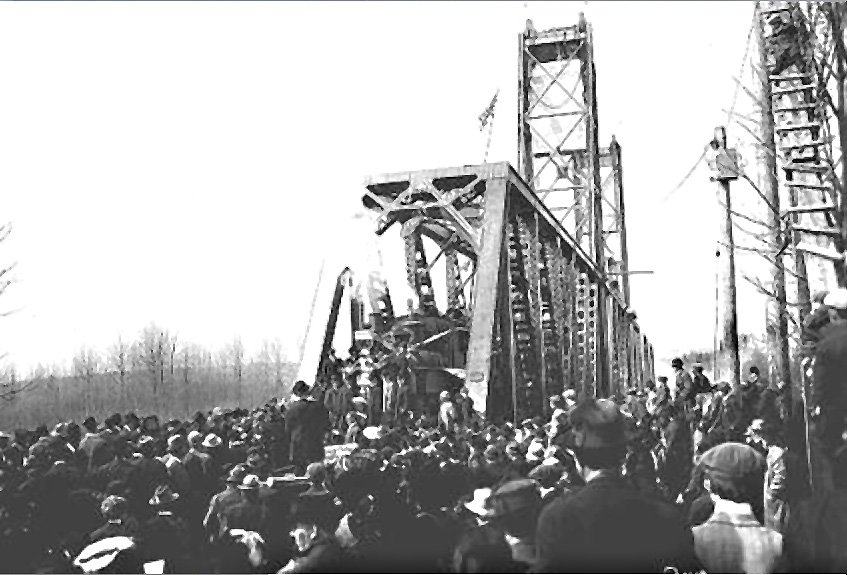
      A new railroad bridge across the Willamette is completed, intended for interurban passenger and freight traffic. The new McKeon gasoline coach made three trips a day between Salem and Black Rock on the Salem, Falls City and Western Railway by way of this new bridge. Forty passengers could be accommodated aboard this coach that traveled 27 miles from terminal to terminal.
      As you travel through Salem on Union Street from the bridge going east,  you will curve south to meet 12th Street. The rail tracks ran along the center of Union Street to the depot. That curve in the street reminds us of the train traffic this street accommodated.
       Between 1850 and 1900, transportation in the Willamette valley had been mainly by steamboats and railroads on each side of the river, but there were no rail crossings, only a highway bridge or ferry. By the time the railroad bridge was built, the future of interurban rail service was in doubt, but it was increasingly used for lumber, freight and canneries. Except in emergency, few passengers used the bridge and even freight use was rare by the 1970s.

      When you visit
       Restoration for pedestrians, 2009

      In 2001, long after the railroad traffic ceased, the bridge was offered it to the city of Salem for $1. The offer was accepted in 2004 and the restoration to pedestrians, bikes, and emergency vehicles was completed for a reopening in April 2009. Stimulus funds from the federal government provided funds for a temporary closing during the winter of 2009-10 in order to encapsulate the lead paint applied many years ago. In May of 2010 the bridge reopened for public use. Three interpretive panels (one on the Union Street side, two at the end of the trestle) highlight the historical uses of this structure. An award for engineering excellence was awarded in January of 2010 and three more since then.

      Other events
      • C. Siegmund became mayor.
      • The new transportation opportunities across the Willamette River accelerated the growth of West Salem in Polk County: it incorporated as a city this year.

      View of Front Street Viaduct from Mill Creek
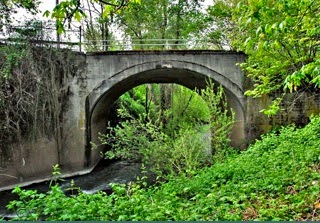
      • On Front Street, a bridge is built over Mill Creek to accommodate rail traffic. This is currently the oldest concrete viaduct in Oregon.
      • Salem Cherrians were organized as the group to organize the annual Cherry City Parade. The former mayor, George F. Roger is the first King Bing.
      • The Oregon State Insane Asylum is renamed the Oregon State Hospital.
      • Salem votes to go "dry" and the local Salem Brewery Association moves to Portland.
      • After the death of Asahel Bush this year, his daughter Sally boards a private railway carriage, travels east, and brings her fifty-year old sister, Eugenia, home to Salem. They live here, together again, for the next twenty years.
      • The Boise Building, designed by Fred Legg, is constructed on State Street for Reuben P. Boise, Jr. Over the years it has been leased as a farm machinery store, a garage and automotive center, as steel warehouse and currently as retail store again. Reuben Boise, Jr. was the owner and editor of the Oregon Statesman. He was named for his father, a distinguished Oregon jurist, and married Minnie, the daughter of Eugene Breyman. The building is seen on the SHINE Historic Downtown Walking Tour.
      • The First Church of the Nazarene builds a church 490 19th Street NE. After that congregation left, the Foursquare Church occupied the building during the 1950s. The Unitarians next purchased the property, but also moved to a new location. Since 1997, it has been our local Quaker Meeting House.
      • The Christian Wiedmer house built this year, and later enjoyed as a popular cottage restaurant, has been moved to State Street and now serves as an antique shop.
      • The Jones-Sherman House is built on D Street in the Grant neighborhood. Ralph Jones built this Craftsman residence and lived there until 1926. Charles Sherman, a professor of Philosophy and Psychology at Willamette University, then purchased the house. Professor Sherman died in 1963, but his wife Grace and four children owned the house until her death in 1978. The present owners, Jeanne and Corbey Boatwright, assumed a purchase contract with Sherman heirs in 1984. The property was placed on the National Register of Historic Places in 1989. Jeanne describes their neighborhood: "Encompassing just ninety city blocks, Grant is the smallest of the recognized Salem neighborhoods. Located adjacent to the north end of downtown, it provides the north gateway to the Capitol Mall and is a beautiful, historic part of Salem. Nearly all of the homes and buildings date to between 1900 and 1940. The many tree-lined streets and intimate lot sizes provide a friendly and close-knit neighborhood. Our treasured Grant Park is adjacent to Grant Community School - a dual language immersion school. Since 1976, the vibrant Grant Neighborhood Association has been actively working to protect this jewel of a neighborhood."

      Tuesday, March 30, 2010

      Salem in 1907

      World Events
      • Elections to the new Parliament in Finland are the first in the world with women candidates as well as the first with universal suffrage.
      • The Anglo-Russian Entente is signed in St. Petersburg, leading to the Triple Entente that includes France. This sets up a balance in European power against the Triple Alliance of Germany, Austro-Hugary and Italy. The players were set for the conflict of 1914.
      • Rasputin gains power in the Russian court as "healer" for Prince Alexei who suffered from hemophilia. A Congress of the Russian Social Democratic Labor Party mets in secret in London. The Bolsheviks attack a cash-filled bank coach in Tiflis, gaining funds for their campaigns.
      • In England, Robert Baden-Powell leads the first Scout camp.
      • The Great White Fleet begins its 15-month circumnavigation of the globe,  demonstrating America's new naval power to the world.
      • Hendrick Baekeland produces the first plastic (synthetic polymer) that is produced as Bakelite.
      • Oklahoma becomes the 46th state.
      • The term "blurb" is first used for the promotional text on a book jacket.
      • Sholem Aleichem (pen-name of Solomon Rabinovich) publishes From Home to America a year after his move from Russia to New York. He was the first Jewish writer to gain fame in America: Whistler on the Roof is his most popularly known story.
        Mary Bowerman graduation
        In Salem
        At Willamette University Medical School, Mary Bowerman was the lone female in a class of five and the butt of their “rather vulgar jokes." The dissecting shed, down near the millrace at the rear of the university grounds was on a “short cut” to town and featured many a knothole in its walls. There was often an audience to observe the gloveless, collidion-dosed, black muslin-gowned students, surgical instruments in hand, making tentative incisions on the cadavers. In 1907, as the wife of Ellis Purvine, she began a medical practice in Salem, specializing in obstetrics.
        Dr. Mary Bowerman Purvine in 1954

        When you visit
        There is no memorial in Salem to Oregon's first female physician or to her medical service to our community. In 1954, to commemorate her half-century in the medical profession, the University of Oregon Medical School Alumni Association recognized Mary for her fifty years “of service and sacrifice to the alleviation of human suffering.”
        Her family included two daughters and a son who became a doctor himself. Dr. Ralph Purvine lived on Fairmount Avenue in the historic Cross House, for many years the home of Mary Purvine's granddaughter. This is a National Register property in the SCAN neighborhood.

        Other Events
        • G. F. Rogers became mayor this year and was "King Bing" of the 1913 Salem Cherry Festival.
        • On April 12, one of Salem's pioneers and most distinguished citizens and jurist, Reuben P. Boise dies. A Pioneer Cemetery record has printed his professional biography. In part, it recalls the young lawyer coming to Salem in 1857 and that "many years his home was there in the winter and on the farm in the summer. He was ever in the market to buy any land that joined his farm so at the time of his death he owned many acres in the Ellendale section.
          In 1851 Judge Boise was united in marriage to Miss Ellen F. Lyon, who died December 6, 1865, leaving three children, "Fisher A., Reuben P., Jr., and Whitney L. The last two named are still living. Mrs. Boise was a daughter of Lemuel Lyon, a Boston merchant, who went to California in the early '50s and came to Oregon about 1854, locating at Independence, where he built the second store building and the first grain warehouse in the town...
          "On December 27, 1866, Judge Boise was married to Emily A. Pratt, who died March 26, 1919. She was a native of Webster, Massachusetts, and a daughter of Ephraim Pratt, a manufacturer of that state. To this union were born two daughters: Sarah Ellen, who died August 5, 1891; and Mrs. Maria Boise Lauterman, now residing in Salem."
        • The Paulus Building on Court Street replaces the Sung Lung Chinese laundry, demolished along with other Chinese businesses. The present building was constructed to provide space for a single retail establishment selling furniture. In 1931 Paulus separated the space: Doughton's Hardware occupied the west end of the building for almost sixty years (1934-1991). The Christopher Paulus family home, built in 1892, recently restored, is on Church Street in the Grant neighborhood.
        • The Local Landmark known as the Christensen House is built on property owned by Curtis Chatfield, a fruit grower. It is best known as the home of Harold and Cora Christensen in the 1920s and 30s; Mr. Christensen was a driver for the Oregon Bakery Company. It is a Local Landmark in the present Highland neighborhood.
        Daue House as it appears today
        • On Saginaw Street, a large two and one-half story Craftsman bungalow was designed and built in 1907-8 by Alexander Daue. The house retains much of its original organization and was listed on the National Register of Historic Places in 1985. It was purchased by the Assistance League of Salem in 1987 and now contains a shop and offices of other league charitable programs. See 1992 photograph of the house. Alexander, his brother Louis and son Elmer owned a successful merchandise store on Commercial Street.
        • Salem Heights Elementary School is built south of Salem. It was established on land purchased from Phil Thomas. A photograph shows the location in 1914. In 1930 the original school was torn down and rebuilt. The many activities of the early years are described in the 1997 booklet published by the school on its 90th anniversary. When the new building was erected in 1930, the school bell was moved to the Community Hall. It was been returned to the school and reinstalled for the school’s 100th anniversary celebration in the spring of 2007. The school is in the South Salem neighborhood.
        • The residence known as the Justice Rossman House is built on Capitol Street. This Colonial style residence still has many original features including the hardwood floors, two fireplaces and 9 1/2 foot ceilings. This handsome home was purchased by George Rossman in 1928, a year after he was appointed to the Oregon Supreme Court. He served as Chief Justice (1947-9) and retired in 1965. It has been refurbished for use as offices and is designated as a Local Landmark in the Grant neighborhood.
        • Built this year at the northwest corner of High and Oak streets, is the Italianate residence of Emma Hughes, the widow of John Hughes, a prominent local merchant. Emma was the daughter of Virgil Pringle and his wife, Pherne Brown, and the granddaughter of Rev. Clark Brown and his wife Tabitha Moffatt. Virgil Pringle was an 1848 pioneer in Salem who took a land claim surrounding the Creek that was named for him. It is possible that Virgil Pringle's home was near the one built this year by his daughter and her husband. No evidence remains of that early residence and Emma's home was demolished after her death for the 1929 construction of the Spanish Colonial residence of Daniel B. Jarman. The original land grant of Virgil Pringle may only be surmised: it might have included the land between Trade and Mission streets where he is now remembered with Pringle Creek and Pringle Plaza. By this year when Emma's house was built, the 1859 Rural Gothic residence of Showalter Smith, across High Street, once the center of Salem social and political events, had been purchased by Daniel Fry. Neighborhood children knew this area as Rattlesnake Hill.
        • Edmond S Meany wrote that in July of this year, when he was visiting the reservations of Siouan tribes with Edward S. Curtis, Mrs. Clark, wife of the Episcopalian missionary at Rosebud, announced that there was a very old lady in the village who would like to meet the historian from the Oregon country. They started for the home of Dr. E. J. De Bell, who for twenty- three years has been a physician and trader at Rosebud. In this time his aged aunt, Sarah DeBell Frost Beggs was spending the last years of her long and eventful life. She was perhaps the last survivor of the Willamette Mission community.
        • Downtown Salem streets are beginning to be paved.

        Monday, March 8, 2010

        Salem in 1891

        World Events
        • After the Hawaiian regent David Kalakaua dies, his sister Liliuokalani is proclaimed Queen of Hawaii. Her attempts draft a new Constitution and extend voting rights led to her overthrow by the U.S. within two years.
        • Java Man, considered the "missing link" between apes and humans is discovered by Eugene Dubois. The fossils are at least 700,000 years old.
        • In France, troops fire on a workers' May Day demonstration in support of the 8-hour workday, killing 9 and wounding 30.
        • New Scotland Yard becomes the HQ of the London Metropolitan Police.
        • Croatian-born Nicola Telsa invents the Tesla Coil, a high voltage transformer. With Westinghouse, Telsa produced the electricity that lit the 1893 World's Columbian Exhibition in Chicago.
        • Edison exhibits his kinetoscope, creating an illusion of movement on film.
        • In Coney Island, Jesse W. Reno patents the first escalator.
        • Appearing this year in British magazines:" A Study in Scarlet", by Conan Doyle and "The Light That Failed" by Rudyard Kipling. Also published in  (in a censored and serialized version), "Tess of the d'Urbervilles: A Pure Woman Faithfully Presented" by Thomas Hardy.
        In Salem
        Willamette students at a YMCA Conference in Massachusetts came home to Salem excited about the new game of basketball, invented by James Naismith. Frank E. Brown, a first year student at Willamette University Academy, was the leader in promoting the game after hearing about it from students who attended the conference. They reported that Naismith had taken two peach baskets and had hung them in the gym as targets for the ball. The first Salem games were played in the YMCA gym housed a handsome, three story building at the northwest corner of Chemeketa and Commercial Streets (The photograph above was taken in 1898.). Players from the YMCA and the University followed the "crudely simple" rules: including players lying in circle and scrambling for the ball at a beginning whistle. A Girls Basketball team was described in the 1905 Wallulah yearbook as "five of the pluckiest girls that ever bloomed forth in bloomers."

        When you visit
        The YMCA moved out of the building in the following year and the building itself (the State Insurance Building) was demolished before 1948. In 1895 Brown convinced University trustees to build a gymnasium and it was used for basketball until it burned in 1921. After his death in 1958, the University dedicated a recreation area to Frank Brown.


        Other events
        • P. H. D'Arcy is elected mayor and will serve for two years.


        • Fire destroys the interior of Waller Building at Willamette University. The photograph of that date shows men and women, all dressed formally (everyone in hats), watching smoke bellow from the roof.
        • Two business establishments are constructed. The Burke Building just north of Ferry on Commercial Street, is significant as the location where the Salem Chamber of Commerce was organized in 1922. The Gray Building at the corner of State and Liberty (above), stands in one of our most important downtown locations. In the early 1900s, the Russell Catlin and James Lynn, merchants doing business together, bought the building. The present owners are descendants of Russell Catlin. (See these in the SHINE Downtown Walking Tour.)
        • Two substantial farmhouses that had recently been built beyond the city limits are now Local Landmarks in the NEN neighborhood. The Pettygrew house at 587 Statesman Street was owned by that farming family from 1910 to 1939. It has retained its integrity for over a hundred years. The Matthews house at 2010 Nebraska Street was not so fortunate. Owned by that family for about 40 years, it had a number of subsequent owners and suffered many unfortunate alterations during the years it was modified into apartments. The current owners have restored it to its former dignity.
        • The Strang House, on the southwest corner of Capitol and Leffelle Streets in the SCAN neighborhood, is somewhat of a mystery. Believed to be of this construction date, it was moved here from its original location on Front Street, in 1891 a typical Salem middle class residential neighborhood. It is likely to be the oldest house in the Gaiety Hill/Bush Pasture Park Historic Residential District. (It can be seen in the SHINE Gaiety Hill/Bush's Pasture Park Walking Tour.)
        • A "development" of three Simpson Cottages are built on Court Street on the block between 17th Street and Mill Creek. These are now part of the Court-Chemeketa Historic Residential District.
        • Four miles southeast of Salem, a $50,000 institution, serving as a reformatory for boys was established as the Oregon State Training School. Inmates would be instructed in behavior and given military drill and discipline. By the 1920's Salem's city limits were closer to the Reform School and townspeople were alarmed by the city's proximity and the relative ease of escape by its youthful inmates. A 1927 fire gutted the main building and the decision was made to relocate the facility to Woodburn, now the MacLaren Youth Correctional Facility.
        • The North School is constructed this year. The name of this imposing building at Market (Garden Road) and North Winter Street was changed in 1908 to Grant School. It was razed in 1954 for the modern school building in that location today.
        • The original First Baptist Church at Marion and Liberty Street is built in an elaborate style that includes a tower and turret, windows of various shapes decorated with stained glass, and a center section rising to a peak in two elevations. It was demolished in 1943.
        • On August 5, a surprise undertow at North Beach (near the former Tioga, WA) took the lives of two members of a bathing party: Willie Steel and Nellie Boise. The tragic incident is reported at length in a newspaper article entitled, "A Cruel Ocean." Miss Boise was the daughter of Salem Judge Reuben Boise.
        • In December, F. S. Dearborn, a book seller on Commercial Street, offered Oregon wild flowers nicely presented and arranged in booklet form as a Christmas gift to be mailed.

        Thursday, February 11, 2010

        Salem in 1874

        World Events
        • France and Viet Nam sign a second treaty giving France full severity over Viet Nam including the city of Saigon.
        • Germans evacuate French land gained in 1871 Franco-Prussian War, however enmity between the two nations persisted.
        • Hawaii signs a treaty with the U.S. granting exclusive trading rights.
        • Harper's Weekly publishes a cartoon by Thomas Nast in which the elephant is first used for a symbol of the Republican political party.
        • Matthew Evans and Henry Woodward patent the first incandescent lamp with an electric bulb
        • Patrick Francis Healy, the first black man to receive a PHD becomes the president of Georgetown University.
        • Gold is discovered in the Black Hills of South Dakota leading to a rush of prospectors, led by George Armstrong Custer, although the land was owned by the Sioux.
        In Salem
        On the southeast corner of Commercial and Court streets, Werner and Eugene Breyman, immigrant brothers from Germany, paint white their new brick commercial establishment. The light color gives it the distinction of being the "White Corner." Their numerous retail and wholesale businesses became the largest in Oregon outside Portland. Retiring from merchandising in 1880, they turned to real estate development and loan business. Their Bush-Breyman Block, across the street, was built in 1889. The homes of the Breyman brothers were one block apart, facing Court and State Streets at Cottage Street, and were centers of social life in Salem.
        Werner Breyman (1829-1916) married Isabella Watt (1833-1909) in 1853. Their only son, Carl, died at the age of ten in 1878. Their three daughters were Mrs. William (Ada) Eldridge, Mrs.William (Elva) Brown and Mrs. R. F. (Anna) Prael. Eugene Breyman (1834-1903) married Margaret E. Skaife (1839-1918) in 1864. They also had three daughters: Mrs. F.F. (Lena) Snedecor, Mrs. Reuben (Minnie) Boise, and Mrs. Charles (Jessie) McNary.
        Descendants continued their involvement in Salem’s business community for over a century and a half. The Breyman brothers had an older sister, Louisa, who was married to one of the most popular gentlemen in the city, E. M. Waite. In 1897, he died suddenly of a heart attack while participating in a parade of local baseball teams. The newspaper extolled his many civic achievements and his personal qualities. His childless widow had the Waite Fountain built in Willson Park, dedicated to his memory. The three Breyman sisters-in-law are featured in an article found in the Salem Lifelines blog.

        When you visit
        A post card of the early 1900s shows the Commercial and Court Street intersection, looking east with the dignified "White Corner" just as you see it above. At one of our busiest downtown corners, you pass this building today without recognizing its age and past Victorian charm. The lifting of the Depression by the prosperity of the World War II caused Americans to want everything to be "modern". This commercial building was among many in Salem to be renovated in the late 1940s, removing all Victorian decorations
        .

        Other Events
        • John G. Wright is elected mayor and serves two years. Mr. Wright of Illinois was an 1853 immigrant to Oregon with his wife Caroline. Their two children, Ella and George were born in this state. He was a merchant, part owner of a hotel, school director and member of the City Council before election as mayor. He died in a local hospital in 1923 at the age of 86.
        • William Griswold installed a water wheel creating a new water system that served several blocks east of High Street. From "Bits for Breakfast" by R. J. Hendricks, "Griswold also put in a water system for South Salem. He got the water from a well which he dug just south of the millpond. The tower was erected at the west end of the "agricultural works". The water was nothing but seepage from the mill pond. There was some sort of a strainer put in but it was of little value. That was over 50 years ago. Many who drank the water are still alive, so it could not have been very deadly. The system was afterward taken over by the city."
        • This was not Mr. Griswold's only downtown enterprise. Salem’s first regular theater was located in the Griswold Block at the southwest corner of State and Commercial Streets. This brick structure (perhaps the first of consequence in Salem) was built by William Griswold in the mid-1850s. Griswold’s Theater was located on the second and third floors. The celebrated Julia Dean Hayes appeared here in Shakespearian roles as early as 1864. On May 20, 1868, the Irwin's presented "Uncle Tom’s Cabin", " The Drunkard," and "Angel at Midnight." In the same year, Salem’s dramatic society offered "Kill or Love" and "The Toodles" at Griswold’s Theater. Admission to the dress circle was four bits (50 cents); six bits (75 cents) reserved a seat, and two bits (25 cents) allowed one to enter the orchestra pit. According to Pioneer Cemetery records, Mr. Griswold "died in the asylum for the insane (present state hospital) here in the early ‘80's, [1900] his mind having become unbalanced on account of the loss of his property."
        • To reduce public drunkenness, at least one day week, a previous city ordinance proscribed Sunday opening of any "store, shop, boll alley, billiard room, tippling house, or any place of amusement . . ." An exception to this law were grocery stores. When this was not effective, a voluntary Sunday closing law, enacted this year, gained the support of a goodly proportion of Salem's businessmen, although only a handful of the town's tavern keepers.
        • Chloe Clark Willson died this year in Portland. Associated with her husband William in the founding of the city, she was also a gifted teacher in the formative years of Willamette University. Profiles are found on Salemhistory and in Salem Lifelines.

        Thursday, January 28, 2010

        Salem in 1865


        World Events
        • The Civil War ends with General Lee's Surrender April 9 and, within a week, President Lincoln is assassinated by John Wilkes Booth who died in a barn fire April 26. Four of his conspirators were hanged in July. ("Lincoln" film 2012)
        • Andrew Johnson, a Southern Democrat, becomes president, clashing politically with the Radical Republicans in Congress.
        • The 13th Amendment to the US Constitution prohibits slavery.
        • Christian Mission, later renamed the Salvation Army, is founded in London by William Booth who instituted the military structure it retains today.
        • Standard Oil Company opens.
        • A fire near Silverton, Oregon destroyed more than one million acres of timber.
        • Best Reading: Mark Twain publishes The Celebrated Jumping Frog of Calaveras County and Walt Whitman writes Drum Taps in memory of fallen soldiers of the Civil War. Young readers are enjoying Lewis Carroll's Alice's Adventures in Wonderland and Mary Mapes Dodge's Hans Brinker or the Silver Skates.
        In Salem
        With the end of war, the assassination of a president and the end of slavery, our nation begins to consider its future course in governance and prosperity. Salem's future continues to rely on water power. An imposing Willamette Flouring Mill is constructed on the north bank of Pringle Creek where it cascades into the Willamette River just south of Trade Street. The mill was financed by owners of the Willamette Woolen Mill that had been built a decade earlier in North Salem. This mill was sold in 1870 to the Kinney Brothers of San Francisco and, at the time, was described as the largest mill of its kind in Oregon and Salem's leading industry; it could turn out 400 barrels of flour a day. The mill was destroyed by fire in 1899 or 1904 ~ there is conflicting information.

        When You Visit: Boise Cascade site
        The site continues to be important for local industry and was most recently occupied by Boise Cascade. That business relocated and the property has been sold to local investors. It is now being redeveloped, with the first steps being the demolition of the existing buildings along Front and Commercial streets. One of the most interesting aspects of the project is the "daylighting" of Pringle Creek. It will pass under the Commercial Street Bridge, as it does now, but will be open on the west side. With completion of the enterprise, pedestrians will be able to walk along the waterway for the length of its passage from Leffelle Street (south of Bush's Pasture Park) through Salem's downtown to the creek's entrance into the Willamette River. A self-guided walking tour slide show of Pringle Creek and its companion, Shelton Creek, is found on this website.

        Other Events
        • John H. Moores is mayor of Salem in 1865.
        • Near Marion Square Park, David McCully, a pioneer Salem merchant who had been successful in the California Gold Rush, builds a home at 891 Front Street. The house was damaged in the 1962 windstorm. It was moved and renovated at 1365 John Street. It is in the SCAN neighborhood and is listed on the National Register of Historic Places (1978).

        • How often we pass this scene at southeast corner of Trade and Church streets (on the south side of the creek on the Robert Lindsey Tower property) without a thought, except how beautiful it is. Few realize a double hanging took place here in 1856.
           Daniel Delaney was murdered in January and his murderers, George Beale and George Baker, were convicted by Judge Reuben Boise. A witness to the murder was a young black boy, Jack, son of Rachel Belden Brooks. His testimony was at first refused on the grounds that negroes could not understand the law in a criminal trail of a white man, but was later allowed. The well-attended double public hanging took place in May at this location.  It attracted families, bringing picnic baskets for lunch, from as far as 20 miles away. After this public execution, there were no murders in Marion County for twenty years.
        • The Watkins-Dearborn Building is erected at the northeast corner of State and Commercial Streets. Part of the original facade can be seen at 110 Commercial Street. R. H. Dearborn, a harness-maker, purchased this property on 1875 and occupied it until 1910. Afterward it housed the Holland Bakery. In 1931 it became the location of the Real Estate and General Insurance offices of Edward Rothstein and Samuel Adolph, prominent Salem businessmen. Mr. Rothstein was also chairman of the city's first water commission. Mr. Adolph was son of one of Salem's first brewers and is remembered today for the beautiful home he built in 1878 at 2493 State Street. This NEN neighborhood property was listed on the National Register in 1978.
        • Lucyanna Grubbs, Jason Lee's daughter and a graduate of Willamette University, follows Mrs. Chloe Willson as "Governess of the Ladies Department" of that institution.

        Saturday, June 13, 2009

        Salem's Moving History #8 and #9 of 12


        photograph courtesy of Keith Chilcote

        The photograph above of residences at 772 and 774 Winter Street NE, was taken in the 1990s when these two Local Landmarks were about to be demolished or removed ~ fortunately, they were relocated and restored by the present owners, Sarah and Keith Chilcote. The house on the left was known historically as the German Methodist Parsonage. The one on the right is the Moon House.The North Capitol Mall Office Building stands there today. Below are earlier pictures in this location and ones taken recently on D Street.

        This ghostly picture of the Parsonage was reproduced by Keith from damaged glass plates recovered when the house was moved. It must have been taken in the 1890s when Winter Street was still rural and unpaved. The property was owned by R. P. Boise from the time it was platted until it was sold to the German Methodist Episcopal South Church for use as a parsonage in 1894. The church paid $500 for the property at 772 Winter Street, indicating that there was a dwelling on the property at that time. The photograph was supplied by Keith Chilcote.

        Bob Koval took the 1978 photograph above in the same location. Except for the change of front porch detail, the house appears to be as built. Winter Street was much changed in 80 years between the pictures ~ by the late 1970s a residential area almost in the core of the city and, of course, the street was paved.

        Here it is today in its restoration at 2981 D Street.

        The Moon house, next door to the Parsonage in the 1990s photograph, was built c.1896 for Amos Long, a teacher in the North Salem School. Oscar Moon bought the property in 1911 and resided there until 1941. After the 1940s the house was a rental. It was also photographed (above) by Bob Koval in 1978. We use his photographs through the courtesy of the Oregon Historical Photograph Collections of the Salem Public Library, Salem, Oregon


        Here is the Moon House in its new location at 2983 D Street with its restoration highlighting the Queen Anne architecture and ornamentation.