SHINE is a look backward from the present to Salem's 1860 charter. In each year we have four sections: glimpses of what was happening around the world, a special event in Salem, what you see when you visit that site today, and other Salem events of interest that year.


Showing posts with label West Salem. Show all posts

Saturday, December 30, 2017

Salem in 2017

World Events
  • Women's Marches in response to Trump election drew the largest American and world-wide protests in recent history.
  • President Trump's first year is overshadowed by Special Council Mueller's investigation of Russian intervention in the 2016 election.
  • Hurricanes created extensive damage in Texas, Florida and Puerto Rico. Puerto Rico recovery and repairs especially delayed.
  • In Las Vegas fifty-eight people are killed and 546 injured during another shooting. Use of "bump" stock and civilian availability of military semi-automatic weapons is debated Congress, but no action.
  • #MeToo signals women's campaign to reveal sexual harassment and abuse against them. Several men in prominent business and political positions lose their reputation and careers.
  • Amid world-wide protect, the US launches 59 Tomahawk missiles against Syrian targets, damaging US-Russian ties.
  •  President Trump announces several international changes in U.S. policy: the intention to leave the Paris Climate Agreement, withdrawal from UNESCO (United Nations Educational, Scientific, and Cultural Organization), and moving our embassy from Tel Aviv to Jerusalem.
  • The Academy Awards: "The Shape of Water" (US), "A Fantastic Woman" (Chile). Prize-winning book: Sing, Unburied, Sing by Jesmyn Ward.
     
    Ron Cooper photograph, City of Salem
    In Salem

    At long last, the eagerly awaited bridge connecting Riverfront Park to Minto Island is completed. The public was allowed, temporarily, to cross in the spring, but it was closed and opened again in August for an official ceremony. The crowd was enthusiastic, despite the soaring midday temperature of over 100 degrees. The joyous occasion began with a parade from Wallace Marine Park, over the Union Street Bridge, and into Riverfront Park ~ dignitaries, musical units, pet dogs, and plain ordinary folks joined in the joyous celebration. Speeches were delivered from under a shade canopy while listeners in the sunshine enjoyed refreshments (supplied by Roth's) although the chocolate in the cookies melted before they could be consumed. Representatives from many city departments attended and all were in a holiday mood. A great time was enjoyed by all!
    The bridge has been deemed a success, with many daily pedestrians enjoying the opportunity to access Minto Island from Riverfront Park.
    Mayor Chuck Bennett said, "The Peter Courtney Bridge is the realization of a decades-old community plan to connect Minto Island to the rest of Salem. The bridge is an iconic and valuable addition to Oregon's Capitol City."
    First envisioned in 1975, the Peter Courtney Minto Island Bridge and Trail is the last critical link in connecting 1,300 acres of City parks and nearly 30 miles of trails between South Salem, Downtown and West Salem. When combined, the acreage is larger than New York's Central Park.

    When You Visit
    The bridge can be accessed from either Minto Brown Park or Riverfront Park. Parking is available from Front Street either at the turnout to the left at State Street or take the Union Street turnoff to the left. The bridge is visible and close by. In Minto Brown Park, use any parking lot and follow the signs. Be aware that the walk in Minto Brown is a mile or more, depending  on which lot you choose. It is a delightful walk, which ever path you choose.
    Because Minto Island is a Conservation Area containing sensitive habitat and wildlife, the City reminds walkers to stay on the trail and keep their pets on leashes.

    Other Events 
    •  A citizen appeal to LUBA, testifying against a recent Urban Growth Boundary extention, was upheld. The mayor recommended to the City Council that other solutions to traffic problems be pursued instead of a "3rd Bridge" between Pine Street and West Salem.
    • The solar eclipse is enjoyed by Salem residents as well as many visitors for the day.
    • Lancaster Mall is partly closed while that shopping enterprise is redeveloped as Willamette Town Center.
    • Two bond measures pass: one will finance a new police facility at a lower price ($61.8 million) and the other to retrofit the city library against human injury and property damage in case of an anticipated earthquake.
    • Homelessness is growing problem, especially downtown. The Union Gospel Mission will relocate from downtown to a location to north, across Liberty Street from the future police facility.
    • A new councilor is elected to replace the one who recently resigned: Chris Hoy is the 5th candidate successfully sponsored by Salem Progressives.
    • Le Breton Hall, the last remaining structure of the former Oregon State Fairview Institution was razed for the creation of a city park. This 1908 structure was designed by Walter Pugh, distinguished architect of many, now demolished, local historic buildings.
    • Another historic structure, the former Wells Fargo building, designed by Pietro Belluschi (who also designed our Marion County Courthouse) was demolished. At the corner of Liberty and Chemeketa streets, it contributed to the Downtown National Register Historic District, but had remained vacant for many years. Eight Frederic Littman marble relief sculptures were removed and will be used to decorate the new building that will be erected in that location.
    • The Historic Landmarks Commission honors David Holton with the Historic Preservation award for serving as a role model while a Commission member and for his leadership in promoting historical renovation projects in Salem.
    • Salem On Ice, a 7,200 square feet seasonal rink opened in Riverfront Park November 17. The temporary facility will be open through January 21, 2018. The city agreed to a four year contract with the sponsors, so we can expect to see the structure reconstructed again for at least three more years.

    Friday, August 6, 2010

    Salem in 2000

    World Events
    • The Supreme Court rules for George W. Bush, defeating Al Gore in the closest presidential election in history.
    • Terrorists bomb USS Cole in Yemen.
    • Pope John Paul II apologizes for wrongdoings of Catholic clergy throughout the ages.
    • Federal authorities seize 6-year old refugee, Elian Gonzales, from relatives home in Miami to return him to his Cuban father.
    • America Online purchases Time Warner for $162 billon, a largest-ever corporate merger. US v. Microsoft rules Microsoft violated US anti-trust laws by "keeping an oppressive thumb" on competitors. The computer "worm" ILOVEYOU infects tens of millions of Windows users.
    • 250 million gallons of coal sludge spills in Martin County, Kentucky~ a greater environmental disaster than the Exxon Valdez oil spill.
    • The Confederate submarine H. L.Hunley is raised to the surface after 136 years on the ocean floor. The Russian submarine Kursk sinks in the Bering Sea resulting in the deaths of 118 men on board.
    • Final "Peanuts" is published due to death of creator, Charles M. Schultz. Academy Awards:"Gladiator" (US), "Crouching Tiger, Hidden Dragon" (Taiwan). Prize-winning Books: In America, Susan Sontag and Interpreter of Maladies, Jhumpa Lahiri.
    • In Salem


     Historic Salem and Eola were two Oregon towns separated not only by a river, but also by county lines. In Polk County, Eola was absorbed by West Salem and, in 1947, the residents voted to be incorporated into the city of Salem in Marion County. However, there are many towns in Polk County that have distinct characters of their own, and it is this historical preservation that concerned residents who organized the Polk County Historical Society in 1959. In 1995, that society merged with a community group interested in establishing a county museum. Fortunately, a large private donation was offered for the project and this inspired smaller matching contributions. A mortgage for the last one-third of the cost was paid off in 2005, five years after the construction. The all-volunteer staff is proud that the only government support has come from Polk County cooperation in use of a portion of fairgrounds property, as seen in the photograph above.
    The 14,000 square-foot, 2-story museum has dozens of different exhibit areas including Native American artifacts, industry from farming to timber, an automobile and stagecoach, an old-fashioned doctor/dentist office and period room furnishings. Its charm is in introducing visitors to a "home town" atmosphere that makes historic preservation a pleasure to experience.
    Of special interest on the second floor galley is an inter-active time line teaching young students about important events in history. For researchers, the archive has approximately 6,000 photographs. The library contains 50,000 files on Polk County.

    When you visit


    Since the museum opened in 2000, Hwy 22, west from Salem, has had major renovations. The museum is now an easy 11 miles west of the Marion Street Bridge on that highway, turning south on 99E to Rickreall.

    The museum also maintains the historic Brunk House. Harrison Brunk and his wife Emily Waller lived in Missouri before making the overland trip to Oregon. They freed their slaves and packed their possessions into two prairie schooners with four oxen to pull each wagon for the seven-month journey west. Following the Barlow Road, they arrived in Polk County where they took a Donation Land Claim northwest of Rickreall. The couple lived in a log cabin until their home was completed (by a neighbor) at a cost of $844 in 1861. More information about Polk County history is found in Pioneer History to about 1900 Churches of Christ and Christian Churches in the Pacific Northwest. This National Register property is on Hwy 22 near the junction with Hwy 51, Eola. Hours are Tuesday, 9-noon. No admission, donations only.

    Other Events
    • Salem's population is 128,595.
    • Larry Wacker retired as City Manager and Bob Wells is appointed in an interim position.
    • Section 61 of city charter: annexations must be approved by a vote of the people. (Ballot Measure 24-34)
    State of Oregon team keeping government computers working in 2000
    • As the capital city of Oregon, Salem was in the midst of the predicted Y2K crisis for state government computers. Much of the alarm was hype, but some of it was real, and state agencies did a good job to fix things before it could occur. Dedicated State of Oregon employees kept the state government computers from crashing as the calendar turned over into the new century.
    • A dedication ceremony for Courthouse Square was held on September 29. Dignitaries present included former U.S. Senator Mark Hatfield who acquired the federal funding for the transit portion of the project. Bus operations at the former on-street transfer facility on High Street ceased at the end of the day on Saturday, September 30 and began at the new R. G. Andersen-Wyckoff Transit Mall on Monday, October 2. The first phase move of county employees from the Customer Service, Operations Supervisors, and Security Offices at 183 High Street to the first floor of Courthouse Square coincided with the beginning of bus operations there. The second phase move of administrative employees from 3140 Del Webb Avenue to the new fifth floor offices at Courthouse Square was made the week prior to the opening of business there on Monday, November 6.
    • Fairview Training Center closed this year. Established by the state in 1908 as the Oregon State Institute for the Feeble Minded, it opened on December 1st of that year with the transfer of 39 adults and children from the Insane Asylum, until that time the only state institution that could provide them with any professional care. Harry E. Bickers of Pendleton was appointed Superintendent of that first home and had supervised the construction of the first five buildings—dormitory, administration building, laundry, a brick powerhouse, and a barn. A reporter described the main buildings as resembling "…a magnificent southern mansion." Here were located the superintendent’s office, reception rooms, attending physician’s office (Dr. W. Carlton Smith was the first to serve in that capacity), and schoolrooms. Separate dormitories for male and female students were maintained, and later the children were grouped in families of 20 to 25 according to levels of intelligence. When it closed in 2000, the few remaining residents were transferred to group homes or returned to live with their families.
    • A reprise of Salem Hospital's "Century of Service", written by John McMillan, is published online on the Public Library's Salemhistory website.

    Wednesday, May 19, 2010

    Salem in 1943

    World Events
    • Russians defend against invasion, encircling German divisions at Stalingrad with heavy military and civilian loss of life.  Allies fight in Italy and by September, Italy surrenders. General Eisenhower becomes Supreme Commander in Europe.
    • In the Pacific: Withstanding tremendous casualties, U.S. Marines take Tarawa, our first victory against the Japanese. Navy Lt. John F. Kennedy's Torpedo Boat PT-109 is rammed by a Japanese destroyer.
    • US Marine Corps Women's Reserve and U.S. Women's Airfare Service Pilots (WASPS) are formed and go into military service.
    • The Jefferson Memorial and the Pentagon are dedicated.
    • Bill Mauldin is a popular wartime cartoonist with "Willie and Joe". Norman Rockwell's "Rosie the Riveter" appears in posters. Zoot suits and jitterbugging are in style. Duke Ellington plays at Carnegie Hall for the first time. "Oklahoma" is a hit on Broadway.
    • "The Little Prince", best selling French children's book, is published in NYC. Academy Award: "Casablanca". Prize winning book: Dragon's Teeth, Sinclair Lewis.
       In Salem
      A local calamity takes everyone's attention for a few weeks: a Willamette flood washes out the Mellow Moon skating rink, floods structures on Wallace Road and lodges timbers against the Union Street trestle. Four hundred homes are flooded and ten people drown as the river crested at 30.6 feet.

      But the war is never far away: gold stars appear on signs in front windows signifying a war death. Restaurants' meat supplies are cut, "oleo" replaces butter and both coffee and sugar are in short supply. Shopping at a grocery is limited by supply in the store and your ration stamps. Victory Gardens are planted. Salem has access to a variety of fruits and vegetables but transporting fresh produce to market and harvesting is a constant source of worry: there are never enough hands, even using schoolchildren or State prisoners. Mexican harvesters are imported this year. A health threat to children appears that summer: polio that crippled or killed. 13 schools fail to open in September for lack of teachers. On the bright side, Hollywood movies are just 10 cents (with a wartime penny tax) and phonograph records by Frank Sinatra are available for 25 cents ~ the same price as a US War Savings stamp.
      Salem concerns were those of a nation at war, with a few distinctly local matters. In February, President Roosevelt had issued Executive Order 9066 calling for the internment of all Japanese, "citizens or not," in one of ten resettlement camps inland. That same month in Portland an espionage cell of some 30 Japanese was raided, leading to the Capital Journal's editorial of February 21st justifying the "Purging of Potential Spies." Marion County's 193 residents of Japanese descent were shipped on June 2, 1942, to a camp at Tulelake, California, about 35 miles south of Klamath Falls, Oregon.

      When you visit
      The photograph above is Edgewater Street in West Salem looking toward the bridge. Another graphic illustration of the flood is found now at the west end of the Union Street Bridge trestle. At the intersection of the pedestrian path across the trestle and the walkway down into Wallace Park, there are two interpretive panels. The one entitled "Against Fire and Flood" shows the height of the waters during that flood: in a photograph taken at that time, the roof of a house is trapped against the pilings just below the tracks. Strolling along the pedestrian path of the bridge and trestle today, the water or park landscape so far below, it is hard to imagine the waters just below the surface where you are walking. There have been nine recorded floods of the river when the height of the water was even higher. Many Salem residents remember the flood of 1996 when the river crested at 35.09 feet. The most severe flood was in the year 1860 when the waters reached at crest of 47 feet.

      Other events
      • I.M. Doughton is elected mayor.
      • There is no State Fair this year, but the members of the 104 Cavalry are served Christmas dinner at the Fairgrounds.
      • A V-12, Navy Officer Training Program, is established at Willamette University and housed in Lausanne Hall. Mark Hatfield graduates and joins the navy.
      • The Salem Brewery Association is doing good business at their office on Commercial Street and from their manufacturing building around the corner on Trade Street. (Now the location of the Conference Center.)
      • The First Baptist Church on the northwest corner of Liberty and Marion Streets is demolished for a new structure.
      • The Jason Lee House, much altered, is still located at its original location at 960 Broadway.
      • A housing project for timber workers is built at Grand Ronde.
      • Staffs at both Salem and Deaconess hospitals are cut in half as members leave to serve in wartime duties. The Red Cross trains students and volunteers as nurses' aides.
      • The Salem Public Market was organized as a "tailgate" market at High and Union Streets. The outdoor enterprise became impractical so a building was constructed. The market moved to Rural Street in 1946.
      From the Capitol Journal:
      • Salem women were urged to save waste cooking fat to make bombs and shells needed in the war. A single pound of waste cooking fat would make enough glycerin to manufacture 1 1/3 pounds of gunpowder. Use cooking oil was turned in at collection points by housewives and restaurants.
      • The Office of Civilian Supply said that "bedrock" wartime economy would have no room for civilian tablecloths, window shades, tombstones, jewelry, amateur cameras or film, curtains or mechanical pencils.
      • Salem's Safeway stores advertised that they would help with your first shopping under point rationing. "You'll have to think about the price in points as well as the price in money. Remember, point ration shopping will take more time."
      • This newspaper noted editorially that zoot suits were inseparably linked to hep-cat music and jitterbug slang. "It is the result of hurling stone-age mentalities into the 20th century civilization, which they cannot assimilate."

      Wednesday, April 7, 2010

      Salem in 1913

      World Events
      • The Romanov dynasty celebrates the 300th anniversary of their rule of Russia. Emperor Nicholas II is destined to be the last.
      • Gandhi is arrested in South Africa during peaceful demonstration.
      • Suffragettes continue to campaign for the right to vote. The women of the Social and Political Union in England begin radical response to the imprisonment and forced-feeding imposed on them.
      • Woodrow Wilson is inaugurated as 28th President of the United States.
      • The 16th Amendment to the US Constitution provides for the collection of an income tax.
      • The 17th Amendment to the US Constitution provides for the direct election of Senators by popular vote instead of by state legislators.
      • Henry Ford creates the assembly line for manufacturing.
      • The new "zipper" is popular.
      • Writer Ambrose Bierce, in Mexico to gain first-hand experience of the revolution, disappears. His short story, An Occurrence at Owl Creek (1890) is described as "one of the finest and most anthologized stories in American literature".
      • Marcel Proust publishes (in Paris), Swann's Way, an influential novel noted for the theme of involuntary memory. New American Books:  O Pioneers! by Willa Cather and Pollyanna by Eleanor H. Porter.
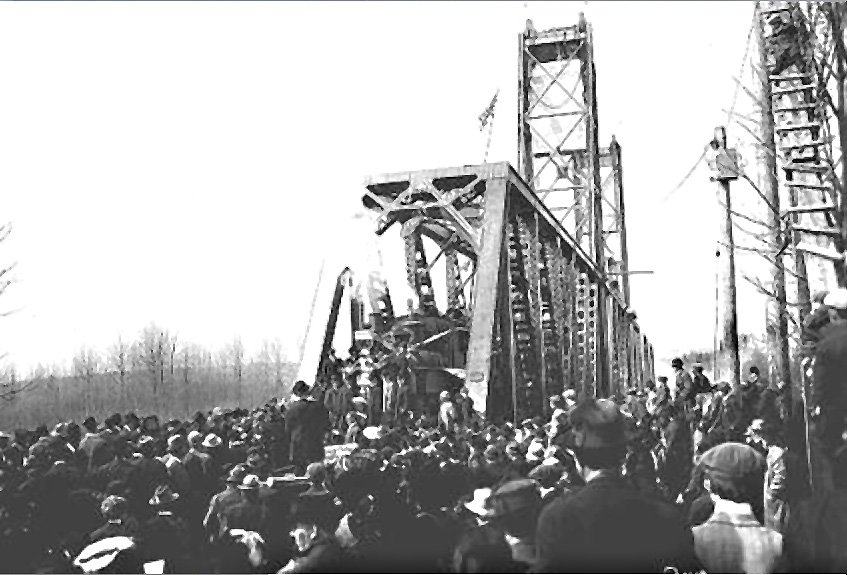
      Opening Day Celebration, 1913
        Opening Day Celebration, 1913

        In Salem
        A new railroad bridge across the Willamette is completed, intended for interurban passenger and freight traffic. The new McKeon gasoline coach made three trips a day between Salem and Black Rock on the Salem, Falls City and Western Railway by way of this new bridge. Forty passengers could be accommodated aboard this coach that traveled 27 miles from terminal to terminal.
        As you travel through Salem on Union Street from the bridge going east,  you will curve south to meet 12th Street. The rail tracks ran along the center of Union Street to the depot. That curve in the street reminds us of the train traffic this street accommodated.
         Between 1850 and 1900, transportation in the Willamette valley had been mainly by steamboats and railroads on each side of the river, but there were no rail crossings, only a highway bridge or ferry. By the time the railroad bridge was built, the future of interurban rail service was in doubt, but it was increasingly used for lumber, freight and canneries. Except in emergency, few passengers used the bridge and even freight use was rare by the 1970s.

        When you visit
         Restoration for pedestrians, 2009

        In 2001, long after the railroad traffic ceased, the bridge was offered it to the city of Salem for $1. The offer was accepted in 2004 and the restoration to pedestrians, bikes, and emergency vehicles was completed for a reopening in April 2009. Stimulus funds from the federal government provided funds for a temporary closing during the winter of 2009-10 in order to encapsulate the lead paint applied many years ago. In May of 2010 the bridge reopened for public use. Three interpretive panels (one on the Union Street side, two at the end of the trestle) highlight the historical uses of this structure. An award for engineering excellence was awarded in January of 2010 and three more since then.

        Other events
        • C. Siegmund became mayor.
        • The new transportation opportunities across the Willamette River accelerated the growth of West Salem in Polk County: it incorporated as a city this year.

        View of Front Street Viaduct from Mill Creek
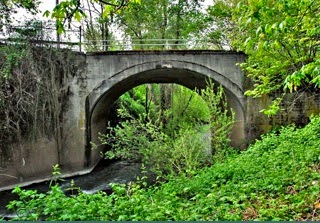
        • On Front Street, a bridge is built over Mill Creek to accommodate rail traffic. This is currently the oldest concrete viaduct in Oregon.
        • Salem Cherrians were organized as the group to organize the annual Cherry City Parade. The former mayor, George F. Roger is the first King Bing.
        • The Oregon State Insane Asylum is renamed the Oregon State Hospital.
        • Salem votes to go "dry" and the local Salem Brewery Association moves to Portland.
        • After the death of Asahel Bush this year, his daughter Sally boards a private railway carriage, travels east, and brings her fifty-year old sister, Eugenia, home to Salem. They live here, together again, for the next twenty years.
        • The Boise Building, designed by Fred Legg, is constructed on State Street for Reuben P. Boise, Jr. Over the years it has been leased as a farm machinery store, a garage and automotive center, as steel warehouse and currently as retail store again. Reuben Boise, Jr. was the owner and editor of the Oregon Statesman. He was named for his father, a distinguished Oregon jurist, and married Minnie, the daughter of Eugene Breyman. The building is seen on the SHINE Historic Downtown Walking Tour.
        • The First Church of the Nazarene builds a church 490 19th Street NE. After that congregation left, the Foursquare Church occupied the building during the 1950s. The Unitarians next purchased the property, but also moved to a new location. Since 1997, it has been our local Quaker Meeting House.
        • The Christian Wiedmer house built this year, and later enjoyed as a popular cottage restaurant, has been moved to State Street and now serves as an antique shop.
        • The Jones-Sherman House is built on D Street in the Grant neighborhood. Ralph Jones built this Craftsman residence and lived there until 1926. Charles Sherman, a professor of Philosophy and Psychology at Willamette University, then purchased the house. Professor Sherman died in 1963, but his wife Grace and four children owned the house until her death in 1978. The present owners, Jeanne and Corbey Boatwright, assumed a purchase contract with Sherman heirs in 1984. The property was placed on the National Register of Historic Places in 1989. Jeanne describes their neighborhood: "Encompassing just ninety city blocks, Grant is the smallest of the recognized Salem neighborhoods. Located adjacent to the north end of downtown, it provides the north gateway to the Capitol Mall and is a beautiful, historic part of Salem. Nearly all of the homes and buildings date to between 1900 and 1940. The many tree-lined streets and intimate lot sizes provide a friendly and close-knit neighborhood. Our treasured Grant Park is adjacent to Grant Community School - a dual language immersion school. Since 1976, the vibrant Grant Neighborhood Association has been actively working to protect this jewel of a neighborhood."

        Friday, March 5, 2010

        Salem in 1890

        World Events
        • William II, autocratic Emperor of Germany, dismisses Chancellor Bismarck, continuing difficult relations with France.
        • King William of the Netherlands died without a male heir, the throne going to the princess who becomes Queen Wilhelmina.
        • At Wounded Knee in South Dakota, an attempt by 7th Cavalry to disarm Lakota Sioux results in the deaths of 153 Native Americans and 25 soldiers.
        • The Land Rush of the year before had produced so many settlers that the Oklahoma Territory was established in May of this year. Idaho and Wyoming are admitted as states.
        • American industry produces an entirely steel frame building in Chicago. The use of Hollerith Company (later IBM) punch cards for the census of this year introduces computing hardware.
        • Mass rallies and one-day strikes in cities in North America and Europe demand an eight-hour workday.
        • Notable new books of this year: Hedda Gabbler, by Hendrik Ibsen and Picture of Dorian Gray by Oscar Wilde. 
          In Salem
          The Salem Canning Company is founded. Robert Wallace secured land on a corner of the Willamette University campus (seen above), opposite the Thomas K. Woolen Mill providing rail car loading on two sides and frontage on 12th Street. In the cannery building tomatoes, peas, corn, beans, cherries, black raspberries, plums, pears, and apples were processed. Mr. Wallace died unexpectedly the following year and the company was sold, later operating under the Allen name. (In 1920 Mr. Allen designed a new home, and had his crew build it, at 901 Capitol Street. This beautiful property on the intersection with D Street is now a Local Landmark. For many years it has been used as a business office.) The plant became the Oregon Packing Company and was later a cooperative known as the Mutual Canning Company. It was secured by the California Fruit Canners Association and that ended local ownership. In 1935 it became known as Calpak Plant #126. The plant closed in 1953.

          When you visit
          The photograph above was taken near the Willamette Heritage Center gate on 12th Street, looking north toward State Street. The railroad tracks, going east into Willamette University, are no longer there since a major renovation for the creation of new campus buildings in the 1980s. The site of the original cannery is now the location of a university parking lot.


          Other events
          • Salem's population reaches 2,617.
          • A structure built just four years before by the enterprising Mr. Wallace, our first bridge over the Willamette River, collapses due to flooding on February 3. The timber wagon bridge cost $50,000 and first opened to traffic on December 7, 1886 when the river crested at 37 feet and one inch. A pier, improperly placed in relation to the current, washed our first. Then the spans crashed. A drawing in West Shore magazine captured the event and shows Billy Chambers and L. Goolsby barely escaping.
          The collapse of our first Willamette River bridge
          • Another successful businessman, brick maker George Collins, builds an elaborate Queen Anne style residence at 245 Church Street. His bricks were used in many of our historic Salem downtown structures. Almost thirty years after the house was built, it was sold to Robert Downing and the property stayed in that family until the death of Hazel Downing Isbell in 1986. In the later years, it had become divided into apartments, but when it was moved to 1340 Chemeketa Street in 1989, it was restored to its original interior design. It now serves as professional offices. This NEN neighborhood property is listed on the National Register of Historic Places.
          This year, Salem continues to experience a boom in residential building:
          • Southeast of downtown, two new Vernacular style homes are built: William Siegmund, a blacksmith, lived at 1396 Lee Street for many years and Jefferson Myers, a local attorney and political figure, lived at 1896 Lee Street. Both houses are Local Landmarks in the SESNA neighborhood.
          • Two farmhouses across the Willamette River in Polk County are built: the Fennell and Stoller houses are preserved as early Local Landmarks in the West Salem neighborhood.

          Dairy Farmhouse
          • There remains today a farmhouse of a large dairy that once extended east from the Oregon State Hospital property to what is now Lancaster Drive in the NESCA neighborhood. Now reduced to a single city lot, the property retains many of the original trees and other features. Three adjoining small houses along Park Avenue to the south were for dairy workers. We often drive pass this house, on the southeast corner of Park Avenue and D Street, without thinking of its long history and how recently this area was all farmland. Unfortunately, we do not know the name of the original dairy owner.
          • On Cottage Street, north of Salem, a house is built as a rental. In 1913 Charles and Lillian McKinley purchased the property. The present owners have restored and thoughtfully maintained this Local Landmark in the Grant neighborhood.
          • Near his brother Joshua's property in Spring Valley, Andrew Jackson Purvine builds a new residence to accommodate his second family. Although altered, it retains many of the qualities of the original home.
          • The originally Quaker community in Highland welcomes the German Baptists on Hazel Avenue. Still retaining its classic exterior, it is a Local Landmark as the Immanuel Baptist Church.
          Ben Maxwell recalls: 
          In May, it is reported that Margaret Hutchins, "squaw wife" of celebrated old Santiam Chief Joe Hutchins, dies of fever in a tent among little trees between the Southern Pacific depot and the woolen mill [on the present 12th Street]. The item noted she was member of the Molalla tribe.
          Within 5 miles of Salem, good fruit and farmland could be bought for $30 to $50 an acre.
          On July 4, Salem staged the greatest celebration in the Willamette Valley. Rev. C. C. Stratton [son-in-law of pioneer Alvan Waller] delivered the oration and W. J. D'Arcy read the Declaration of Independence. The national anthem was sung by 150 trained voices and 7 brass bands offered additional music. Previous to this ceremony, there was a 13-gun salute. Residents on Wilson [Willson?] Avenue were advised to leave windows open to prevent their being shattered by the concussion.
          (See Ben Maxwell's Salem, Oregon, edited by Scott McArthur, 2006)

          Sunday, June 14, 2009

          Salem's Moving History #10 of 12

          photograph courtesy of Keith Chilcote

          In this original 1890 location at 1118 Oak Street, this house was the residence of the John G. West family: the Wests were parents of Oswald West, later governor of Oregon. At the time the occupation of Mr. West was listed as "drover." In the mid 1890s the house was sold to C. M. Beak and in 1898 to Mrs. A. Klein. The Kleins continued in ownership and residency through the early 1920s. After being used by Willamette University and other owners, it was divided into six living units in 1993. In this late 1990s photograph, the house must be demolished or moved for the expansion of the Salem Hospital.

          Fortunately, the house was moved by Sarah and Keith Chilcote and restored to this welcoming appearance. It stands between the two houses they moved from Winter Street (see #8 and #9 of this series) at 2983 D Street.

          Saturday, June 13, 2009

          Moving Salem's History #8 of 12

          This house, shown in the 1990s when it was located on the corner of Oak and University Streets, was the residence of the John G. West, father of Oswald West, later governor of Oregon. In the mid 1890s the house was sold to C. M. Beak and in 1898 to Mrs. A. Klein. The Kleins continued in ownership and residency through the early 1920s. It was moved, shortly after this photograph was taken, for the expansion of the Salem Hospital.

          Here it is today in its new location on D Street, lovingly restored and with bright new paint. The owner has restored several houses on this property and we are grateful to him for preserving this residential local history,