SHINE is a look backward from the present to Salem's 1860 charter. In each year we have four sections: glimpses of what was happening around the world, a special event in Salem, what you see when you visit that site today, and other Salem events of interest that year.


Showing posts with label Salem Railroad Station. Show all posts

Wednesday, April 14, 2010

Salem in 1918

World Events
  • First Constituent Assembly provides for Russian democratic republic, but Bolsheviks desolve it the same day. Romanov family (Tsar, wife, four daughters and son) executed by the Cheka at Ipatiev House in Ekaterinburg, Russia.
  • Soldiers of Allied and Central Powers endure brutal, useless trench warfare.  (The novel All Quiet on the Western Front, by Erich Maria Remarque, 1929, is a German soldier's view of the battlefront. It was made into an Academy Award-winning film in 1930.)
  • Kaiser Wilhelm abdicates and goes into exile in Netherlands.
  • On November 11, an Armistice is signed, suspending the combat of World War I. President Kilson delivers his "Fourteen Points" speech in Congress outlining peace aims among nations: free trade, open agreements, equal opportunity and self-determination of government. When he sails for Paris to attend the peace conference, it is the first time a president has left American during his term of office.
  • New nations are created out of the Austro-Hungarian Empire: Austria, Hungary, Czecho-Slovakia, Yugoslavia, Poland and Romania.
  • An influenza epidemic is worldwide: about 548,000 die in the US.
  • The first airmail sent between Chicago and New York and time zones are established, approving Daylight Savings Time periodically.
  • Magnificent Ambersons, by Booth Tarkington, is the winner of the first Pulitzer Prize for novels. Also notable, My Antonia, Willa Cather.
        In Salem
        The new Southern Pacific Railroad, the third station in Salem, is rebuilt after a fire of the year previous. It is the standard design for passenger station construction during the heyday of passenger rail service in the United States. Even today, senior residents can remember when rail service to Salem was so personal that trainmen knew where to stop the engine along 12th Street so a family in a carriage would be nearest the street leading to their home. Citizens were proud of their many rail lines through the city and the "Iron Ring" of electric tracks was a convenience to passengers, the canneries and local industry.

        When you visit
        As passenger rail service diminished during the last decades of the 20th Century, there was a decline in the condition of the Salem station. However, the 1990s brought renewed interest in the passenger rail services and the realization that high-speed passenger service, could again become a vital part of the nation's transportation system. In 1991, Congress set aside funds for improving passenger rail service. Using that funding source, the Oregon Department of Transportation purchased the station from the Southern Pacific Railroad for about $600,000 in 1995. The department spent another $1 million in federal ISTEA funds to restore the station. The location of the station, now in the middle of town, is interesting place to visit with its inviting, old-fashioned lobby. AMTRAK has five runs, both north and south, through Salem daily and the trains are well patronized.

        Other events
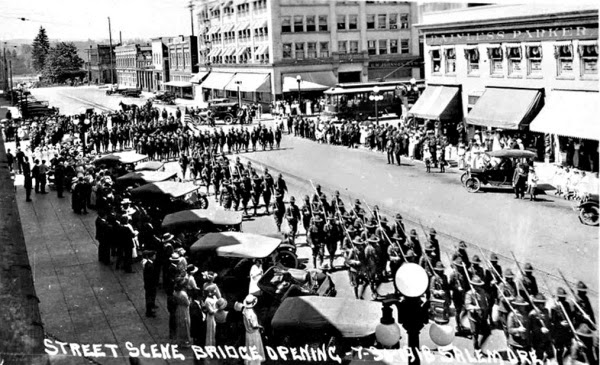

        • The Center Street Bridge across the Willamette is completed in July with a lively parade to celebrate the occasion. A parade of troops marched east on State Street (above) with a caravan of automobiles carrying local luminaries following.
        • Another transportation link is disappointing to Aumsville, Marion, Stayton and Turner. They had asked that 99E go through their towns, providing a more scenic, less hilly route than a new straight highway between Salem and Jefferson. A similar request over the routing of I-5 decades later was also rejected.

        • In November the troops march again to signal the Armistice. Luella Patton drove the family Studebaker in the parade.
        • A. C. Gilbert, former local resident, opens the world's largest toy factory featuring a chemistry set. The Council of National Defense tried to eliminate toy production during the war, but Gilbert successfully fought the ruling. In the press, he earned the name "The man who saved Christmas."
        • Winifred Pettyjohn, a widow at 31, placed her daughters in the care of her parents and enrolled at Capitol Business College "to see what she was 'fit' for". She found she had a flair for salesmanship when the local business world was opening itself to women because of the many men enlisting for service in the war. When the men returned, she was unable to keep her job or find new employment. She opened her own real estate office, beginning a career as one of Salem's outstanding business and civic leaders.
        • At the southwest corner of Market and Summer, a traditional two-story frame residence was built this year. The original owner is not known, but it may have been G. L. Busick who lived there from 1926 to 1940. Mr. Busick was the well-known owner and operator of Busick’s Market in the Bush-Brey Block downtown. In spite of its location on a busy corner of Market and Summer Streets, the grounds and house maintain their original character befitting that prestigious residential area, once the entrance to the city. It is a Local Landmark in Grant neighborhood.
        • Among the victims of the 1918 influenza epidemic is twenty-one year old Eugenia Thayer, the daughter of Estelle Bush Thayer and niece of A. N. Bush, director and owner of the Ladd and Bush Bank. Five years later, after the death of her husband, Estelle returned to Salem, building home on Capitol Street near her brother.
        • The wife of US Senator Charles McNary, the former Jessie Breyman, dies in July as a result of an automobile accident. Mrs. McNary was visiting her family in Salem. Her two sisters, Mrs. Boise and Mrs. Snedecor, also in the car, were only slightly injured. The senator returned to Salem for the funeral which was held in Boise residence on Court Street. (This will be one of seven family funerals performed in that home before it was demolished.)
        From the Capitol Journal:
        • Cooperation of school children was asked by the War Department in the collection of peach, prune and cherry pits as well as nutshells of all kinds needed in the manufacture of gas masks. The Salem Public Library would be the collection point.
        •  Running for the job of City Alderman need not be expensive. Paul V. Johnson got through for 15 cents. A. H. Moore, without previous experience, spent 20 cents for an application blank, but to make sure of his job spent $2 more for cards to pass around. It cost Earl Race just $4 to make the race for City Recorder.
        • Auto hearses of two Salem undertakers met with peculiar misfortunes in November. While headed into a rural area for a body, the Webb and Clough hearse ran off a bridge on 25th Street and overturned. The driver unhurt returned to Salem to borrow the Rigdon's hearse for the call. On the second trip, he got on the wrong road and was stuck in mud for several hours.
        • A lady elevator girl, the first, is Miss Minnie Breeden, working the lift in the Hubbard (Later Oregon) Building.
        (See Ben Maxwell's Salem, Oregon, edited by Scott McArthur, 2006.)

        Thursday, March 18, 2010

        Salem in 1899


        World Events
        • Russia increases control over Finland, declaring the right to veto their legislative rulings.
        • U. S. takes possession of Wake Island. Philippine people demand independence and hostilities begin in Manilla. The war will continue until 1902.
        • The Hague Convention establishes the first multinational treaties addressing the conduct of the military forces toward defeated opponents  and the protection of civilians caught up in combat. These treaties are based on the Lieber Code signed by Abraham Lincoln during the Civil War.
        • The Great Blizzard brings freezing temperatures as far south as Florida, bringing disaster to the Florida citrus crop.
        • Marconi successful send a radio signal across the English Channel.
        • Voting machines are approved by Congress for U. S. federal elections.
        • Scott Joplin's "Maple Leaf Rag" is copyrighted as ragtime music becomes popular.
        • The Story of Little Black Sambo, by Scottish author and illustrator Helen Bannerman, is published as one of a series in The Dumpy Books for Children. This was the first story to portray black heroes in children's literature. It has undergone criticism of racism since the mid-20th century.

          In Salem
          This photograph from Ed Austin's collection was displayed as a part of the 1995 Railroads in Salem exhibit in the Heritage Room at the Salem Public Library. It shows a large crowd has gathered at the Salem station on August 10, 1899 to welcome the returning Oregon 2nd Volunteers home from the Spanish American War. The view, taken from the water tower (now Mission Mill Museum property), gives an interesting perspective of the early Salem layout south of this location. Note the street car to the right and the stub switch on the mainline in the foreground. A band was on hand to lead the parade downtown where table were spread for a welcome home luncheon.

          When you visit
          Unfortunately, we are not able to perch at the top of the water tower (which is still there) and take a comparative photograph in 2010. However, we can pick out some urban developments since that day. The area to the left was later occupied by a hop warehouse, and then the California Packing Company cannery. After the cannery closed, the Tokyo International University campus was built in that area. The station burned and was replaced by 1918 by the third railroad station, the one we use presently. The old freight depot (out of sight beyond the passenger station) survived again and is part of the Salem Railroad Station's listing on the National Register of Historic Places.

          Other Events
          • This year Greenbaum's Department Store opened at 240 Commercial Street. Now Greenbaum's Quilted Forest, it celebrated a 100th anniversary in 1999. It is located in the remaining section of the 1889 South Eldridge Block. In 1919 the local merchants partnership of Rostein & Greenbaum bought the building. In the second Greenbaum generation, Adolph continued the enterprise, changing it to "Greenbaum's Fine Fabrics" in the 1940s when the building was sold. When Adolph died in 1960, his sister, Irene Depenbrock, took over the business. She was responsible for purchasing the building in 1966 and so preserving it for the future of the business. Her daughter and son-in-law, Sylvia and Bill Dorney continued this family business into the present commercial life of our historic downtown.
          • Maud Hill, who had walked from Missouri to Oregon as a child, marries John Zackary, the great-grandson of the noted pioneer, Tabitha Brown, often called the "Mother of Oregon." When the marriage ended with the death of her husband in 1917, Maud made a home for her family on Front Street, laboring as a laundress to raise her five children. She died in 1954 and is remembered with honor by her descendants.
          • In 1899 Steusloff Meats has a prominent downtown location at 284 Commercial and an impressive display in the interior. However, just five years later, in 1904, a new concrete building was completed for the business at 399 Court Street. In 1947-8, the exterior of the building was altered and then sold by the Steusloff family. It housed the popular "Sally's", a ladies' clothing store for several years. A Starbuck's coffee shop now occupies this northwest corner of Court and Liberty Streets.
            This change in Salem's downtown architectural style was also reflected modifications of the Pearce and Breyman buildings one block to the west at the Commercial and Court Street intersection. Nearly all modernization efforts involved the removal of decorative detail, resurfacing of the exterior facade, and updating of the ground-level storefronts. These changes reflect the evolving, post-war feeling that becoming "modern" in Salem's commercial district would bring economic prosperity and dynamic growth.
          A June ad in the Capitol Journal advised readers to stop smoking. No-To-Bac, it reported, removes the desire for tobacco without nervous distress, expels nicotine, purifies the blood, restores lost manhood, and makes you strong in health, nerve and pocketbook. 

          In September, another advertisement extolled the use of Dr. Peau's Yellow Nerve Pills that were guaranteed to cure all nervous diseases, weak memory, headache, wakefulness and (as above) lost manhood. It noted that these pills could be carried in the vest pocket.
          In August, the property of the closed Orphans' Home situated "near the state asylum", was being sold to the Salem Hospital. It had closed for want of funds and standing idle. It was planned that the property and buildings be deeded to the hospital with the provision that they should always be used for hospital purposes.
           Local businesses made the news:
          Jos. Myers and Sons, Salem's greatest store, advertised blankets for hop-pickers for 29 cents.
          Frank Dearborn's bookstore offered juvenile attractions: The Oliver Optic series, Henty books and the Sailor Boy with Dewey series.
          Capital Lumber Co. was working a short day ~ a nine hour shift.
          On a Sunday, a swarm of wasps and honeybees gained access to the Harritt & Lawrence Grocery Store and carried away 30 pounds of honey. On the next Monday, they made another raid and the store had to be closed while the bees were smoked out with sulfur.
          (See Ben Maxwell's Salem, Oregon, edited by Scott McArthur, 2006.)

          Thursday, February 4, 2010

          Salem in 1870

          World Events

          • The 15th Amendment to the US Constitution gives the right to vote to all citizens.
          • Heinrich Schliemann, a German pioneer in archeology, excavates the ruins of the Troy of the ancient world of Homer. 
          • John D. Rockefeller, the wealthiest man of his day, founds Standard Oil, the largest oil refinery in the world. 
          • The Brooklyn Bridge construction over the East River in NYC begins. While underground, the Tower Subway in London is the first passenger "tube" railway.
          • "Twenty Thousand Leagues Under the Sea" introduces science fiction.
          • Louisa Ann Swain of Laramie, Wyoming, becomes the first woman in the U.S. to vote legally since 1807.
            In SalemTransportation is a main fascination (both in big city daily life and in a popular novel) this year.  Salem residents also look forward to extended opportunities in travel with hoped-for arrival of Oregon and California Railroad service convenient to the business and residences around Commercial Street. However, the citizens of 1870 would not agree to pay the railroad an additional $30,000 for laying track to the center of town. So the first railroad station was built over a mile east of downtown on 12th Street. Citizens then complained about the distance they had to travel to deliver and pick up passengers and baggage. Fortunately, by 1888 Salem had its first horse-drawn street railway, The Salem Street Railway Company. It operated from the corner of State and Commercial, extending to 12th Street and eventually along 12th to the Southern Pacific depot. Electric trolleys quickly followed.

            When you visit: Salem Railroad Station
            The 1889 station, shown above, was the second. Just prior to World War I, this one also burned and was replaced by the present station at 500 13th St. SE.
            Once the focus of lively, bustling out-of-town travel before World War II, the station was also the scene of sad family departures when the Japanese-Americans were evacuated to relocation camps during 1942. After passenger travel declined, the station fell into disrepair. The station of now serves Amtrak passenger trains on a daily basis and the classic, 1930s lobby has been restored. It is a pleasure to visit, and you might even be there when the passenger train whistles in and the conductor escorts them onto the correct coach. All aboard!

            Other events
            • Three new commercial buildings are constructed downtown. The Wade and Smith building on State Street retains its 1910 appearance. The Anderson and Durbin/Dearborn buildings on Commercial Street have also undergone extensive renovations. Both are featured on the SHINE Hisotric Downtown Walking Tour.
            • Salem residents found entertainment in Sandy Burns' North Star Saloon, witnessing the first set of "hurdy-gurdy" girls ever brought to town and were delighted with the lively performance. In those times, North Star Saloon faced Court Street, oppose Reed's Opera House. Before Sandy Burns took over the building, the structure had served as publication office for Rev. Thomas Hall Pearne’s Pacific Christian Advocate. A new theater was the Oro Fino Theater, opening on October 16, with seating capacity for 700. "Fernande" was the initial presentation, followed by "Aladdin," the wonderful "Scamp"- a burlesque that filled the house. Oro Fino did not long survive as a theater, and the structure itself collapsed in a gale, probably during the big blow that struck Salem on January 8, 1880.
            • In this year, an unusual farming photograph records Lewis Judson's threshing machine on his South Salem farm.  Judson and his wife, Almira Roberts, arrived in Oregon in 1840 on the Lausanne.  Besides his work at the mission, Judson assisted in the creation of the Oregon Institute, served as a magistrate, and was appointed Marion County surveyor. He used his self-taught medical skills to assist Salem's early residents. Judson was known as a versatile, if blunt and stubborn man.  In 1846, two years after Almira's death, he married Nancy Hawkins, the sister of Martha Boon. She divorced him in 1859. At that time he was living in Clatsop County where he spent the last years of his life.

            • The Smith-Ohmart family builds a new home (above) at what is now 2655 East Nob Hill. For 70 years it was the home of the Fabritus Smith families, his daughter Velleda (Mrs. Adam Ohmart) and her son Roy Ohmart. Still in its original Italianate style appearance above the present SCAN neighborhood, it was listed on the National Register of Historic Places in 1979.
            • A true pioneer wife and loving mother to her adopted daughter, Lucy Anna Lee, Lydia Bryant Hines's life of adventure ended with her death in Salem this year. The wife of a circuit riding Methodist minister, Gustavus Hines, she had left her parents' comfortable home to endure privation as a young wife even before making the voyage to Oregon in 1840 on the Lausanne. Her years in the earliest settlement of Salem, her travels in the new northwest settlements and world-wide and her reflections on her experiences, have all been recorded in journals and make fascinating reading. She lived the last 14 years of her life here in Salem.
            • The James Joseph/G.W. Gray Cottage was one of the first built in the earliest East Salem Subdivision, the Roberts Addition of 1865. It was owned by one of the brothers who built the Grey Building downtown. The cottage is in the NEN neighborhood and part of the Court-Chemeketa Historic Residential District, featured on this website.
            • Polk County tax records show Lindbeck House on Orchard Heights Road in West Salem, built this year, to be one of the oldest residences of that neighborhood. Very little past ownership information is available. The previous owners were the Bouffleur family, prominent growers at this location as long ago as the 1930s. In 1967, John Lindbeck retired from the US Navy and returned to his hometown to purchase this property. With his wife Carolyn, they sold fruit from this 36-acre orchard. The property recently sold for construction of a retirement community and the house has unoccupied for several year. Its fate is uncertain.