SHINE is a look backward from the present to Salem's 1860 charter. In each year we have four sections: glimpses of what was happening around the world, a special event in Salem, what you see when you visit that site today, and other Salem events of interest that year.


Showing posts with label Steeves. Show all posts

Monday, April 26, 2010

Salem in 1926

World Events
  • Crown Prince Nguyen Phuc Vinh Thuy ascends to the throne of Vietnam. He will be their last monarch of that country.
  • Spain's General Francisco Franco participates in a failed coup against the republic, beginning the Spanish Civil War that precedes World War II.
  • The United States Congress passed the Air Commerce Act, licensing pilots and planes. Robert Goddard launches the first liquid-fuel rocket, at Auburn, Massachusetts. A weather map was televised for the first time, sent from NAA Arlington to the Weather Bureau office in Washington, D.C.
  • Prohibition and prostitution are major sources of revenue for criminals breaking the law, Al Capone as a "racketeer" is at the height of his career.  The National Bar Association is incorporated this year.
  • Gertrude Ederle is the first woman to swim the English Channel from France to England.
  • Vitaphone premieres with the movie "Don Juan", starring John Barrymore. But the death of film actor and sex symbol, 31 year-old Rudolph Valentino, causes world-wide grief.
  • A. A. Milne's Winnie-the-Pooh is published in London. American books: Early Autumn by Louis Bromfield and The Sun Also Rises, Ernest Hemingway.
In Salem
Thomas A. Livesley, an internationally prominent hop grower, created two of Salem's most admired structures. One is our only skyscraper, the 11 story First National Bank Building built this year on State Street downtown, The Capitol Tower, often called the “Livesley Building", the other is the former Livesley family home, "Mahonia Hall", built in 1924 on Lincoln Street in Fairmount Hills, It was once considered "out in the country" as a 1958 photograph shows. In the next year, Thomas Livesley will become Salem's "Good Roads Mayor". His priorities included bridge, street, alley and sidewalk improvements. Other major projects included expanding fire protection, new playgrounds, the Salem Airport, streetlights and traffic signals. His repeated efforts to establish a city council-manager form of government would be successful in 1947, the year of his death.

When you visit
The Livesley Building has had several owners, the present being Roger Yost. Its ground floor interior reflects the dignified banking atmosphere of the years when it was built and professional offices are still maintained in the floors above. The elaborate exterior decorations of the upper levels, representing stylized historical and mythical characters, are only partly visible from the street below. The Livesley home, Mahonia Hall, is now the governor's mansion, secured by a fence and guarded by state police. It is open to the public by invitation for special events and there are occasional tours guided by members of AAUW. Both buildings continue to reflect the life of Thomas Livesley and are his gifts to Salem's architectural heritage. They are both listed on the National Register of Historic Places.

Other Events
  • Among the other new downtown constructions in this prosperous year: the New Salem Hotel/Hughes Building at the corner of Ferry and High Streets; the Elsinore Theatre with its beautiful lobby recalling a Shakespeare Castle courtyard at night; and the Bligh Building, now called the Pacific Building, which replaced the 1864 Cook's Hotel.
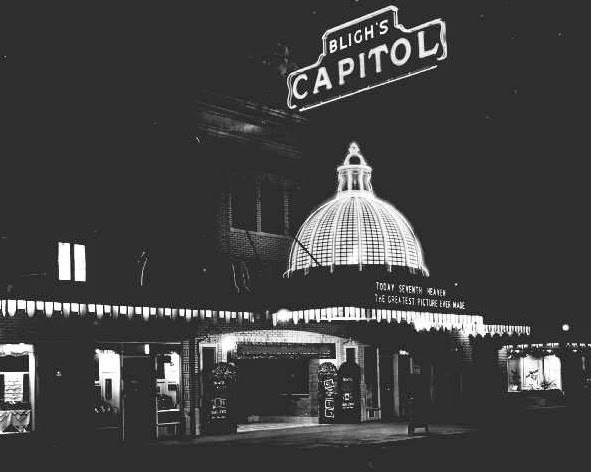
  •  Located on the southeast corner of High and State Streets, the Capitol Theater of the Bligh Building was constructed adjoining, to the east. Its distinctive dome feature over the entrance was even more attractive when it was lit at night. This building was demolished in 2000 and now is marked only by the outline of the rear wall as you pass the site, now a parking lot, on State Street.
  • Among the residences built near downtown this year: the David Eyre home on Summer Street, moved in 1939 for the construction of the North Capitol Mall, and now in the Gaiety Hill/Bush's Pasture Park Historic District at High and Mission Streets; the Baumgartner home on Winter Street, now on Summer Street after two previous moves; the Collins-Busick House on Court Street; and the Steeves House, a block to the east. The Court Street residences are in the Court-Chemeketa Historic Residential District of the NEN neighborhood.
  • The Shipley House on Washington Street, built this year, is now listed on the National Register of Historic Places. The gardens of the Shipley house were designed by well-known nurseryman Ernie Lufer. When the Depression forced the closing of the Shipley business, this English Cottage style residence was sold to Cora Kay, the widow of Thomas Kay, the mill owner. (Her home had been demolished for the construction of the Oregon State Library.) She lived here until her death in 1944. The landscaped grounds with the original underground watering system and rock gardens were restored in 1984 by Mrs. Kay’s grandson, W. K. Huntington for the present owners.
  • Across the Willamette River in West Salem, the First Methodist Church, after many years in construction, is finally completed. 
  • On Ferry Street at 19th, a beloved Congregational minister and civic leader is honored with the construction of Knight Memorial Church. Plutarch Knight's obituary of 1914 (excerpted here) lists an amazing number of accomplishments. He came to Salem in December of 1857 and attended Willamette University from 1857 to 1860.  He was reporter and editor of the Statesman from 1862 to 1864, was also state librarian and city recorder, read law, and was admitted to the bar in this same period of years. He was ordained a Congregational minister at Oregon City in 1866, and was pastor of the Congregational church of Salem from 1867 to 1883, sixteen years. He was superintendent of schools for Marion County from 1870 to 1872 and in charge of the Oregon school for deaf mutes from 1871 to 1892. The degree of Doctor of Philosophy was conferred upon him by Willamette university in 1890. He platted Knight's addition to Salem in 1888; bought Capital Park addition in 1889; Central addition and part of Capital Home addition in 1890; Simpson addition in 1891. Mr. Knight was the moving spirit and the largest original stockholder in the Capital City electric railway, started in 1890. As a minister, a writer, a public speaker, a public spirited and useful citizen, as a businessman, Mr. Knight has kept the esteem, respect and confidence of the people among whom he has led such a busy, active and useful life.

Thursday, April 8, 2010

Salem in 1914

World Events
  • Diplomatic relations with Mexico break down, U.S. Marines land in Veracruz which they will occupy for 6 months.
  • Archduke Franz Ferdinand of Austria assassinated. As European nations begin World War I, President Wilson promises to keep America out of the conflict. (He signs a Mother's Day Proclamation.)
  • German trips invade Belgium: The British Empire declares war on the German Empire, including Austro-Hungary, which declares war on Russia. China declares neutrality. Japan extends its influence in China and seizes German territories in the Pacific and East Asia.
  • Ford Motor Company establishes an 8-hour day for workers with a minimum $5 a day wage.
  • Panama Canal opens in Panama with the passage of the SS Ancon, a 1901 steamship that had played a major part in ferrying supplies for canal construction. (The Path Between the Seas, David McCullough, 1977)
  • Charlie Chaplin makes his first movie debut with the character of the tramp in "Making A Living". Mary Pickford's name appears above the title of film "Hearts Adrift", beginning the "Star" recognition.
  • New American Books: The Titan, Theodore Dreiser; Penrod, Booth Tarkington, The Congo and Other Stories, Vachel Lindsay.
    In Salem

    William C. Knighton, the official state architect of that time, designed this handsome Supreme Court building costing $320,000. The exterior is finished with cream-colored terra cotta and the interior is marble and tile. At the rear of the ground floor, there is an ornate stairway leading to a handsome columned library. The third floor contains the Court Chambers with a glass skylight that includes a replica of the seal of the state of Oregon.
    Former Oregon Chief Justice Wallace Carson, Jr. was honored as the Salem Citizen of the Year 2010 at the Chamber of Commerce banquet February 11, 2011.

    When you visit
    The building is open to visitors after passing a security officer inside the front door. You will be told whether the upper floors are available for visiting at that time. The beautiful library and courtroom are well worth a visit and you may be able to hear some of the deliberations of the court.
    It is easy to see the impact the Oregon State Government has on the life of the city. It provides stable local employment and helps make Salem a destination for many visitors, but also increasingly occupies properties, particularly in the core of the city, for which the city provides services but receives no tax revenue.

    Other Events
    • B. L. Steeves is elected as mayor. The family's 1926 Dutch Colonial home still stands at 1694 Court Street, however the lawn and trees of the property were lost when 17th Street was widened in the 1960’s. The home was owned and occupied by the family into the second generation. The house next door at 1674 Court Street was built for the Steeves daughter, Muriel. Her family occupied this home until 1960. These properties can be seen on the SHINE Court-Chemeketa Walking Tour.
    • Three blocks, away in this same historic district, is the Buchner House also built this year. It was owned by Walter Buchner and his wife May. Mr. Buchner grew hops on 160 acres he owned south of Salem and established a feed store and mill in town. The family sold the house in 1942. It had long since been converted into rental apartments when it was firebombed in the early 1990s. The neighbors bought the structure, restored it and sold the house to new owners.
    • The Roberts Store is established south of Salem and a farming community (complete with train stop) grew up around it. The store remained open until a recent closure (the photograph was taken in 2008), then opened again. The school was put to other uses and the abandoned church collapsed.
    • The local YWCA is started in the spring of 1914 with Mrs. C.K. Spaulding heading the board. The organization’s headquarters were in the Knight home on North Liberty Street and the Salem Women’s club made the arrangements and gift of money which made the organization possible. An excerpt from the front page of the Daily Oregon Statesman on April 1, 1914 says, “Salem business men have heartily endorsed the organization plan and have promised to assist in any manner possible should the association care to call on them”.
    • Richmond School in its first year, 1914
      Students of the new Richmond School pose for a photograph.
    • Two years after the completion of the new Carnegie Library on State Street, the city takes over financial responsibility for this cultural institution. The Salem Public Library Advisory Board (our first Advisory Board) is created with members appointed by the mayor and councilors. The nine members presently meet at the library with the Director on second Wednesday of each month at 7 pm. The public is welcome.
    • Another public structure, the Mt. Crest Mausoleum, was completed this year. The architect was Ellis Lawrence who designed the Mahonia Hall, Elsinore Theater and other Salem structures. The building has been added to 9 times, have 6 governors interred there and a number of other prominent people of Salem through out the years. It is a part of City View Cemetery, just to the west of Pioneer Cemetery, sharing a fence.
    • April 18 on this year, John Zachary began serving an indeterminate sentence of three to twenty years in the Oregon State Penitentiary.  He did not survive his sentence, dying in the prison hospital on November 27, 1915.  He is buried a short distance from his great-grandmother, Tabitha Brown, in Pioneer Cemetery. His widow, Maud Hill Zachary, moved to Front Street with their five children, making a living as a laundress.
    From the Capitol Journal:
    • Governor Oswald West made an official visit to Washington, D. C. and the round trip cost the state of Oregon just $1.50. In New York, Governor West made a speech for which he was paid $375. This he turned over to Secretary of State Ben Olcott when he filed his expense account. The state's share of $1.50 was the cost for the governor's travel between Salem and Portland.
    • Benjamin S. Via and C. L. Imus, sponsors of the organization of a cavalry troop in Salem to participate in a possible war with Mexico, said they had their quota signed up and were ready for a call by the proper authorities.
    • In December, "Old Tiger", the fire engine that had seen service in Salem for many years, was taken to Willamette Slough to pump water on the ice and make the surface smooth for skaters.
    (See Ben Maxwell's Salem, Oregon, edited by Scott McArthur, 2006.