SHINE is a look backward from the present to Salem's 1860 charter. In each year we have four sections: glimpses of what was happening around the world, a special event in Salem, what you see when you visit that site today, and other Salem events of interest that year.


Showing posts with label Elsinore. Show all posts

Tuesday, June 15, 2010

Salem in 1962

World Events
  • In October, a two-week Cuban Missile Crisis ends as Kennedy announces that Khrushchev will remove Soviet missiles in Cuba. Linus Pauling is awarded the Nobel Peace Prize for his campaign against nuclear weapons testing.
  • John Glenn orbits the earth in Friendship 7. Walter Schirra and Scott  Carpenter complete pioneer space flights. The U. S. Navy SEALS, elite special forces are commissioned for both the Atlantic and Pacific fleets.
  • Two world-famous American women die: August 5, Marilyn Monroe; November 7, Eleanor Roosevelt. First Lady Jacqueline Kennedy takes TV viewers on a tour of the White House.
  • Rachel Carson warns of eco-danger. Her book, Silent Spring, gives rise to the modern environmental  movement.
  • The term "personal computer" is coined.  AT&T's commercial communications satellite is launched into orbit. "Big Box" stores are created: Kmart, Target and Wal-Mart. Taco Bell opens its doors.
  • Wilt Chamberlain scores a record-breaking 100 points in a NBA game.
  • Andy Warhol premieres his "Campbell's Soup Cans" art exhibition. The Century 21 Exposition World's Fair, with Space Needle, opens in Seattle.
  • Academy Award:"Lawrence of Arabia" (US), "Sundays and Cybele" (France). Prize-winning Books: The Moviegoer, Walker Percy and The Edge of Sadness, Edwin O'Conner.
    In Salem
    If the 1935 fire that destroyed the State Capitol building is the most remembered event in the city's history, the windstorm of 1962 probably ranks as the second.
    The majority of structures in Salem experienced damage during that calamitous storm on Columbus Day. At its peak, between 4 p.m. and 7 p.m. that Friday, it brought gusts of 90 M.P.H. and sustained winds of over 70 M.P.H. The $4 million total damages to Salem were higher than for any disaster the City had yet seen. The storm came with little warning and hit hard. It crossed the Oregon-California border on Friday, October 12, at noon, moving north at 48 M.P.H., reaching Salem at mid-afternoon. The ferocity of the winds as they roared through Salem shocked residents. Downtown, pedestrians were hit by glass from shattering windows, and dodged flying debris. Shoppers trying to get home were knocked to the ground. Cars were blown onto sidewalks and yards. The large sign on the roof of the Elsinore Theater was battered and crumpled by the wind and part of a wall at the Capitol Press Building fell onto two cars; rain then poured into the building. The steeple was torn from the Christ Lutheran Church at 18th and State Streets and dropped onto the sidewalk. Trees were blown over and uprooted. On the Capitol grounds, a falling tree knocked over the 3 1/2 ton statue of The Circuit Rider. (The photo seen here is from the Hugh Stryker Collection.)

    When you visit
    A few months later, the statue was repaired and replaced on its plinth.
    The Circuit Rider statue was sculpted by A. Phimister Proctor to honor Oregon's circuit-riding ministers. Robert A. Booth, whose father was a Methodist Episcopal circuit rider, presented the statue to the state as a gift in 1924. It was originally placed in an imposing location in front of the 1876 State House. When the Capitol was rebuilt in 1937, facing north instead of west, the Circuit Rider was repositioned among other statuary in a wooded area. The imposing memorial can be seen to the east of the Capitol on the path leading to Waverly Street.

    Other Events
    Purification ponds on Minto Brown Island, 1965
    • Boise Cascade purchases Oregon Pulp and Paper Company, a lumber company that began production at the same site in 1920. (The gabled roof of the Oregon Pulp and Paper Company building was still visible as part of the Boise Cascade plant when it was demolished in 2009.) After 1962 purchase, a yeast plant was added to convert byproducts of paper making into a food additive. In 1964 a container facility supplied cartons for food processing plants. Several improvements were made under Boise both to expand production and to meet air and water quality standards; purification lagoons were built on Minto Brown Island across the slough. Today these lagoons are both a protection from further water contamination and a hindrance to development of that section Minto Brown Island for public use. The industrial abuse of both the Willamette Slough and the island beyond makes urban development adjoining Riverfront Park's south border especially difficult. The plan for a pedestrian bridge from the park (beginning near the Eco Ball) must avoid disturbing the soil beneath the slough and the users of the bridge will have limited access to the island on the other side. A path will lead users to the now public section of the Minto Brown Park.
    • The Chemeketa Street property of the Church of Christ Scientist is sold in September, providing space for the future development of the Nordstrom Mall. Meanwhile, church members have purchased property at High and Kearney Streets from Willamette University for the purpose of constructing a new church. This was the site of the 1860 John Carson house. (See 1954)
    • Migrant Hispanic workers are employed in Marion County fields, but in Salem itself, the Latino population is small. Isabella Varela Ott moved to Salem in the 1950s to live with her daughter, Mary Varela Martinez, and her husband Pablo Martinez, a native of Peru. Mrs. Ott had a strong work ethic and wanted her children and grandchildren to have the same. She would take them out into the fields in the summers to pick beans, hops, and string beans. She also worked in local canneries. She was proud to be an American citizen and considered it a privilege to be able to vote and would do so at every opportunity. She also respected the people and culture of Mexico and stayed in contact with her son Luis who lived with his wife and family in Guadalajara. As the wife of a railway worker, she had access to a Southern Pacific pass that authorized her to travel free to Mexico. These trips continued every other year until her last one in 1971 at the age of seventy-six, twice taking her grandson David. She made it very clear that the American family should never forget their Mexican relatives. That grandson, Dr. David Martinez of Portland, recalls that theirs was one of only four Latino families in Salem in the 1960s and his social life as a high school teenager was difficult. 
    Thomas Kay Mill in last years of operation
    • Thomas Kay Woolen Mill closes due to loss of business in a changing market. The mill had been under continuous ownership and management of three generations of the Kay family until it was sold to the Mission Mill Museum Association for $160,000 in 1965, after having been closed for three years. The Mission Mill Association restored it to show authentic manufacturing processes from the time, and to depict the industrialization of America. Its buildings, exhibits and tours are now the centerpiece of the Willamette Heritage Center. The Kay family home on Court Street, only a few blocks away from the mill itself, had been demolished in 1937 when the State of Oregon had appropriated the property for the first building of the North Capitol Mall. The Oregon State Library stands on the former residence site.

    Tuesday, May 4, 2010

    Salem in 1932

    World Events
    • Adolph Hitler is leader of the NAZI party in Germany where harsh "Law and Order" policies require the death penalty for many offenses.
    • The Chinese regular forces of Manchuria surrender to the invading Japanese army, but continue to fight in guerrilla campaigns.
    • In July, Hoover orders the US Army to evict the Bonus Army of WW I veterans, assembled in Washington D.C. to demand their benefits. Troops do so the next day. 
    • The tragic news story is the kidnapping and death of the Lindbergh baby.
    • Americans celebrate Amelia Earhart's solo flight cross the Atlantic. Hattie W. Caraway is the first woman elected to the US Senate.
    • Roosevelt's election in November brings in the "New Deal" government recovery programs.
    • "Tarzan of the Apes" stars Olympic swimming gold medal winner,  Johnny Weissmuller. Academy Award: "Grand Hotel". Pulitzer Prize: The Store, Thomas Sigismund Stribling.

      In Salem
      The Elsinore Theatre presents a new type of popular diversion: sound for movies: no more captions as the actors speak! The Elsinore is an example of the 1930s "atmospheric" movie palace intended to be part of the entertainment. Built to resemble a Gothic castle in 1926, it was named for the palace in Shakespeare's Hamlet. The exterior was designed by Ellis F. Lawrence, an architect who was founding dean of the University of Oregon's School of Architecture and Allied Arts. One of his associates designed the interior. The upper balcony windows are made of stained glass pieces from a cathedral in Germany bombed in World War I.

      When you visit
      The Elsinore continued as a movie theater until 1993, when it was converted into a performing arts center and placed on the National Register of Historic Places. An extensive, community financed restoration was completed in 2002. The theater is featured on this website's self-guided walking tour of Salem's Historic Downtown. Tours of the theater can be arranged, but the best experience is to attend one of the performances which are listed on the Elsinore website.

      Other events
      • Douglas McKay becomes mayor. His first job off his father's farm was at the age of 13 to help support himself and his mother. Later he sold candy in Portland theaters, delivered papers, and drove a meat wagon. He quit high school to work at a railroad office. He attended Oregon Agriculture College (now Oregon State University) in Corvallis where he was elected student body president in 1916 and earned a Bachelor of Science degree in 1917. That year he married Mabel Hill. McKay served in the First World War, rising to the rank of First Lieutenant. A severe arm injury suffered in the Argonne combat almost cost him his life. He saw the growing popularity of automobiles and in 1927 he was offered an automobile sales organization in Salem, then at Center and Commercial. He purchased the automobile agency, now Capitol Chevrolet. By 1929, his family was in their home at 395 Jerris Street. It would be the family’s only home in Salem. A natural-born politician, McKay was Salem mayor this year.
      • Prices offered by canners for cherries drop to 2 cents a pound and 53 growers form the Willamette Cherry Growers Co-op.
      • As a sign of things to come, a first view of television is seen at the State Fair. It will be twenty years before TV becomes developed enough for home viewing.

      • Hannah Dautoff Hanzen is the first woman elected to the Oregon Legislature where she serves four terms. During these eight years, she became known as a spitfire who did her homework and was a match for anyone. She recalled later that she "was never looking for a fight, but...wasn't there to be stepped on, either...The year and issues change, but people don't change very much." In 1942 she cracked another all-male stronghold when she was elected Salem Municipal Judge, serving one term. Her marriage to Harry Hanzen led her to withdraw from her career, much to the disappointment of the police department whose members were ready to campaign for her second term. After retirement, Mrs. Hanzen served as president of the Salem Women's Club, corresponding secretary of the Oregon Federation of Women's Clubs, and Executive Secretary of the Marion County Bar Association. She also was an instructor at Willamette University. Her home at 2220 High Street SE, retains the original appearance (with the addition of a garage) and her beautiful garden is much as she designed it.
      • Edgar and Ursula Pierce build a home in the Fairmount section of the city for the staggering sum (in those days) of $17,000. This stone English manor house, with its elements of Queen Anne style of architecture, is a unique residence in Salem. The family lived in the house from 1932 to 1935 and from 1940 to 1942, moving out temporarily when it became the rented residence of Governor Martin. Now remembered by both names, it is a National Register property (1997) in the SCAN neighborhood.
      • A few blocks away, Dr. Charles G. Robertson builds an English Provincial house, designed by Clarence Smith with gardens created by Lord and Schryver. High on a dead end street, it has wide views over the city. Only its hipped roof and front gable are visible beyond the driveway entrance. It is also a National Register property (1982) in the SCAN neighborhood.
      • Elizabeth Lord builds her home on the Mission Street lot adjacent to the site of her parents' home that had burned some years before. Across the street from the home of her friend, Sally Bush, the Bush hillside was an excellent site for experimental plantings. Many of the beautiful trees we enjoy there today date from the 1930s. The Lord residence that she shared with friend and landscape business partner, Edith Schryver, is in the Gaiety Hill/Bush's Pasture Park Historic District. It is now the property of the Lord and Schrvyer Conservancy.

      Monday, April 26, 2010

      Salem in 1926

      World Events
      • Crown Prince Nguyen Phuc Vinh Thuy ascends to the throne of Vietnam. He will be their last monarch of that country.
      • Spain's General Francisco Franco participates in a failed coup against the republic, beginning the Spanish Civil War that precedes World War II.
      • The United States Congress passed the Air Commerce Act, licensing pilots and planes. Robert Goddard launches the first liquid-fuel rocket, at Auburn, Massachusetts. A weather map was televised for the first time, sent from NAA Arlington to the Weather Bureau office in Washington, D.C.
      • Prohibition and prostitution are major sources of revenue for criminals breaking the law, Al Capone as a "racketeer" is at the height of his career.  The National Bar Association is incorporated this year.
      • Gertrude Ederle is the first woman to swim the English Channel from France to England.
      • Vitaphone premieres with the movie "Don Juan", starring John Barrymore. But the death of film actor and sex symbol, 31 year-old Rudolph Valentino, causes world-wide grief.
      • A. A. Milne's Winnie-the-Pooh is published in London. American books: Early Autumn by Louis Bromfield and The Sun Also Rises, Ernest Hemingway.
      In Salem
      Thomas A. Livesley, an internationally prominent hop grower, created two of Salem's most admired structures. One is our only skyscraper, the 11 story First National Bank Building built this year on State Street downtown, The Capitol Tower, often called the “Livesley Building", the other is the former Livesley family home, "Mahonia Hall", built in 1924 on Lincoln Street in Fairmount Hills, It was once considered "out in the country" as a 1958 photograph shows. In the next year, Thomas Livesley will become Salem's "Good Roads Mayor". His priorities included bridge, street, alley and sidewalk improvements. Other major projects included expanding fire protection, new playgrounds, the Salem Airport, streetlights and traffic signals. His repeated efforts to establish a city council-manager form of government would be successful in 1947, the year of his death.

      When you visit
      The Livesley Building has had several owners, the present being Roger Yost. Its ground floor interior reflects the dignified banking atmosphere of the years when it was built and professional offices are still maintained in the floors above. The elaborate exterior decorations of the upper levels, representing stylized historical and mythical characters, are only partly visible from the street below. The Livesley home, Mahonia Hall, is now the governor's mansion, secured by a fence and guarded by state police. It is open to the public by invitation for special events and there are occasional tours guided by members of AAUW. Both buildings continue to reflect the life of Thomas Livesley and are his gifts to Salem's architectural heritage. They are both listed on the National Register of Historic Places.

      Other Events
      • Among the other new downtown constructions in this prosperous year: the New Salem Hotel/Hughes Building at the corner of Ferry and High Streets; the Elsinore Theatre with its beautiful lobby recalling a Shakespeare Castle courtyard at night; and the Bligh Building, now called the Pacific Building, which replaced the 1864 Cook's Hotel.

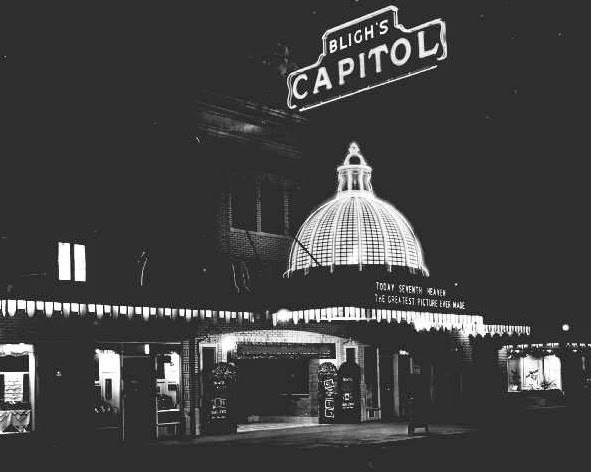
      •  Located on the southeast corner of High and State Streets, the Capitol Theater of the Bligh Building was constructed adjoining, to the east. Its distinctive dome feature over the entrance was even more attractive when it was lit at night. This building was demolished in 2000 and now is marked only by the outline of the rear wall as you pass the site, now a parking lot, on State Street.
      • Among the residences built near downtown this year: the David Eyre home on Summer Street, moved in 1939 for the construction of the North Capitol Mall, and now in the Gaiety Hill/Bush's Pasture Park Historic District at High and Mission Streets; the Baumgartner home on Winter Street, now on Summer Street after two previous moves; the Collins-Busick House on Court Street; and the Steeves House, a block to the east. The Court Street residences are in the Court-Chemeketa Historic Residential District of the NEN neighborhood.
      • The Shipley House on Washington Street, built this year, is now listed on the National Register of Historic Places. The gardens of the Shipley house were designed by well-known nurseryman Ernie Lufer. When the Depression forced the closing of the Shipley business, this English Cottage style residence was sold to Cora Kay, the widow of Thomas Kay, the mill owner. (Her home had been demolished for the construction of the Oregon State Library.) She lived here until her death in 1944. The landscaped grounds with the original underground watering system and rock gardens were restored in 1984 by Mrs. Kay’s grandson, W. K. Huntington for the present owners.
      • Across the Willamette River in West Salem, the First Methodist Church, after many years in construction, is finally completed. 
      • On Ferry Street at 19th, a beloved Congregational minister and civic leader is honored with the construction of Knight Memorial Church. Plutarch Knight's obituary of 1914 (excerpted here) lists an amazing number of accomplishments. He came to Salem in December of 1857 and attended Willamette University from 1857 to 1860.  He was reporter and editor of the Statesman from 1862 to 1864, was also state librarian and city recorder, read law, and was admitted to the bar in this same period of years. He was ordained a Congregational minister at Oregon City in 1866, and was pastor of the Congregational church of Salem from 1867 to 1883, sixteen years. He was superintendent of schools for Marion County from 1870 to 1872 and in charge of the Oregon school for deaf mutes from 1871 to 1892. The degree of Doctor of Philosophy was conferred upon him by Willamette university in 1890. He platted Knight's addition to Salem in 1888; bought Capital Park addition in 1889; Central addition and part of Capital Home addition in 1890; Simpson addition in 1891. Mr. Knight was the moving spirit and the largest original stockholder in the Capital City electric railway, started in 1890. As a minister, a writer, a public speaker, a public spirited and useful citizen, as a businessman, Mr. Knight has kept the esteem, respect and confidence of the people among whom he has led such a busy, active and useful life.

      Friday, March 19, 2010

      Salem in 1900

      World Events
      • Secretary of State John Hay proposes an Open Door policy, promoting trade among European powers and the U. S. with China on an equal basis, keeping any one from domination. The anti-colonial movement in China leads to the Boxer Rebellion this year.
      • The people of the Philippines revolt against American rule.
      • The Boer conflict between Britain and the two Boer (Dutch word for farmer) colonies in South Africa. The Dutch-founded South African Republic and the Orange Free State were part of the Dutch-founded areas annexed to Britain in 1902.
      •  Spectators at Lake Constance in Germany see the inaugural flight of a Zeppelin, later to be the first commercial airliners.
      • The Davis Cup tennis tournament is created; the American League in baseball is organized in Philadelphia.
      • Notable new books: The realistic novel, Sister Carrie, by Theodore Dreiser and as fantasy for children, Wonderful World of Oz by L Frank Baum. Sigmund Freud publishes The Interpretation of Dreams. The Guide Michelin appears for French motorists. (The first American guide is published in 2005.)
        photo used courtesy of Carole Smith
        In Salem
        The local enthusiasm was for the elegant new "Odd Fellows" Hall where the Grand Theater opened with John Phillip Sousa's comic "El Capitan". In a building designed in Richardson Romanesque style, this lodge was among the most successful fraternal orders of 19th century America, providing member benefit funding for illness or funerals, administrative training and community services. The Grand Theater provided popular stage, and later, movie entertainment. After the Elsinore opened in 1927, the attraction of this theater declined and it closed in 1950.

        When you visit
        After a period of temporary occupation by renters, the current owners, Carole Smith and Eric Kittleson, have extensively remodeled the proud old building. On the top floor, the large ballroom is frequently used for meetings and celebrations. The theater has reopened under the management of a Friends Board and is the scene of regular stage and film attractions. The tower, unfortunately lost in a storm many years ago, has not been replaced. The adjoining Central State Terminal and Hotel (now the Hotel Annex) was completed in 1921. It is now occupied by Travel Salem, a tourism marketing organization. Both structures were listed on the National Register of Historic Places in 1988.

        Other events
        Northeast over Capitol Street with 12th Street and East School on right
        North between Summer and Capitol Streets.
        • Census shows Salem population has reached 4,258. These two remarkable photographs of this year show how small the city was at that time. The large, white A.N. Bush house figures in both (at left and at right).
        • Due to the opening of the Grand Theater, the Reed Opera House gives a final theatrical performance featuring the Great Barlow Minstrels. It is followed by a farewell speech by the manager, Hal Patton.
        • The Catlin Linn Building is erected at 246 State Street. This is the site of earlier Tiger Engine Fire House, No. 2, organized in 1869 that continued as a volunteer organization until 1893 when the city created a paid fire department. A garage with concrete floor was a feature of this building through the 1920s, testifying to its early use for auto storage and repairs. 
        • Two residences new to city in 1900 are found on the same street, but in two different neighborhoods: the still graceful, Queen Anne styled Perkins House is at 198 21st Street NE in NEN, named for a 1930s owner, Granville Perkins who worked in the local canning industry. It was originally in the Waller Donation Land Claim. The Zielinski House at 212 21st Street SE in SESNA. The first occupants that are recorded here are Burt and Ellen Zielinski who lived there between 1924 and 1932. In almost original condition, it is another example of the fine craftsman workmanship that went into the Queen Anne style homes of the late twentieth century.
        • The Bethel Baptist Church builds a parsonage beyond the city limits on Cottage Street, in the present Grant neighborhood. The words “Baptist Parsonage” have been pressed into the cement of the step leading up to the front door of this historic residence, always owned by the church next door. Pastors who lived there included Gustave W. Rutsch (1932-5), John F. Olthoff (1940-5) and Rudolph Wolke until 1954. By 1957 it had become the Sunday School Annex. The simple vernacular architecture of this building is relieved by lacy scrollwork under the arch of the upper front eave.
        • Our only existing image of the Leslie House is a drawing made this year. One hundred acres of the Leslie property, including the house, were sold to Asahel Buch in 1860. The house was the family home fir 17 years until the present Bush House was built in 1877-8. The house was moved at the time and later demolished.
        • North of the city on Garden Road (now Market Street), the Swegle District established its first school, now in the ELNA neighborhood. The school was built when George Swegle sold one acre of land on Garden Road (Market Street) to the District for $80. The first section of the school as we know it today was built in 1923-4. By the 1938, the school had four classrooms, three teachers and enough students to field a sports program. In one year girls were recruited to fill out the baseball team: the lack of funds for uniforms forced them to play after-school games in their dresses. The school's 100 year history was celebrate with many former students in attendance.
        • Thomas Lister Kay, the founder of the Kay Woolen Mill died this year. He was responsible for much of Salem's early industrial growth and the development of the textile industry in Oregon.  Born in 1837 in England, he had an early background in woolen mill operations. Kay was succeeded in management of the mill by son Thomas Benjamin Kay (four times state treasurer), grandson Ercel Kay, (founder of the Salem Golf course), and great grandson Thomas Kay Jr. (a Salem businessman). The mill closed in 1959 and became the centerpiece of the Mission Mill Museum ( now Willamette Heritage Center), 1313 Mill St SE in Salem. It is an irony that Thomas Lister Kay's daughter, Fannie, who was passed over for management, later founded with her husband Charles Bishop and their sons, the Pendleton Mills.