SHINE is a look backward from the present to Salem's 1860 charter. In each year we have four sections: glimpses of what was happening around the world, a special event in Salem, what you see when you visit that site today, and other Salem events of interest that year.


Showing posts with label Center Street Bridge. Show all posts

Friday, June 25, 2010

Salem in 1970

World Events
  • The Nuclear Non-Proliferation Treaty is ratified by 56 nations.
  • Norway announces rich oil deposits found off its North Sea coast.
  • Four students are killed and nine wounded at Ohio's Kent State University during a protest against the U.S. extending the Vietnam combat into Cambodia.
  • Earth Day is inaugurated; Environmental Protection Agency created; Clean Air Act passed in Congress. Norman E. Borlaug is awarded the Nobel Peace Prize for his contributions to the "Green Revolution".
  • Wichita State University football team's "Gold" plane crashes on the way to Utah State game. 29 died including starting players, coach, athletic director and wives.
  • Soviet author Aleksandr Solzhenitsyn, who helped raise global awareness of the Gulag forced labor camps of Russia, is awarded the Nobel Prize in Literature, but declines to go to Stockholm for fear he would not be allowed to return to his family.
  • The wreck of the Confederate submarine Hunley is found off South Carolina. It was the first submarine in history to sink a ship.
  • Academy Awards: "Patton" (US), "Investigation of a Citizen Above Suspicion" (Italy). Prize-winning books: them, Joyce Carol Oates and The Collected Stories of Jean Stafford, Jean Stafford.


    In Salem
    The Salem Public Library is part of the new Civic Center being built on a hill south of Pringle Creek. Hugh Morrow was completing a thirty-three year career with this visionary project that will be completed before he retires in 1972. Mr. Morrow came to Salem in 1939 as director of the Salem Public Library. He had a great interest in history, was a member of the Oregon Historical Society and a founder of the Marion County Historical Society. He was the first president of the Oregon Library Association and secretary of the Downtown Rotary Club for 15 years. Mr. Morrow died July 20, 1990. He was an outstanding cultural leader and an honored member of the Salem community.

    When you visit
    Mr. Morrow is remembered at the library today by a collection of historical materials. These shelves contain not only books and pamphlets about Salem, many by local authors, but our City Directories including editions from the 1890s to the most current. For anyone doing genealogical or historic property research, these resources are invaluable.

    Other Events

    City Council Meeting photograph from Salem City Library collection
    • 1970 City Council meetings are conducted with a slightly different physical layout than in the Civic Center of two years later. Mayor Miller, City Administrator Moore, and the city attorney are seated on a raised platform at the front of the chamber with four councilors on each side (as would be continued). Directly in front of the mayor, also facing the public, sit the city recorder, Betty Marsh, and secretary to the administrator, Mary Brady. Historically, the City Recorder had an important position in Salem city government, keeping records of meetings, being ex-officio clerk of the common council and assessor. The recorder previously had jurisdiction over all violations of city ordinances and presided in the absence of the mayor. It was an elected office from 1857 to 1964 when it became a position appointed by the City Administrator. Voters approved an amended charter in May 1996 and in June 1996 an ordinance was passed that created the office of City Recorder with in the legal Department.
    • A new fire station on Lansing Avenue is completed in May. The Lansing area had been annexed into the city in 1920, but it had remained rural farmland until after the accelerated residential boom of the 1950s and 1960s that transformed farmlands surrounding the city into suburban neighborhoods. Because of the increased population between Market Street and Silverton Road, Lansing would, in 1973, become one of the first neighborhoods to become a recognized association.
    • In July, a photographer snaps a dramatic picture of the traffic congestion on the Center Street Bridge ramp as cars make their way into Salem. The problem of traffic crossing the Willamette River remains a concern. Emergency access has been partially relieved by the project to remodel the Union Street Railroad Bridge and Trestle for pedestrians and bicycles. It was approved by the City Council when the plans included a provision for emergency vehicle use. A "Third Bridge" has been in the planning stages for a number of years and will need considerable federal financing to be a future reality. In 1966, a Citizen's Advisory Traffic Commission was established that meets to address all concerns about traffic on our roadways and make recommendations to the City Council in the area of traffic movement and safety. The nine appointed members meet as needed, usually on a Thursday at 7 pm. Residents are encouraged to apply for volunteer service on this important Salem commission.
    • In November, a groundbreaking ceremony is held to begin the construction of the new Statesman Journal building at the corner of Chemeketa and Church Streets. (The building is for sale in 2014.)  A photograph features Jenny Mainwaring, Blanch Sprague and Wendell Webb. The construction of this building completed the transformation of the former residential area east of Church Street into commercial properties. During the previous thirty years, during the expansion of the state buildings north of the Capital and the relocation of the First Presbyterian Church, the substantial homes of many prominent citizens were either demolished or moved to other sites. Fortunately, the Court-Chemeketa Historic Residential District, between 13th and 18th streets, has preserved a flavor of an early Salem urban neighborhood and recorded the history of many pioneer families.
    • Miller's Department Store closes in the historic Reed Opera House. When the Odd Fellows Hall and Grand Opera House was built in 1900, the auditorium space in the Reed Opera House was converted to Joseph Myers and Sons store. New stores adjacent to the former opera house included E.P. McCormack's smaller building to the south and the new J. C. Penney store. Liberty Street soon surpassed Commercial Street as the hub of local shopping. In 1920 Miller's department store took over the Myers store and later the entire building, creating an enterprise supplying fashions and household products in a family shopping environment typical of the next 30 years. Salem seniors still remember their youthful fascination with the system of vacuum tubes that controlled cash payments in the years before credit cards and electronics. After the close of Miller's, a major rehabilitation of the retail space would not occur until 1976.
    • Christmas lights on a temporary tree decorated the old City Hall for the last time in 1970. In 1913, Salem had the first outdoor tree in the United States to be decorated with Christmas lights. The Marion County Courthouse tree was a Norway spruce tree planted by Judge J. J. Shaw in 1882. Over the years, this tree had been featured in many photographs of the old courthouse.

    Wednesday, April 14, 2010

    Salem in 1918

    World Events
    • First Constituent Assembly provides for Russian democratic republic, but Bolsheviks desolve it the same day. Romanov family (Tsar, wife, four daughters and son) executed by the Cheka at Ipatiev House in Ekaterinburg, Russia.
    • Soldiers of Allied and Central Powers endure brutal, useless trench warfare.  (The novel All Quiet on the Western Front, by Erich Maria Remarque, 1929, is a German soldier's view of the battlefront. It was made into an Academy Award-winning film in 1930.)
    • Kaiser Wilhelm abdicates and goes into exile in Netherlands.
    • On November 11, an Armistice is signed, suspending the combat of World War I. President Kilson delivers his "Fourteen Points" speech in Congress outlining peace aims among nations: free trade, open agreements, equal opportunity and self-determination of government. When he sails for Paris to attend the peace conference, it is the first time a president has left American during his term of office.
    • New nations are created out of the Austro-Hungarian Empire: Austria, Hungary, Czecho-Slovakia, Yugoslavia, Poland and Romania.
    • An influenza epidemic is worldwide: about 548,000 die in the US.
    • The first airmail sent between Chicago and New York and time zones are established, approving Daylight Savings Time periodically.
    • Magnificent Ambersons, by Booth Tarkington, is the winner of the first Pulitzer Prize for novels. Also notable, My Antonia, Willa Cather.
          In Salem
          The new Southern Pacific Railroad, the third station in Salem, is rebuilt after a fire of the year previous. It is the standard design for passenger station construction during the heyday of passenger rail service in the United States. Even today, senior residents can remember when rail service to Salem was so personal that trainmen knew where to stop the engine along 12th Street so a family in a carriage would be nearest the street leading to their home. Citizens were proud of their many rail lines through the city and the "Iron Ring" of electric tracks was a convenience to passengers, the canneries and local industry.

          When you visit
          As passenger rail service diminished during the last decades of the 20th Century, there was a decline in the condition of the Salem station. However, the 1990s brought renewed interest in the passenger rail services and the realization that high-speed passenger service, could again become a vital part of the nation's transportation system. In 1991, Congress set aside funds for improving passenger rail service. Using that funding source, the Oregon Department of Transportation purchased the station from the Southern Pacific Railroad for about $600,000 in 1995. The department spent another $1 million in federal ISTEA funds to restore the station. The location of the station, now in the middle of town, is interesting place to visit with its inviting, old-fashioned lobby. AMTRAK has five runs, both north and south, through Salem daily and the trains are well patronized.

          Other events


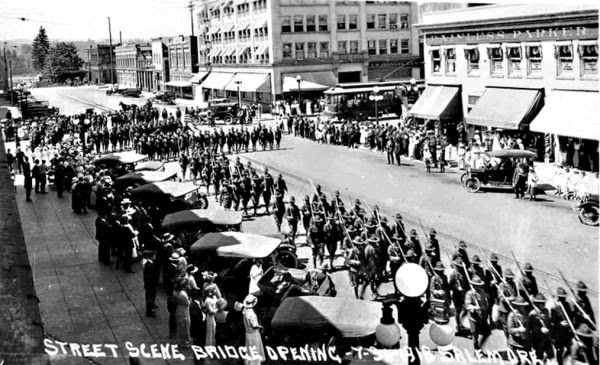
          • The Center Street Bridge across the Willamette is completed in July with a lively parade to celebrate the occasion. A parade of troops marched east on State Street (above) with a caravan of automobiles carrying local luminaries following.
          • Another transportation link is disappointing to Aumsville, Marion, Stayton and Turner. They had asked that 99E go through their towns, providing a more scenic, less hilly route than a new straight highway between Salem and Jefferson. A similar request over the routing of I-5 decades later was also rejected.

          • In November the troops march again to signal the Armistice. Luella Patton drove the family Studebaker in the parade.
          • A. C. Gilbert, former local resident, opens the world's largest toy factory featuring a chemistry set. The Council of National Defense tried to eliminate toy production during the war, but Gilbert successfully fought the ruling. In the press, he earned the name "The man who saved Christmas."
          • Winifred Pettyjohn, a widow at 31, placed her daughters in the care of her parents and enrolled at Capitol Business College "to see what she was 'fit' for". She found she had a flair for salesmanship when the local business world was opening itself to women because of the many men enlisting for service in the war. When the men returned, she was unable to keep her job or find new employment. She opened her own real estate office, beginning a career as one of Salem's outstanding business and civic leaders.
          • At the southwest corner of Market and Summer, a traditional two-story frame residence was built this year. The original owner is not known, but it may have been G. L. Busick who lived there from 1926 to 1940. Mr. Busick was the well-known owner and operator of Busick’s Market in the Bush-Brey Block downtown. In spite of its location on a busy corner of Market and Summer Streets, the grounds and house maintain their original character befitting that prestigious residential area, once the entrance to the city. It is a Local Landmark in Grant neighborhood.
          • Among the victims of the 1918 influenza epidemic is twenty-one year old Eugenia Thayer, the daughter of Estelle Bush Thayer and niece of A. N. Bush, director and owner of the Ladd and Bush Bank. Five years later, after the death of her husband, Estelle returned to Salem, building home on Capitol Street near her brother.
          • The wife of US Senator Charles McNary, the former Jessie Breyman, dies in July as a result of an automobile accident. Mrs. McNary was visiting her family in Salem. Her two sisters, Mrs. Boise and Mrs. Snedecor, also in the car, were only slightly injured. The senator returned to Salem for the funeral which was held in Boise residence on Court Street. (This will be one of seven family funerals performed in that home before it was demolished.)
          From the Capitol Journal:
          • Cooperation of school children was asked by the War Department in the collection of peach, prune and cherry pits as well as nutshells of all kinds needed in the manufacture of gas masks. The Salem Public Library would be the collection point.
          •  Running for the job of City Alderman need not be expensive. Paul V. Johnson got through for 15 cents. A. H. Moore, without previous experience, spent 20 cents for an application blank, but to make sure of his job spent $2 more for cards to pass around. It cost Earl Race just $4 to make the race for City Recorder.
          • Auto hearses of two Salem undertakers met with peculiar misfortunes in November. While headed into a rural area for a body, the Webb and Clough hearse ran off a bridge on 25th Street and overturned. The driver unhurt returned to Salem to borrow the Rigdon's hearse for the call. On the second trip, he got on the wrong road and was stuck in mud for several hours.
          • A lady elevator girl, the first, is Miss Minnie Breeden, working the lift in the Hubbard (Later Oregon) Building.
          (See Ben Maxwell's Salem, Oregon, edited by Scott McArthur, 2006.)