SHINE is a look backward from the present to Salem's 1860 charter. In each year we have four sections: glimpses of what was happening around the world, a special event in Salem, what you see when you visit that site today, and other Salem events of interest that year.


Showing posts with label City Hall. Show all posts

Tuesday, June 29, 2010

Salem in 1972

World Events
  • President Nixon makes historic visit to China, meets Mao Zedong. He signs SALT I and Anti-Ballistic Missile Treaty with Leonid Brezhnev.
  • Five White House operatives burglarize Watergate offices of Democratic National Committee. FBI investigations discovered connection between the Watergate burglars and the Committee for the Re-Election of the President, the official Nixon campaign.
  • Eleven Israeli athletes are murdered in Munich after a Arab terrorist group invades the Olympic Village. Five terrorists and one policeman die in a failed hostage attempt.
  • Okinawa is returned to Japan after 27 years of U.S. occupation. On Guam, Japanese soldier, Shoichi Yokoi, is discovered after 28 years in the jungle, the last 8 years alone after his companions left or died.
  • George Wallace, Governor of Alabama who fought desegregation, is shot and paralyzed at a political rally. He survived, remaining politically active until his death in 1988.
  • Bobby Fischer defeats Boris Spassky in a Reykjavik chess match becoming the first American world chess champion.
  • Worship of Norse gods is officially approved in Iceland.
  • Academy Awards: "The Godfather" (US), "The Discreet Charm of the Bourgeoisie" (France). Prize-winning Books: The Complete Stories, Flannery O'Conner, Angle of Repose, Wallace Stegner.
In Salem
The new complex of municipal offices and public library is complete. A four-year campaign had been launched by Mayor Vern Miller with Wes Sullivan as chairman of a 26-person committee. Citywide “grass roots” efforts were undertaken, especially to decide whether the site would be north of the city along Mill Creek or south of downtown. The bond issue passed and the southern site was selected. Above, a crowd has gathered on August 18 for the dedication of the complex. A band plays in front of the fountain while onlookers watch from the area between the city hall and the library and from the (then) porch of the library. A feature of the modern styled City Hall structure is a landscaped interior courtyard. The Civic Center also contains publicly owned art works. This collection was begun this year with a Mayor's Invitational Mayor's Invitational exhibition when the Civic Center first opened. The Peace Plaza is a beautiful open space between the City Hall and the Salem Public Library.

When you visit
There is now a third major building of our Civic Center, a parking garage with entrances from Liberty Street and Leslie Street. A short walkway leads to the main entrance of the library. As patrons enter, they enjoy "In a Quiet Meadow"; statuary by Delbert Hodges donated this year when the library opened. Salem's art collection is now displayed throughout the Civic Center, on the lawns and plazas, in the corridors, offices, meeting rooms, in both the Library and City Council Chambers. This is an important local artistic and historic resource. The Salem's Civic Center Art Collection, as it was in 2000, is listed on the Salem History website.
City Hall of the Vern Miller Civic Center houses several of the nine municipal departments including Administration, Finance, Legal (Municipal Court), Human Resources, Police and Community Development. The headquarters of the Fire Department is in Fire Station #1 across Pringle Creek on Trade Street. Other departments such as Public Works, Urban Development, Information Technology are housed elsewhere.
Citizens have the best opportunity to learn how the city government operates by attending City Council meetings. At the meetings, citizens may testify about issues they wish to support or of concern. Another way to effect city programs or services is by volunteering to serve on one of the more than twenty Boards and Commissions. Information about vacancies on Boards and Commissions is found on the city's website.

Other events
Photograph from the collection of Marylou Green
  • In the night before demolition, the clock in tower of the empty 1893 City Hall has stopped at 1:17. The tower of the 1893 City Hall is the last part of the building to be demolished.


 Unoccupied Dalrymple House awaiting move. Separated floors aloft. The crash!
  • On Marion Street, the unoccupied 1863 Dalrymple House awaits its fate. In preparation for moving the Italianate-style house, the two floors were separated. As a first step in the removal process, the second floor is lifted over the street by a crane, but it crashes to the pavement. A Statesman Journal photographer catches the moment of this spectacular accident. James Dalrymple and his wife had three daughters who married into prominent Salem families, leaving many local fourth-generation descendants.
  • Sprague High School, named for former owner-editor of the Oregon Statesman and Oregon governor Charles Arthur Sprague (1886-1969), is dedicated at 2373 Kuebler Road South. Among the guests present on the stage for the dedication on December 3 were Mrs. Martha Sprague Hurley, Mrs. Blanche Sprague, Wallace Sprague and Wesley Sullivan. Bill Kendrick, Salem Superintendent of Schools, and Don Dubois, the principal, conducted the ceremonies.
  • Eola Village is typical of housing for migrant labor that harvests crops outside the city. The Community Conservation Committee inspects the area for low income Turnkey Housing in Northgate Village.
  • On the Capitol steps, Governor McCall meets with employees after a shutdown of paper production at the Boise Cascade plant.
  • The Grier Building is erected at the former location of the 1842 Jason Lee House. A plaque inside commemorates the importance of this historic site.
  • South of Trade Street, urban renewal is creating new buildings and parks where there had been canneries along the south side of Pringle Creek. Groundbreaking ceremonies are held for the parking structure and the SAIF building construction begins. These downtown development projects would continue for three years.
  • At the Liberty Street bridge over Pringle Creek, Sambo's is a popular restaurant. Built before 1969, it was originally "Little Black Sambo's", the name taken from a children's book about a South Indian boy's encounter with four hungry tigers. The Tudor Rose replaced this restaurant in a few years. Waterplace has now (2010) been built in this site.
  • On the northeast side of the same bridge, construction begins on Pringle Park Plaza.
  • Neighborhood Associations are established. City Neighborhood Services Specialists and staff liaisons from the city assigned to assist neighborhoods with communications, obtaining information, and better organizing. Faye Wright , an area annexed to the city only 10 years before, is organized this year. The 1920s house (photographed in 2007) is associated with the Frank Hrubetz family for whom the road was named. Two other houses on the same street, at 235 and 230, are associated with this family and research continues. Another significant historical property is the Chesley house at 225 Boone Road. Asked about the neighborhood , Wendy Pyper, Chair in 2010, gave this description: " Thanks to the efforts of Phil Webb and Dean Orton, our association was created so residents would have more influence in land use issues affecting our area. It is alive and well today! Our neighborhood is a mix of apartments, affordable to up-scale single family homes, good schools and churches, parks and businesses. Populated by a diverse group of wonderful people, we have a low crime rate and few issues of concern. We believe this is one of the best places in Salem to live, work and play!"


Friday, June 25, 2010

Salem in 1970

World Events
  • The Nuclear Non-Proliferation Treaty is ratified by 56 nations.
  • Norway announces rich oil deposits found off its North Sea coast.
  • Four students are killed and nine wounded at Ohio's Kent State University during a protest against the U.S. extending the Vietnam combat into Cambodia.
  • Earth Day is inaugurated; Environmental Protection Agency created; Clean Air Act passed in Congress. Norman E. Borlaug is awarded the Nobel Peace Prize for his contributions to the "Green Revolution".
  • Wichita State University football team's "Gold" plane crashes on the way to Utah State game. 29 died including starting players, coach, athletic director and wives.
  • Soviet author Aleksandr Solzhenitsyn, who helped raise global awareness of the Gulag forced labor camps of Russia, is awarded the Nobel Prize in Literature, but declines to go to Stockholm for fear he would not be allowed to return to his family.
  • The wreck of the Confederate submarine Hunley is found off South Carolina. It was the first submarine in history to sink a ship.
  • Academy Awards: "Patton" (US), "Investigation of a Citizen Above Suspicion" (Italy). Prize-winning books: them, Joyce Carol Oates and The Collected Stories of Jean Stafford, Jean Stafford.


    In Salem
    The Salem Public Library is part of the new Civic Center being built on a hill south of Pringle Creek. Hugh Morrow was completing a thirty-three year career with this visionary project that will be completed before he retires in 1972. Mr. Morrow came to Salem in 1939 as director of the Salem Public Library. He had a great interest in history, was a member of the Oregon Historical Society and a founder of the Marion County Historical Society. He was the first president of the Oregon Library Association and secretary of the Downtown Rotary Club for 15 years. Mr. Morrow died July 20, 1990. He was an outstanding cultural leader and an honored member of the Salem community.

    When you visit
    Mr. Morrow is remembered at the library today by a collection of historical materials. These shelves contain not only books and pamphlets about Salem, many by local authors, but our City Directories including editions from the 1890s to the most current. For anyone doing genealogical or historic property research, these resources are invaluable.

    Other Events

    City Council Meeting photograph from Salem City Library collection
    • 1970 City Council meetings are conducted with a slightly different physical layout than in the Civic Center of two years later. Mayor Miller, City Administrator Moore, and the city attorney are seated on a raised platform at the front of the chamber with four councilors on each side (as would be continued). Directly in front of the mayor, also facing the public, sit the city recorder, Betty Marsh, and secretary to the administrator, Mary Brady. Historically, the City Recorder had an important position in Salem city government, keeping records of meetings, being ex-officio clerk of the common council and assessor. The recorder previously had jurisdiction over all violations of city ordinances and presided in the absence of the mayor. It was an elected office from 1857 to 1964 when it became a position appointed by the City Administrator. Voters approved an amended charter in May 1996 and in June 1996 an ordinance was passed that created the office of City Recorder with in the legal Department.
    • A new fire station on Lansing Avenue is completed in May. The Lansing area had been annexed into the city in 1920, but it had remained rural farmland until after the accelerated residential boom of the 1950s and 1960s that transformed farmlands surrounding the city into suburban neighborhoods. Because of the increased population between Market Street and Silverton Road, Lansing would, in 1973, become one of the first neighborhoods to become a recognized association.
    • In July, a photographer snaps a dramatic picture of the traffic congestion on the Center Street Bridge ramp as cars make their way into Salem. The problem of traffic crossing the Willamette River remains a concern. Emergency access has been partially relieved by the project to remodel the Union Street Railroad Bridge and Trestle for pedestrians and bicycles. It was approved by the City Council when the plans included a provision for emergency vehicle use. A "Third Bridge" has been in the planning stages for a number of years and will need considerable federal financing to be a future reality. In 1966, a Citizen's Advisory Traffic Commission was established that meets to address all concerns about traffic on our roadways and make recommendations to the City Council in the area of traffic movement and safety. The nine appointed members meet as needed, usually on a Thursday at 7 pm. Residents are encouraged to apply for volunteer service on this important Salem commission.
    • In November, a groundbreaking ceremony is held to begin the construction of the new Statesman Journal building at the corner of Chemeketa and Church Streets. (The building is for sale in 2014.)  A photograph features Jenny Mainwaring, Blanch Sprague and Wendell Webb. The construction of this building completed the transformation of the former residential area east of Church Street into commercial properties. During the previous thirty years, during the expansion of the state buildings north of the Capital and the relocation of the First Presbyterian Church, the substantial homes of many prominent citizens were either demolished or moved to other sites. Fortunately, the Court-Chemeketa Historic Residential District, between 13th and 18th streets, has preserved a flavor of an early Salem urban neighborhood and recorded the history of many pioneer families.
    • Miller's Department Store closes in the historic Reed Opera House. When the Odd Fellows Hall and Grand Opera House was built in 1900, the auditorium space in the Reed Opera House was converted to Joseph Myers and Sons store. New stores adjacent to the former opera house included E.P. McCormack's smaller building to the south and the new J. C. Penney store. Liberty Street soon surpassed Commercial Street as the hub of local shopping. In 1920 Miller's department store took over the Myers store and later the entire building, creating an enterprise supplying fashions and household products in a family shopping environment typical of the next 30 years. Salem seniors still remember their youthful fascination with the system of vacuum tubes that controlled cash payments in the years before credit cards and electronics. After the close of Miller's, a major rehabilitation of the retail space would not occur until 1976.
    • Christmas lights on a temporary tree decorated the old City Hall for the last time in 1970. In 1913, Salem had the first outdoor tree in the United States to be decorated with Christmas lights. The Marion County Courthouse tree was a Norway spruce tree planted by Judge J. J. Shaw in 1882. Over the years, this tree had been featured in many photographs of the old courthouse.

    Wednesday, June 16, 2010

    Salem in 1963

    World Events
    • In January, Alabama Governor George Wallace proclaims "...segregation now...tomorrow...forever!" During April and May, in Birmingham, Martin Luther King, Jr., other black leaders and demonstrators, many children, are arrested. In June, President Kennedy promises a Civil Rights Bill. In August, Martin Luther King, Jr. delivers "I Have a Dream" speech in Washington, D.C.
    • In June, Kennedy gives his "Ich bin ein Berliner" speech in Germany.
    • Travel and all other transactions with Cuba are made illegal.
    • In November,  John Kennedy is assassinated in Dallas, Texas. He is buried in Arlington  Cemetery.
    • Lyndon Johnson becomes president.  His "Gulf of Tonkin" resolution in Congress escalates US  involvement in the Vietnam civil war.
    • Zip codes are introduced in U.S. AT&T makes push-button phones available. Viewers see improved instant-replay in TV sports broadcasts.
    • Country music star Patsy Cline dies in a plane crash. Betty Friedan's The Feminine Mystique sparks women's rights movement. Beatles' songs are released in the U.S. creating international  "Beatlemania"
    • Academy Awards:"Tom Jones" (US), "8 1/2" (Italy). Prize-winning books: Morte d'Urban, J. F. Powers and "The Reivers", William Faulkner.
      In Salem
      The Capital Manor Retirement Center has been completed and the first residents moved in. Built along the highway to Dallas in West Salem, its 10 floors contain 255 apartments with views of the Willamette River. From its first construction, it was the largest and best known of the retirement facilities in this area.
      The recent photograph shows landscaping and physical improvements that have softened the appearance of the structure. There are other additions to the retirement center including eighty-three villas added in 1987 and town houses added in 1994. Also incorporated over the years are a health care center, assisted living units, an indoor pool, fitness center, bank branch, computer lab, beauty salon, and auditorium.

      When you visit
      At Capital Manor or at other local retirement facilities, you may be visiting members of your own family or friends of many years. They have selected to live in a new environment with fewer household responsibilities or are in conditions of health that require assistance. Another factor in the benefit of a retirement facility is the fact that families today are often divided by distant career opportunities for the younger generations: senior citizens rarely live with adult children as was the custom in the past. The retirement home is a new social community and one visits friends or family there just as conveniently as at any former residence.

      Other events
      • After the disastrous Columbus Day storm in the previous year, restorations of properties in Salem continue for many months. Willson Park is a major project and a sign indicating a possible time line for completion of various elements of repair is posted for public information. The work was done by the City of Salem's Regional Park Agency. Soon thereafter, the park was transferred to the State of Oregon that is still responsible for its maintenance.
      McMahan House on Front Street after storm
      Buren House on Court Street after storm
      • Because of damage, the McMahan/McCully house on Front Street, then owned by David Duniway, is removed to John Street for a restoration. The house had been erected by David McCully in 1864 and purchased by Judge L. H. McMahon in about 1900. Mr. Duniway was Oregon State Archivist and a leading Salem proponent of historical preservation.
      • Another residential victim of the windstorm was at 745 Court Street. An uprooted fir tree caused considerable damage to a three-story Tudor style house. The porch roof and the railing of the balcony above it sustained the most damage. A photograph taken at that time, shows the shallow roof system of the uprooted tree. The residence was razed two years later for the expansion of the Presbyterian Church buildings along Court Street. The home had been built in 1907 for a prominent Salem family, the Max Burens.
      • The Jason Lee house, in its original location at 960 Broadway, is stripped of additions and prepared for a move to a temporary site while awaiting a permanent home. It was later moved to Mission Mill property, now Willamette Heritage Center.
      • Another historical structure that is moved this year is the John Boon house. It was located originally next door to the Boon Store, now Boon's Treasury, a McMenamins restaurant enterprise. The historic residence was also relocated to Willamette Heritage Center.
      • Horse racing was still a traditional entertainment at the Oregon State Fair in Salem in 1963. The grandstand looked over the Lone Oak raceway with horse barns across the track.
      • Woodry's Furniture Store at 474 Commercial Street in downtown Salem suffers a major fire during the night of June 16. The store carried furniture, appliances, floor coverings and all types of household furnishings. It had been in business at that location since 1947.
      • A fire also destroys the historic barn on the city-owned Bush Park property. It was the only building that pre-dated the 1860 purchase of the farm property from the Pringle family. It was rebuilt to resemble the original structure and is a part of the National Register Bush Park. Salem Art Association uses the building for offices, galleries and a shop.
      • J. C. Penney moves north to a new location at 305 Liberty Street. The Nelson Building, on the northwest intersection with Chemeketa Street was torn down for this new construction. The Grand Opening of the new facility would not be until 1965. Meanwhile, the former Penney's becomes the Metropolitan, a variety store.
      • Old City Hall was showing its age, and a bond measure referred to Salem voters on February 23, 1963, to build a new facility. Condemned by the Public Works Department as a fire hazard, the City Hall also had critical space limitations, forcing various City departments and agencies to seek office space elsewhere in town. Because the elevator often stalled between floors, employees joked it had been "installed by Mr. Otis himself." The bond issue failed, but its publicity alerted Salem residents to the realization that the old building was nearing its demise.
      • In accordance with a state regulation, Salem creates a Citizen Budget Committee. The members are the City Council and nine appointed citizens representing the wards of the city and one member-at-large. Their duty is to examine, analyze and recommend an annual budget for the city. The committee conducts public meetings in Council Chambers for about 6 weeks in April and May. The public is welcome to attend and testify on matters of concern or may watch on CCTV. In 2008, the City Manager, Linda Norris, held a series of four community meetings, in advance of the Budget Committee sessions, in order to inform Salem residents of the current budget priorities and to hear comments from attendees. One of these was conducted in Spanish to accommodate residents who are more comfortable discussing civic matters in that language.

      Wednesday, March 24, 2010

      Salem in 1903

      World Events
      • With U.S. encouragement, Panama proclaimed independence from Colombia. Several different treaties between U. S. and Columbia (and then Panama) in what was called "gunboat diplomacy" were necessary until  U. S. had the authority to build a canal across Isthmus of Panama. (Roosevelt's popularity leads to toy bear being called the "Teddy Bear".) 
      • Cuba leases Guantanamo Bay to U. S. "in perpetuity".
      • The Russian Social Democratic Labor Party splits: Bolsheviks (Russian word for "majority") and Mensheviks ("minority").
      • The Wright Brothers make the first successful petrol-powered, heavier-than-air flight at Kitty Hawk, North Carolina.
      • The first Tour de France bicycle race is won by Maurice Garin. In the first World Series, the Boston Red Socks defeat the Pittsburgh Pirates in 8 games. The first stock car event is held at the Milwaukee Mile.
      • Crayola crayons are introduced, 8 colors in a box for 5 cents.
      • Best New American Books: Call of the Wild, Jack London and The Ambassadors, Henry James. For children: Rebecca of Sunnybrook Farm, Kate Douglas Wiggins.
        In Salem
        The city welcomes President Roosevelt who speaks to our Legislature in the State House. In this photograph he is leaving as a group of top-hatted gentlemen walk along, Governor Chamberlain to his right. The local star of the day was our own soprano, Hallie Parrish Hinges, who sang the National Anthem for the thousands who were present to hear his speech. Her clear soprano, it was reported, could be heard as far away as the top of High Street hill eleven blocks away. President Roosevelt said to Governor Chamberlain, "She has one of the most beautiful voices I have ever heard. Have her sing again." Hallie responded by singing a favorite of the time, "The Flag Without a Stain," and soon the president wiped his eyes, asked for her name and said, "Truly, she is the Oregon Nightingale." This was the second time Hallie had sung for a president: she performed for Benjamin Harrison in 1891. In 1911, she gave her third presidential performance. Standing beside William Howard Taft in an open, touring car (surrounded by secret service men), she led a group of school children in serenading the top-hatted president on Court Street.
        Mrs. Hinges was the granddaughter of Josiah Parrish, a Methodist missionary pioneer of the "Lausanne" party of reinforcements in 1840. He was noted for his work among the Indians to whom he was known as "the man of peace". He was awarded the one-mile square donation land grant that was the northeast section of the four-mile Salem distribution. The Lee Memorial Cemetery, where many pioneers are buried, was begun by his family on their land. His 1860s Capitol Street home (across from the school that honors his memory) was relocated to the A. C. Gilbert Discovery Village on Water Street in 1990 due to the construction of the Oregon State Archives. Hallie's parents were Norman O. Parrish and his wife Henrietta. She married Dr. Charles H. Hinges and had two children, Karl and George.

        When you visit
        If the popular "Teddy" left any other memento of his visit except this photograph, none is known. The State House burned in 1935 and has been replaced by a modern structure, unlike this classic building.
        Governor Chamberlain, whose wife did not wish to leave her home in Portland, rented a room in the Cooke-Patton mansion across the street, now the site of the Oregon State Library. He resigned in 1909 when elected to the US Senate.
        Long a favorite performer at Oregon vocal events, Hallie Hinges died in 1950 at the age of 82. A home associated with her family (and later Samuel Kimball) was at the SW corner of Chemeketa and Summer Streets. In 1938 it was removed due to construction for the State Library. It has since moved twice due to the expansion of the North Capitol Mall and is now at 1075 Capital Street, NE.

        Other events
        • The city grows for the first time since its incorporation: annexations include all of the present Grant neighborhood, the south half of Highland, almost all of NEN, SESNA to about the present Airport Road to the east and SCAN to Rural Street on the south. The 5th, 6th and 7th wards are added, bringing the number of Aldermen to 14, two for each ward.
        • The first Cherry City parade is organized, sponsored by the Elks Club. Its lodge hall was the State Street structure that is now the Micah Building of the United Methodist Church. Agnes Gilbert was named Cherry Festival Queen. Fifty-three years later, as Mrs. B. O. Schucking, she became Salem's First Citizen.
        • A public library committee is formed with the first collection of books in a room of the City Hall.
        • The Queen Anne-styled Ada and Mark Skiff Block, just east of Liberty on Court Street, is completed. It will be used as commercial shops and offices, but not for the Skiff family. Dr. Lansing F. Skiff was one of the first dentists in the Far West, a so-called "circuit rider" of dentistry. He was also one of the first dentists in the United States to use a water motor in the in cleaning teeth. He founded the Oregon State Dental Society. His son, Mark, followed in this profession and reportedly set the first gold crown in Salem. Neither dentist practiced in the building. It is included in the SHINE Downtown walking tour.
        Cole-Jewett House

        • At 1020 16th Street, a Queen Anne residence is built, probably by Vincent Cole. In 1911, the large, many gabled residence was purchased by George and Hattie Jewett who lived there for forty years with several other adults of their family. After the mid-forties, the property was subsequently sold to a succession of owners: Thomas and Frances Moisan, Mrs. Stella Ashton and Arnold and Mary Unger. Well maintained with its original architectural integrity, it stands in a mature landscape with other houses of similar age. It is an outstanding local Landmark in the NEN neighborhood.
        Mystery House moved from Ferry Street to 17th in 1903
        • Another residence is moved in that neighborhood: from Ferry Street (directly behind the Methodist Church) to 17th Street. north of Mill Creek. A few years ago, a lady came to the house and said she (or perhaps her relatives) had lived in the house after its relocation here in 1903 when the owners placed it here and sub-divided the several acres around it ~ constructing the street that runs along the north side of the creek and selling lots for other houses.
          We hope the owner will continue research so we may learn the names of earlier owners of this house and its history. This may be the oldest residence in Salem.
        • South of the city, in the Ewald Fruit Farms (now 3915 Liberty Street South), a hilltop farmhouse is built among the orchards. It may have been on the Chapman land in the 1920s, but 1951 was the home of Robert D. Taylor and his wife Hope. He was president of the Salem Brake and Wheel Alignment Company. By 1976, he had retired and this was the last year his name appeared at this address. No other research has been done on this house that is now a rental.
        • The first automobile, an Oldsmobile, is brought to Salem by Otto J. Wilson.

        Friday, March 12, 2010

        Salem in 1895

        World Events
        • Between 1894 and 1896, the Hamidian Massacres of Christian Armenians resulted in hundreds of thousands of deaths as the Sultan Abdul Hamid II reasserted Islam as the state ideology. Targeting all ages, the murders were especially brutal. The telegraph spread news of these crimes around the world and the massacres were condemned in Western Europe and America.
        • The Kiel Canal, connecting the North Sea to the Baltic across the base of the Jutland peninsula in Germany, is completed.
        • Wilhelm Roentgen discovers a type of radiation that will be known as X-rays. Sigmund Freud publishes his theories on mental illness.
        • The National Trust for Places of Historic Interest or Natural Beauty s registered in England. This is the fore-runner of our National Register and regional projects to preserve historical properties.
        • The Chicago Times-Herald sponsors the first American auto race and Rudolf Diesel patents his engine in Germany. Mintonette (volleyball) is created in Holyoke, Massachusetts.
        • Gillette invents the safety razor.
        •  The author of "Casey at the Bat" is identified when Ernest Thayer recites it at a Harvard reunion. This baseball poem has become one of the best-known in American literature,
          In Salem 
          The new City Hall, splendid in High Victorian Gothic architecture, is completed after two years of complications: both a national economic recession and local problems with construction contracts and bond funding. The structure would serve to house all the City offices, including the police department (with jail in the basement), until 1972 when the current Civic Center was built on Liberty Street. More photographs and facts are found in the Salemhistory website.

          When you visit 


          The site of the former City Hall is now a quarter-block parking lot on the southwest corner of Chemeketa and High Streets. An interpretive plaque commemorates this historic location. Standing here, looking west toward Liberty Street, you see the rear of the 1947 First National Bank (later the Wells Fargo Bank) designed by Pietro Belluschi. The parking lot and that former bank building constitute a half block area that is proposed for a future mixed-use development. Since the structure is a contributing property in the Salem Downtown Historic District, permission for demolition was requested and obtained from the city's Historic Landmarks Commission. No date for the project has been set.

          Other Events


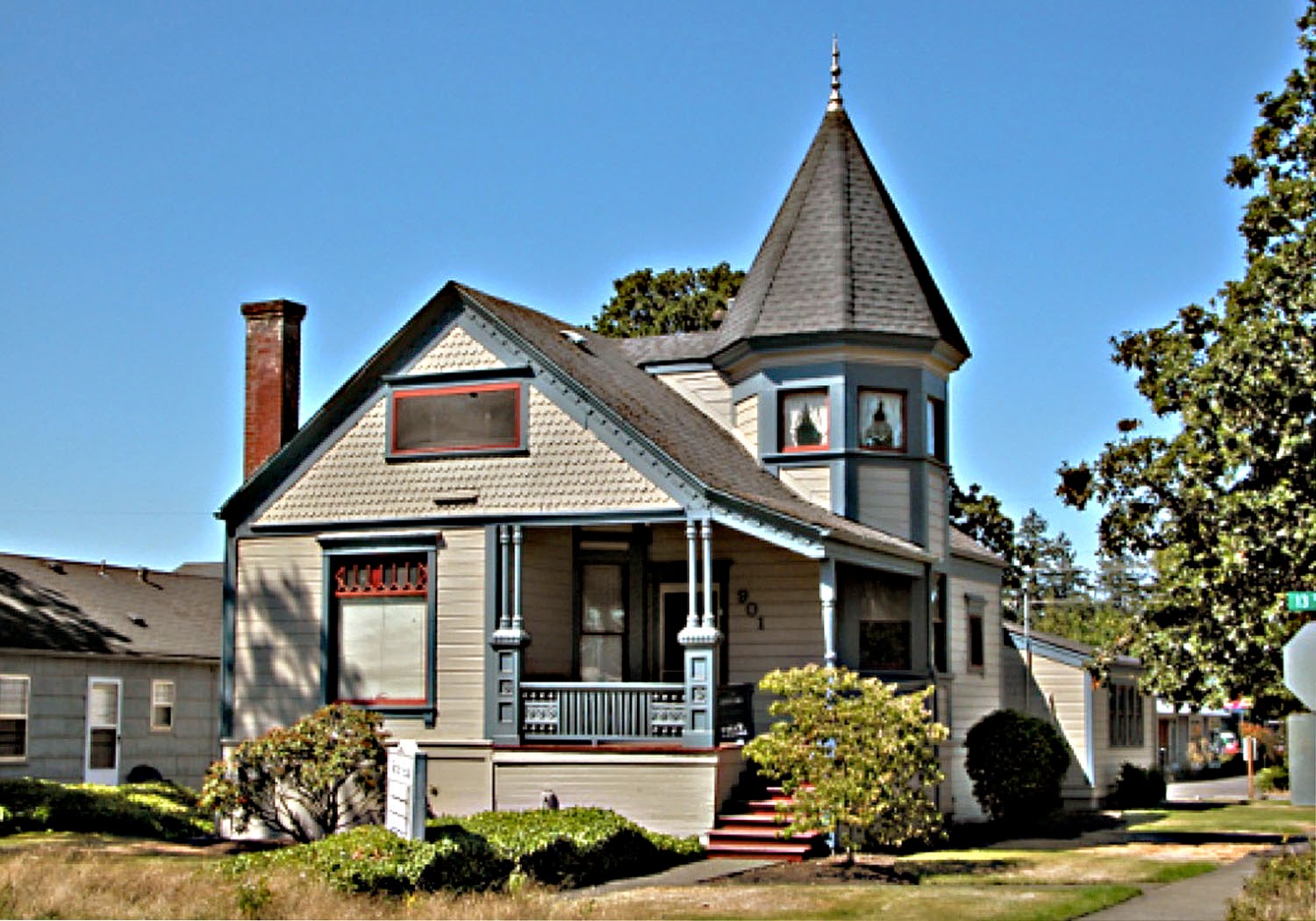
          • As the century of beautifully crafted Victorian homes ended, a few more were being built in Salem. Driving north along 13th. Street, a former residence at 901 (above) is an outstanding example of the houses being built in Salem for the prominent citizens of that time. This Victorian Queen Anne residence was designed by architect Charles Henry Burggraf as his own home. It was later the residence of Judge Daniel Webster, Justice of the Peace in Salem 1905-1918. The third owner was Julia Webster, the Judge’s daughter. It was also the home of Thomas P. Burt, a railroad engineer. This National Register property is an example of a historic home being converted into an office without altering its integrity.
          • Two other Victorian, Queen Anne style houses built this year, both homes of teachers, have been preserved. The Barquist House was originally on Mission Street where, from 1927 to 1967, it was the home of Carmelita Barquist, a popular high school biology teacher. In 1989 it was moved to Court Street. (See it in the SHINE Court-Chemeketa Walking Tour.)  The Hurd House is still in its original location on Marion Street. Originally a rental property, it was purchased by the Hurd family in 1921. Confred Hurd was a teacher at Washington School. These houses are still private residences.
          • More typical of the Colonial Revival or Craftsman style homes to be built at the turn of the century are two Court-Chemeketa Historic District homes. The John and Kate Griffith house is on Court Street, across from a residence owned by their son Lewis and daughter-in-law, Ila Spaulding Griffith.  Her sister and brother also owned homes in this neighborhood (See Spaulding 1909). A grandson, Dr. John Griffith, has lived in his parents home all of his life. A beautiful Japanese maple, designated a Heritage tree in 1982, stands in front of the John Griffith house. The Weller-Schramm House on 17th Street was built in this year on the site of the Supreme Court Building on Waverly Place. It was moved in 1916 for the new owners, the Weller family. In 1944, Pietro Belluschi remodeled the house for Alfred and Lucille Schramm. These are also seen on the SHINE Court-Chemeketa Walking Tour.
          From the Capitol Journal:
          Rev. G. W. Grannis, in a discourse for men only held at the Salem YMCA, said that lust was the sin of Eden, that 999 persons out of 1,000 in the race of mankind were products of lust. He denounced the existing condition of matrimony as little better than legalized licentiousness.
          A new town hall for West Salem with a seating capacity for 300 and costing $500 was dedicated. West Salem people in attendance were told by their speaker that if they behaved themselves and continued to improve morally, then they would someday be annexed.
          These prices prevailed at Strong's restaurant: hot cakes 5 cents, ham sandwich 5 cents, three doughnuts 5 cents, pigs feet 5 cents, fried mush 10 cents, Swiss cheese sandwich 10 cents, eggs any style 10 cents.
          In women's fashions, the newspaper stated: "The refined woman is one who avoids exceedingly bright colors for any garment worn on the street. Her gowns are characterized by texture. Indeed, one of the requisites of all her belongings is that they be of as fine as quality as her own nature."
          (See Ben Maxwell's Salem, Oregon, edited by Scott McArtur, 2006.)

          Wednesday, March 10, 2010

          Salem in 1893

          World Events
          • Hawaiian Queen Liliuokalani attempts to re-write the constitution but a Committee of Safety, led by American businessmen, place the queen under arrest and overthrew the Hawaiian monarchy.
          • The Second Irish Home Rule Bill passes in British Commons, but is defeated in House of Lords.
          • Grover Cleveland, 22nd. President, is sworn in as 24th. Only president to serve two non-consecutive terms. 
          • The World's Columbian Exposition, the Chicago World's Fair, opens.
          • A crash on the New York Stock Exchange starts a financial depression.
          • Lizzie Borden is acquitted of murdering her parents.
          • At a special meeting of the American Historical Association, historian Frederick Jackson Turner presents his essay, "The Significance of the Frontier in American History". His theory is that the opportunities and the fascination with our frontier and, especially the expansion of the American west, has shaped American character and culture.
          • The Hill sisters copyright a book of children's songs, one of which is later published, without authorization,  as "Happy Birthday to You". (They win a copyright lawsuit in 1934.)
          In Salem
          The city is taking new responsibilities as the Fire Department moves from a volunteer to a paid force. Firefighters on duty this year are shown above as they were photographed that year. The end of the volunteer era actually began in 1883 with the introduction of Salem's first steam fire engine. After the introduction of horses to Salem Fire Department in 1889, there was no longer the need for a 220-man force. It was reduced to 14 paid firefighters and a handful of volunteer "call men". The new, paid fire department responded to a fire on March 15, 1893, at the Wilson residence at Center Street and Liberty Street. The fire was caused by a defective flue and the damage only required a $5 repair. Salem Fire Department responded to 10 fires this year, but two calls were false alarms. The total dollar loss in the City of Salem due to these fires was $110.


          When you visit
          Salem currently has four Fire Station museums. You may glance at the historic equipment through the street-front windows, or make an appointment through Fire Station #1 and enjoy a guided tour of any museum. Closures of several stations, due to budget cuts, may effect when visiting times are available.

          Other events
          • Mayor Gatch proposes a site for municipal offices on High Street, but a report of the city attorney suggests a city hall at the west end of Willson Avenue [now Willson Park]. The mayor prevails, but depressed economic conditions cause a two-year delay in completion of the new City Hall.
          • On Mill Street, George Eyre builds a residence, seen above as it looked in 2007. It is now a SESNA neighborhood Local Landmark. The Vernacular Queen Anne house had two owners in the ten years before George Eyre purchased it. In 1893 Mrs. Martha J. Atwood acquired the lot and the house was built for her. In the next year, her daughter, Linnie, married A. A. Lee in the new house. Mrs. Atwood sold the property to J. D. Trammel in August of 1903, and Mr. Trammel sold it to George and Ida Eyre a year later. It remained in the Eyre family from 1904 until sold by the daughter, Mary Eyre, in 1996. Mary was a well-known teacher who lived there most of her 101 years. Her brother, David Eyre, a banker with Ladd and Bush, lived on Summer Street in Piety Hill. In the 1940s, his home was part of the evacuation of residences for the construction of the state buildings in North Capitol Mall. The house was purchased from the state and moved to the northeast corner of Mission and High Streets. It is in the Gaiety Hill/Bush's Pasture Park Historic District of the SCAN neighborhood.
          • Thomas Cronise leaves his occupation as a printer and joins his sister Anna in a photography business. Though the 1920s, his studio set the standard for Salem photographic portraits of city life.
          • The state spends $11,000 upgrading and renovating the State Fairgrounds, adding new a new water system, floral garden and a mile-long racetrack.
          • A copper-clad dome is added to the State House, completing the structure and adding to the dignity of this classic building. For more than forty years the dome was a photographic symbol of the Oregon capitol city.
          • This year Johnny Jones is among the few "colored" residents of Salem this year named in the City Directory. Jones was listed as a 47 year-old mulatto working on the steamboat, Willamette. His 16 year-old daughter Mollie was "in school". Another member of his family in Salem was his sister Anna Smith who was doing housework and day labor. Jones later gained considerable local fame as a caterer of style and talent: if you were fortunate enough to secure his services, you were considered a success socially.
          Ben Maxwell recalled concerns of moral rectitude:
          In an April ministers' strike, clergymen refused to serve state institutions until a more adequate pay was available. Authorities offered ministers $2.50 for a penitentiary service, $4.00 for one at the asylum or reform school. The ministers insisted that the dignity of their labor deserved a better reward. Five dollars a service would be acceptable to them.
          In July, patrons near the windows north of the Hotel Willamette dining room complained that the business block across the street possessed a full-fledged bawdy house with windows draped in red to attract attention. Vigorous protests were voiced.
          In November, church people were demanding that the council enforce ordinances regulating Salem's saloons and were circulating petitions asking that the license for Bill Anderson's Elkhead Saloon at 217 South Commercial Street be revoked. However, it was noted, when the good folks of Salem were seeking support for some worthy charity, the hat was usually passed at this saloon.
          (See Ben Maxwell's Salem, Oregon, edited by Scott McArthur, 2006.)

          Monday, February 23, 2009

          The City Hall as Art

          Eric asked, "Has anyone in Salem ever done a temporary installation by projecting a film or film loop on a building to be demolished?"
          No, I can't remember that happening in Salem, Eric, but why wait to use demolition as an occasion for art? Here's the Barcelona City Hall splashed with color from one of many projections during in evening of celebration last September.
          When and where can we do this?