SHINE is a look backward from the present to Salem's 1860 charter. In each year we have four sections: glimpses of what was happening around the world, a special event in Salem, what you see when you visit that site today, and other Salem events of interest that year.


Showing posts with label Capitol Theater. Show all posts

Friday, July 23, 2010

Salem in 1990

World Events
  • The US invades Panama. Manuel Noriega is deposed as leader and surrenders to the American forces.
  • After 26 years in prison, Nelson Mandela is freed. South Africa ends segregation of libraries, trains, buses, toilets, swimming pools, and other public facilities.
  • Iraq, led by Saddam Hussein, invades Kuwait: the  UN intervenes.
  • German reunification  begins as East Germany and West Germany merge their economies with the West German mark being the currency for both. 
  • The Supreme Soviet approves changes to create a U. S.-style presidency: Mikhail Gorbachev elected. He is awarded the Nobel Peace Prize for his efforts to reform his nation.
  • Juan-Bertrand Aristide is elected president of Haiti, ending 30 years of military rule.
  • US companies will on longer buy tuna caught in nets that trap dolphin.
  • President Bush signs the Americans with Disabilities Act (ADA)  to protect disabled Americans from discrimination.
  • Academy Awards: "Dancing with Wolves" (US),"Journey of Hope" (Switzerland). Prize-winning Books: Middle Passage, Charles Johnson and The Mambo Kings Play Songs of Love, Oscar Hijuelos.
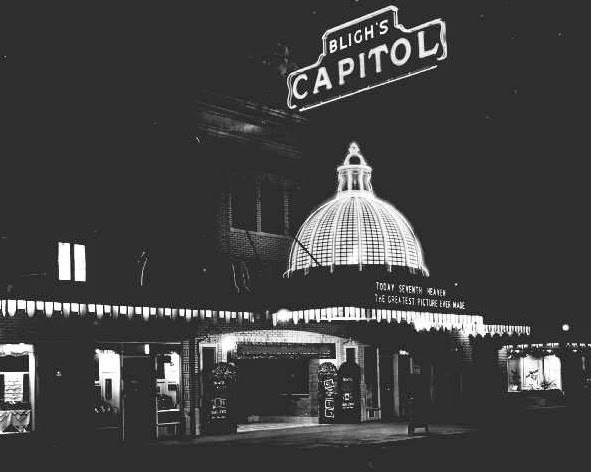
Salem's Capitol Theater at Night

    In Salem
    The Capitol Theater, here easily distinguished for the lighted dome of its marquee, closes this year. Twenty years later, even for residents who did not live here then, it is sad that such an attractive feature of downtown life could have been extinguished. However, when this theater and the Elsinore (around the corner on High Street) were built in 1926, silent movies were quite an exciting advance in entertainment. "Talkies" were the sensation of the early 1930s. Going to the movies continued to be the favorite leisure entertainment through the Depression with tickets only a dime. Movies we look back on as classics date from the late 1930s: "Gone with the Wind", "Wizard of Oz", "Grapes of Wrath". These were followed during the early 1940s by "Citizen Kane", "Casablanca" and "Mrs. Miniver". Then came young Elizabeth Taylor in "National Velvet", Ronald Reagan in "Kings Row" and the unforgettable duo of Bogart and Bacall in "To Have and Have Not".
    But the public found it more convenient to stay home once TV entertained the family in the living room. By 1956 was announced that downtown Salem would be served by only two movie houses during the winter and that the Capitol and the Elsinore would operate only at night, except for Saturday and Sunday afternoon matinees. Movie theaters have gradually changed to suit special audiences, but the older houses like the Capitol were not able to adjust and so closed.

    When you visit
    Take a walk east on the south side of State Street, crossing High. The first structure you pass will be the Bligh Building (now a restaurant) and then there is a small parking lot. Look at the back of the lot and you will see the impression of the theater building that is no more.

    Other events
    The Davis-Karn House on Hollywood Drive
    • The NOLA (North Lancaster Association) neighborhood association is organized this year. One of the main residential streets is Hollywood Drive, between Sunnyview and Silverton Road. Above: This beautiful 1925 home looks like a movie set: the French windows that line the front of the house make one imagine Fred Astaire is about to dance out with Ginger Rogers. Walter Davis built the house according to the design of his wife Ella, who loved to read "movie magazines", according to her niece, Edna Munson Karn. Edna's family lived with her grandparents on their farm, also on Hollywood Drive. Edna (with her brother and sister) moved in with the childless Davis couple when their own parents moved to West Salem for orchard work during the Depression: the children wanted to continue at Parrish School. Edna met David Karn at the Crystal Garden ballroom and after their marriage in 1947, they lived in a house they built next door to this property. They moved into this house in 1982. The fifth generation of the family visits to enjoy this park-like property in NOLA.
    •  North Gateway Redevelopment Board is established this year as a citizen group to advise the city on North Gateway Renewal Area projects. This 902-acre renewal area centers on Portland Road, once the main highway between Seattle and San Francisco. After the I-5 construction, the area had lost business opportunities and transportation problems that included poor traffic circulation. Due to railroad lines, some streets did not go through, or there were areas with only one access into an industrial area: that was a fire/safety hazard if one of the many trains blocked it. Projects in this renewal area also include rehabilitation for business to attract new investment and improved amenities in the residential areas.
    • State Lands Building on Summer Street
      The State Lands Building is built on North Summer Street between D and Union Streets. The State Land Board is Oregon’s oldest board, established in 1859 as the “Board of Commissioners for the sale of school, and university lands, and for the investment of the funds arising there from." The board has retained the same membership (Governor, Secretary of State and State Treasurer) throughout its history. It presently manages grazing and agricultural land; forest land; industrial, commercial and residential land; off-shore land, estuarine tidelands, and submerged and submersible lands of the state’s extensive navigable waterway system. The agency also manages 3 million acres of mineral rights owned by other state agencies. Proceeds from management of lands and waterways and other activities become part of the Common School Fund principal. 
    • The historic Eugene Breyman residence was demolished for the new state building. The photograph below shows the location of the house with the railing of the Mill Creek Bridge in the place as in the previous picture.
    • The Eugene Breyman residence. Notice the railing of the Mill Creek Bridge crossing Summer Street.
    • Salem’s Sesquicentennial Celebration observes the 150th anniversary of the founding of the pioneer Salem settlement. A series of activities enabled the whole community to join in the festivities. The Celebration Committee and other organizations scheduled events for all ages, and the Salem City Council’s proclamation officially recognized this special time in the history of our city.
    • The church building at 1760 State Street, now the Church of God of Oregon, celebrates a 100th anniversary.
    • In November, Barbara Roberts is elected as Oregon's first woman governor and takes office January 1, 1991.
    • The Northern Spotted Owl is listed as an endangered species by the US Department of Fish and Wildlife. This and other listings lead to drastic cuts in timber harvesting with a permanent loss in Oregon employment.
    • An initiative approved by voters requires seat belts for all occupants of automobiles, including car seats for young children.
    • Salem's population reaches 107,786.

    Friday, May 21, 2010

    Salem in 1945

    World Events
    • President Roosevelt dies; Vice President Harry Truman takes his place.
    • Germany surrenders in May. Germany is divided among Allied occupation troops. 
    •  The first nuclear device of the Manhattan Project is detonated in New Mexico.  In August, the US launches two atomic explosions over Japan: that country surrenders. (The General and the Genius, James Kunetka, 2015.)
    • The US joins many other nations in newly created United Nations organization.
    • GI Bill of Rights passed by Congress, giving veterans benefits including tuition for education, low-cost mortgages and one year of unemployment insurance .
    • Nazi atrocities made public when The Red Army liberates inmates of Auschwitz and Birkenau: Nuremberg war trials follow.
    • French are expelled from Viet Nam:  Viet Minh (north) and Viet Cong (south) compete for control. American troops intervene in south, Soviet Union in the north, 38th parallel being dividing line.
    • Cordell Hull is awarded the Nobel Peace Prize for (in part) "his efforts to create a peace block of states on the American continents and his work for the United Nations".
    • Japanese balloon bomb kills six picnickers in Lakeview, Oregon, the only known civilian deaths in continental U.S. during WW II.
    • Academy Award: "Lost Weekend". Prize-winning book: A Bell for Adano, John Hersey.
        In Salem
        In an essay for Salemhistory, Sue Bell described Salem's greeting of V-J day:
        "Then, and only then, did Salem celebrate: "shrieking, horn blowing, gun shooting, singing, and praying" through the two days' holiday proclaimed by President Truman for Wednesday and Thursday. Banks and all government agencies (aside for essential services) were closed; retail stores closed on Wednesday; liquor stores and taverns closed for both days; playgrounds and swimming pools closed on Wednesday; and all scheduled meetings were canceled so Salem residents could enjoy the blessings of peace at last. (Only the canneries worked overtime to process the perishable harvest of fruits and vegetables.)
        "Along with all the joy and elation, there was deep sadness, too, for many families in the city had lost loved ones in the 4 years of war: 142 men dead, not counting those Missing In Action or still hospitalized with serious injuries. The war was over, the young men who survived could return home, industry could shift back to production of civilian goods, peacetime mobilization could begin; a new era of prosperity was on the horizon. The atomic age had begun, but a plethora of benefits to humankind had been introduced, including the development of radar and streptomycin this year. Art treasures stolen by the Nazis were returned to their various countries, and the war criminals who had instigated such horrendous acts could be rounded up to be tried by International courts of justice."

        When you visit
        This Ben Maxwell photograph has the following caption: "Salem celebrates the end of World War II on August 14, 1945. Teenager and college students sit on a car, covered with flags and drive along State and High Street. The street is covered with confetti. The gas rationing ended that day, too. On the right side is the Warner Bros Capitol theater."
        The street scene to the right is much the same today, with the exception of the loss of the Capitol movie theater. The post to the left, at the old Courthouse, is also no longer there.

        Other events
        • James Brand of Salem serves as a justice in the Nuremberg Trials. Brand had been appointed to the Oregon Supreme Court on May 14, 1941, replacing Henry J. Bean, who had died in office on May 8, 1941. Then, in 1942, Justice Brand received a full six-year term after winning the election. In 1947 Justice Brand was appointed by the War Department to the War Crimes Tribunal to be convened in Germany after World War II. There he was one of four judges of Nazi War Crimes at the Judges Trial, the third in a set of twelve trials. The trial began in March 1947 with Brand as a member of a three-person Military Tribunal, but on June 19, 1947 he became the Presiding Judge. After returning from Germany, he resumed his position on Oregon's highest court James Brand won re-election in both 1948 and 1954. In between elections he was chosen by his fellow justices to serve as chief justice from 1951 to 1953. Justice Brand resigned his position on the bench on June 30, 1958.
        • An adjudication of water rights from the North Santiam River gave three parties, Oregon Pulp and Paper Company, the City of Salem and Thomas Kay Woolen Mills, each an undivided share of power and water rights.
        • Consolidated Grocers is located on Front Street at the present Truitt Brothers location. There are 15 very busy canning and freezing plants in Salem this year. Blue Lake Packers were among these, using local produce for their many popular processed foods.
        • A new ferry opens for autos traveling between Salem and Independence. A bridge will be completed in 1950.
        • Wartime housing in Salem appears to have included the Gay Marie, a boat moored at our riverfront that advertised "apts" on its hull.
        • Waters Field at 25th and Turner Streets was crowded for local baseball games. (The stadium was destroyed by fire in 1961.)
        • Sally's at Court and Liberty, originally the Steusloff Building, was a popular shop for women's clothing through the 1940's and 50s: it is now a Starbucks coffee shop.
        • From the capitol Journal: Soldiers on leave from Camp Adair arrived in Salem in unprecedented numbers. The USO was flooded with demands for sleeping rooms, cots, or places where men could sit up overnight in chairs. Local hotels had all rooms booked, all available davenports and chairs occupied and some men accepted a place to sleep on rugs in the lobby. (Ben Maxwell's Salem, Oregon, edited by Scott McArthur, 2006.)

        Thursday, May 13, 2010

        Salem in 1939

        World Events
        • In June, the St. Louis, a ship carrying 907 Jewish refugees, is denied permission to land in Florida. Forced to return to Europe, many of its passengers later die in Nazi death camps during The Holocaust.
        • In September Germans invade England's ally, Poland and World War II begins. United Kingdom, New Zealand, Australia, India and France declare war on Nazi Germany. The U.S. declares neutrality.
        • African-American opera star, Marian Anderson, denied the use of the DAR Constitution Hall in Washington, D.C., sings before an audience of 75,000 at Lincoln Memorial. First Lady Eleanor Roosevelt resigns from the DAR.
        • Legendary baseball retires after contracting amyotrophic lateral sclerosis ~ now commonly known by his name: Lou Gehrig's disease. University of Oregon defeats Ohio State to become champions of the first NCAA basketball tournament.
        • Academy Award: "Gone With the Wind". Prize-winning novels: Grapes of Wrath, John Steinbeck:  Johnny Got His Gun, Dalton Trumbo and The Yearling, Margorie Kinnan Rawlings.
        In Salem

        One Salem citizen, Ralph Barnes, with his young wife and two daughters, is witnessing the political affairs in Europe as Foreign Correspondent for the NY Herald Tribune. The news Ralph is getting from his Salem father that the new State Library in the North Capitol Mall has been completed and that the Piety Hill homes along Court Street will be demolished next, for the Public Service Building. The Barnes handsome family home on Chemeketa Street, threatened by the construction of the state buildings on the North Capitol Mall, is safe for the present. Ralph learns that Charles Sprague, owner, editor, and publisher of the Oregon Statesman newspaper has been elected governor.
        This scene, looking west on State Street, would be familiar to Ralph. Business is picking up with industry anticipating wartime contracts and increased employment. With few suburbs, downtown is in easy walking distance for many residents. It is the center of shopping and professional appointments for adults, for teenagers' drugstore sodas after school and movies on weekends, for family church services. But this is a watchful and anxious time as residents of Salem gather around their radios to listen to the news broadcasts and President Roosevelt's "fire-side chats".

        When you visit
        Many of these buildings remain, but of significant loss is the Capitol Theater to the left with its marquee dome. It was demolished in 2001: the lot remains empty with the only the back wall of the theater as evidence of its past presence. Beyond the next intersection at High Street, the interurban electric rail line, even then, no longer operated; travel of any distance was by automobile. Other familiar landmarks of this photograph remain, several recently renovated. From left to right, the Livesley Building, still our only skyscraper at 11 floors, the Pioneer Trust Bank and the Masonic Hall. Since 2001, a significant part of downtown has been accepted on the National Register of Historic Places and Heritage Tourism is encouraged. The new Grand Hotel and Conference Center have replaced the Marion Hotel (which was destroyed by fire in 1971) as a social center for both residents and visitors. Civic efforts are strongly focused on bringing more business downtown.

        Other Events
        • William W. Chadwick becomes mayor. He is among the group at the railroad station greeting Prince Olaf and Princess Martha of Norway on their brief stop in Salem. Since 1926, William W. and Lorena Chadwick had made their home at 1390 Winter Street NE. (above) Mr. Chadwick had been in Salem for only a few years, having been the Postmaster in Canby before 1921. From 1932, He rose in his local hotel career, becoming manager of the Senator Hotel, and General Manager of the Chadwick Hotel Co. Inc. and Chadwick Operating Company. The Chadwicks continued to live in their Winter Street home through his death in 1968.

        • With the Patton residence gone, the new Oregon State Library and one remaining tree loom over empty space. The first of four state buildings envisioned for North Capitol Mall, it is an impressive structure. Faced in Georgia marble, granite steps lead to the main entrance, on the east, and the seal of Oregon, carved by Gabriel Lavare. This artist also created the "Pioneer Mother" statuary in the main lobby, the brass elevator, and the decorative architectural features of the second floor; plaques along the wall memorialize persons and symbols important in Oregon history.
        • The last two Salem Civil War veterans, John Olsen and Al Feilen, march in the Memorial Day parade.
        • South of town, the Buena Vista ferry operates across the Willamette near the town of Independence.
        • At Wheatland to the north, another ferry is in operation. One commercial ferry or another has crossed the Willamette River between Yamhill and Marion Counties for over 160 years.
        • Hugh Morrow becomes Director of the Salem Public Library, beginning a more than 30 career of service to that facility and our cultural community.
        • The first wedding takes place in the new Oregon State Capitol.
        From the Capitol Journal:
        • Plans to extend water mains into the Salem Heights area reached the stage for voter approval.
        • Salem High School was dropped from the basketball tournament because of participation in the "riot" staged after the Salem-Chemewa game in March.
        • A Salem man was asking for a divorce from his wife, alleging she struck him in the face without first removing his eyeglasses.
        • The following comics were features: Little Orphan Annie, Reg'lar Fellows, Tailspin Tommy, Dumb Dora, Bringing Up Father and Mutt and Jeff.
        • The American Legion's Committee on Subversive Activities reported that four un-American organizations were active in Oregon: Young Communists, the Communist party, German-American Bund and the Silver Shirts. The Silver Shirts were potentially most dangerous since they relied on the "vigilante spirit" in achieving their un-American ends.
        • In November, other municipalities of Oregon referred to the city government of Salem as a "three ring circus" because its affairs were conducted by a mayor and 14 councilmen serving without pay and each responsible only for the department immediately under individual control.

        Monday, April 26, 2010

        Salem in 1926

        World Events
        • Crown Prince Nguyen Phuc Vinh Thuy ascends to the throne of Vietnam. He will be their last monarch of that country.
        • Spain's General Francisco Franco participates in a failed coup against the republic, beginning the Spanish Civil War that precedes World War II.
        • The United States Congress passed the Air Commerce Act, licensing pilots and planes. Robert Goddard launches the first liquid-fuel rocket, at Auburn, Massachusetts. A weather map was televised for the first time, sent from NAA Arlington to the Weather Bureau office in Washington, D.C.
        • Prohibition and prostitution are major sources of revenue for criminals breaking the law, Al Capone as a "racketeer" is at the height of his career.  The National Bar Association is incorporated this year.
        • Gertrude Ederle is the first woman to swim the English Channel from France to England.
        • Vitaphone premieres with the movie "Don Juan", starring John Barrymore. But the death of film actor and sex symbol, 31 year-old Rudolph Valentino, causes world-wide grief.
        • A. A. Milne's Winnie-the-Pooh is published in London. American books: Early Autumn by Louis Bromfield and The Sun Also Rises, Ernest Hemingway.
        In Salem
        Thomas A. Livesley, an internationally prominent hop grower, created two of Salem's most admired structures. One is our only skyscraper, the 11 story First National Bank Building built this year on State Street downtown, The Capitol Tower, often called the “Livesley Building", the other is the former Livesley family home, "Mahonia Hall", built in 1924 on Lincoln Street in Fairmount Hills, It was once considered "out in the country" as a 1958 photograph shows. In the next year, Thomas Livesley will become Salem's "Good Roads Mayor". His priorities included bridge, street, alley and sidewalk improvements. Other major projects included expanding fire protection, new playgrounds, the Salem Airport, streetlights and traffic signals. His repeated efforts to establish a city council-manager form of government would be successful in 1947, the year of his death.

        When you visit
        The Livesley Building has had several owners, the present being Roger Yost. Its ground floor interior reflects the dignified banking atmosphere of the years when it was built and professional offices are still maintained in the floors above. The elaborate exterior decorations of the upper levels, representing stylized historical and mythical characters, are only partly visible from the street below. The Livesley home, Mahonia Hall, is now the governor's mansion, secured by a fence and guarded by state police. It is open to the public by invitation for special events and there are occasional tours guided by members of AAUW. Both buildings continue to reflect the life of Thomas Livesley and are his gifts to Salem's architectural heritage. They are both listed on the National Register of Historic Places.

        Other Events
        • Among the other new downtown constructions in this prosperous year: the New Salem Hotel/Hughes Building at the corner of Ferry and High Streets; the Elsinore Theatre with its beautiful lobby recalling a Shakespeare Castle courtyard at night; and the Bligh Building, now called the Pacific Building, which replaced the 1864 Cook's Hotel.

        •  Located on the southeast corner of High and State Streets, the Capitol Theater of the Bligh Building was constructed adjoining, to the east. Its distinctive dome feature over the entrance was even more attractive when it was lit at night. This building was demolished in 2000 and now is marked only by the outline of the rear wall as you pass the site, now a parking lot, on State Street.
        • Among the residences built near downtown this year: the David Eyre home on Summer Street, moved in 1939 for the construction of the North Capitol Mall, and now in the Gaiety Hill/Bush's Pasture Park Historic District at High and Mission Streets; the Baumgartner home on Winter Street, now on Summer Street after two previous moves; the Collins-Busick House on Court Street; and the Steeves House, a block to the east. The Court Street residences are in the Court-Chemeketa Historic Residential District of the NEN neighborhood.
        • The Shipley House on Washington Street, built this year, is now listed on the National Register of Historic Places. The gardens of the Shipley house were designed by well-known nurseryman Ernie Lufer. When the Depression forced the closing of the Shipley business, this English Cottage style residence was sold to Cora Kay, the widow of Thomas Kay, the mill owner. (Her home had been demolished for the construction of the Oregon State Library.) She lived here until her death in 1944. The landscaped grounds with the original underground watering system and rock gardens were restored in 1984 by Mrs. Kay’s grandson, W. K. Huntington for the present owners.
        • Across the Willamette River in West Salem, the First Methodist Church, after many years in construction, is finally completed. 
        • On Ferry Street at 19th, a beloved Congregational minister and civic leader is honored with the construction of Knight Memorial Church. Plutarch Knight's obituary of 1914 (excerpted here) lists an amazing number of accomplishments. He came to Salem in December of 1857 and attended Willamette University from 1857 to 1860.  He was reporter and editor of the Statesman from 1862 to 1864, was also state librarian and city recorder, read law, and was admitted to the bar in this same period of years. He was ordained a Congregational minister at Oregon City in 1866, and was pastor of the Congregational church of Salem from 1867 to 1883, sixteen years. He was superintendent of schools for Marion County from 1870 to 1872 and in charge of the Oregon school for deaf mutes from 1871 to 1892. The degree of Doctor of Philosophy was conferred upon him by Willamette university in 1890. He platted Knight's addition to Salem in 1888; bought Capital Park addition in 1889; Central addition and part of Capital Home addition in 1890; Simpson addition in 1891. Mr. Knight was the moving spirit and the largest original stockholder in the Capital City electric railway, started in 1890. As a minister, a writer, a public speaker, a public spirited and useful citizen, as a businessman, Mr. Knight has kept the esteem, respect and confidence of the people among whom he has led such a busy, active and useful life.