SHINE is a look backward from the present to Salem's 1860 charter. In each year we have four sections: glimpses of what was happening around the world, a special event in Salem, what you see when you visit that site today, and other Salem events of interest that year.


Showing posts with label Livesley. Show all posts

Monday, April 26, 2010

Salem in 1926

World Events
  • Crown Prince Nguyen Phuc Vinh Thuy ascends to the throne of Vietnam. He will be their last monarch of that country.
  • Spain's General Francisco Franco participates in a failed coup against the republic, beginning the Spanish Civil War that precedes World War II.
  • The United States Congress passed the Air Commerce Act, licensing pilots and planes. Robert Goddard launches the first liquid-fuel rocket, at Auburn, Massachusetts. A weather map was televised for the first time, sent from NAA Arlington to the Weather Bureau office in Washington, D.C.
  • Prohibition and prostitution are major sources of revenue for criminals breaking the law, Al Capone as a "racketeer" is at the height of his career.  The National Bar Association is incorporated this year.
  • Gertrude Ederle is the first woman to swim the English Channel from France to England.
  • Vitaphone premieres with the movie "Don Juan", starring John Barrymore. But the death of film actor and sex symbol, 31 year-old Rudolph Valentino, causes world-wide grief.
  • A. A. Milne's Winnie-the-Pooh is published in London. American books: Early Autumn by Louis Bromfield and The Sun Also Rises, Ernest Hemingway.
In Salem
Thomas A. Livesley, an internationally prominent hop grower, created two of Salem's most admired structures. One is our only skyscraper, the 11 story First National Bank Building built this year on State Street downtown, The Capitol Tower, often called the “Livesley Building", the other is the former Livesley family home, "Mahonia Hall", built in 1924 on Lincoln Street in Fairmount Hills, It was once considered "out in the country" as a 1958 photograph shows. In the next year, Thomas Livesley will become Salem's "Good Roads Mayor". His priorities included bridge, street, alley and sidewalk improvements. Other major projects included expanding fire protection, new playgrounds, the Salem Airport, streetlights and traffic signals. His repeated efforts to establish a city council-manager form of government would be successful in 1947, the year of his death.

When you visit
The Livesley Building has had several owners, the present being Roger Yost. Its ground floor interior reflects the dignified banking atmosphere of the years when it was built and professional offices are still maintained in the floors above. The elaborate exterior decorations of the upper levels, representing stylized historical and mythical characters, are only partly visible from the street below. The Livesley home, Mahonia Hall, is now the governor's mansion, secured by a fence and guarded by state police. It is open to the public by invitation for special events and there are occasional tours guided by members of AAUW. Both buildings continue to reflect the life of Thomas Livesley and are his gifts to Salem's architectural heritage. They are both listed on the National Register of Historic Places.

Other Events
  • Among the other new downtown constructions in this prosperous year: the New Salem Hotel/Hughes Building at the corner of Ferry and High Streets; the Elsinore Theatre with its beautiful lobby recalling a Shakespeare Castle courtyard at night; and the Bligh Building, now called the Pacific Building, which replaced the 1864 Cook's Hotel.
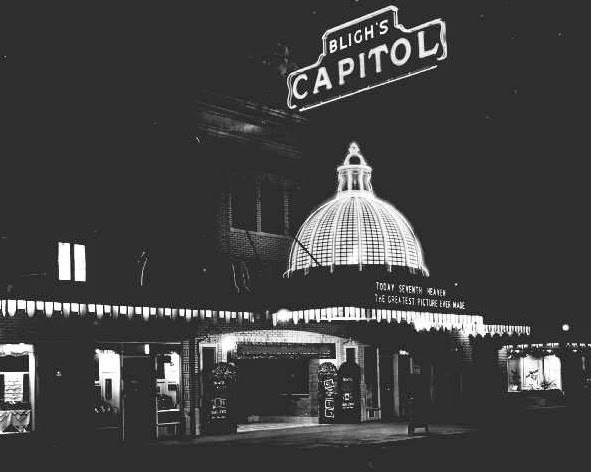
  •  Located on the southeast corner of High and State Streets, the Capitol Theater of the Bligh Building was constructed adjoining, to the east. Its distinctive dome feature over the entrance was even more attractive when it was lit at night. This building was demolished in 2000 and now is marked only by the outline of the rear wall as you pass the site, now a parking lot, on State Street.
  • Among the residences built near downtown this year: the David Eyre home on Summer Street, moved in 1939 for the construction of the North Capitol Mall, and now in the Gaiety Hill/Bush's Pasture Park Historic District at High and Mission Streets; the Baumgartner home on Winter Street, now on Summer Street after two previous moves; the Collins-Busick House on Court Street; and the Steeves House, a block to the east. The Court Street residences are in the Court-Chemeketa Historic Residential District of the NEN neighborhood.
  • The Shipley House on Washington Street, built this year, is now listed on the National Register of Historic Places. The gardens of the Shipley house were designed by well-known nurseryman Ernie Lufer. When the Depression forced the closing of the Shipley business, this English Cottage style residence was sold to Cora Kay, the widow of Thomas Kay, the mill owner. (Her home had been demolished for the construction of the Oregon State Library.) She lived here until her death in 1944. The landscaped grounds with the original underground watering system and rock gardens were restored in 1984 by Mrs. Kay’s grandson, W. K. Huntington for the present owners.
  • Across the Willamette River in West Salem, the First Methodist Church, after many years in construction, is finally completed. 
  • On Ferry Street at 19th, a beloved Congregational minister and civic leader is honored with the construction of Knight Memorial Church. Plutarch Knight's obituary of 1914 (excerpted here) lists an amazing number of accomplishments. He came to Salem in December of 1857 and attended Willamette University from 1857 to 1860.  He was reporter and editor of the Statesman from 1862 to 1864, was also state librarian and city recorder, read law, and was admitted to the bar in this same period of years. He was ordained a Congregational minister at Oregon City in 1866, and was pastor of the Congregational church of Salem from 1867 to 1883, sixteen years. He was superintendent of schools for Marion County from 1870 to 1872 and in charge of the Oregon school for deaf mutes from 1871 to 1892. The degree of Doctor of Philosophy was conferred upon him by Willamette university in 1890. He platted Knight's addition to Salem in 1888; bought Capital Park addition in 1889; Central addition and part of Capital Home addition in 1890; Simpson addition in 1891. Mr. Knight was the moving spirit and the largest original stockholder in the Capital City electric railway, started in 1890. As a minister, a writer, a public speaker, a public spirited and useful citizen, as a businessman, Mr. Knight has kept the esteem, respect and confidence of the people among whom he has led such a busy, active and useful life.

Thursday, April 22, 2010

Salem in 1924

World Events
  • Fascist Benito Mussolini, using secret police to crush unions and enforce extreme nationalism, is elected Prime Minister and then Il Duce (the leader) in Italy.
  • At the death of Lenin, Joseph Stalin purges his rivals to become ruler in the USSR.
  • Congress passes the Immigration Act, excluding Asians. The Indian Citizenship Act grants U.S. citizenship to Native Americans born within territorial limits. With the close of the Apache Wars, all conflict with Native Americans ends after 302 years.
  • The British Empire Exhibition opens in London with representations from its 58 nations. The International Olympic Committee is formed with the first modern games in Paris. (see movie "Chariots of Fire")
  • J. Edger Hoover is named head of the U.S. FBI. Nellie Ross of Wyoming is named first woman governor.
  • A tabulating company is renamed International Business Machines (IBM). A media company, MGM is founded in Los Angeles. Mercedes-Benz is organized in Stuttgart, Germany. Caesar Salad is invented in Tijuana, Mexico.
  • Comedian Will Rogers is at the height of his career. The Pulitzer Prize goes to Edna Ferber for So Big.
In Salem
In Salem’s Crystal Garden Ballroom residents danced on Wednesday and Saturday nights to some of the best-known bands in the nation. Modern dancing was on the main floor and old time polkas, schottisches and two-steps upstairs. The building was constructed for Otto Klett who died in 1947. The next owner extensively remodeled the building for meetings, banquets and conventions in addition to the dancing. Ballroom dancing declined in popularity and the last “old time dance” was held in 1964. A 1961 photograph of the Crystal Garden Ballroom shows how little the exterior of the building has changed from its original appearance.

When you visit
According to an article written by Wilma Bonsanti for the Oregon Statesman in December of 1971, the crystal chandelier was stored in the home of Mr. Gwynn, a former owner. Of Czechoslovakian prisms, it was the twin to one hanging in the East Room of the White House in Washington, D.C. The building retains its original appearance and has housed several businesses and a successful restaurant. Until recently, the lobby contained a framed newspaper clipping recalling this building's important place in a past Salem social life that included the whole family.

Other events
  • The Willamette freezes, wrecking sternwheeler vessels. The freighter Relief, operating between Portland and Salem, was crushed by an ice jam at the Salem waterfront moorage, then listed further to its side and sank.
The Doughboy Memorial at Oregon Veterans Building
  • To commemorate the service and sacrifice of Marion County members of the American Expeditionary Force in France during the recently past World War, a statue of the "Doughboy" is erected on the Courthouse lawn. The Courthouse was demolished in 1954, but the statue remained in place until 1991. When the Oregon Department of Veterans Affairs building was constructed, it was moved to that military memorial park where it stands in a beautiful landscape near Mill Creek.
  • The Circuit Rider, a memorial statue created by A. Phimister, was placed on the Capitol grounds. Robert Booth of Eugene, whose father was a Methodist Episcopal circuit rider, donated it to the State of Oregon.
  • Busick and Sons Grocery is established in the Bush-Brey Building on Commercial Street and will be a feature of Salem household shopping until 1970.
  • Parrish Middle School is built facing Capital at D Street on land that was originally a part of the Josiah Parrish Donation Land Claim. The Chamber of Commerce had fully supported the school bond of $225,000 to build this first Salem junior high school and Dr. H. H. Olinger, head of the school board, urged the construction. The school opened September 29 with HF Durham as Principal. In 1948 the first remodeling took place when an auditorium, gymnasium, and three new classrooms were added. In 1974 Parrish had its Golden Anniversary; 200 former students and teachers attended. In 1994 students and staff moved out for one year while Parrish was updated. In 1999, during the 75th celebration, a time capsule was buried.
Nelson Home
  • On E Street, an English Cottage is designed by Jamison Parker for Carl Nelson, a securities broker who went into wool and hops businesses after the crash of 1929. After the death of Mrs. Nelson in 1944, the house was sold. In the 1990s it became the Cottonwood Cottage Bread and Breakfast business establishment. It is a National Register property (1997) in the Grant Neighborhood.
  • In the Fairmount Hills south of Salem, three prominent families have lived in a Spanish Colonial Revival home built for Curtis Cross at the top of fashionable Fairmount Hill. The second owner was Asel C. Eoff, the owner of Eoff Electric Company. The third owner was Dr. Ralph Purvine. Dr. Purvine was significant in both the medical and education fields in Salem, having been a physician at Willamette University and a founder of the Salem Clinic. Dr. Purvine’s daughter lived there for many years. It became a National Register property in 1982.

Mahonia Hall
  • A neighbor of the Cross House is the former Thomas Livesley family home on Lincoln Street, a Tudor-style mansion designed by Ellis Lawrence and occupied by the Livesley family for 34 years. It was sold in 1958 and had four more owners before being purchased by the State of Oregon as the official governor's mansion. It is now known as "Mahonia Hall" after the state flower, the "Oregon grape".
From the Capitol Journal:
  • Some substance, which many car owners believed to be little flakes of sulfur cast off from the paper mill, was wreaking havoc with the finish of automobiles parked along Salem streets. The small flakes ate their way through and right down to bare metal surface.
  • Rev. H. D. Chambers, rector of St. Paul's Church, in a sermon condemned the movement among local churches to bring Billy Sunday to Salem. Said Rev. Chambers, " When the pulpit has to degenerate into a place of sensationalism and emotionalism in order to compete with worldly agencies, it is time to admit failure."