SHINE is a look backward from the present to Salem's 1860 charter. In each year we have four sections: glimpses of what was happening around the world, a special event in Salem, what you see when you visit that site today, and other Salem events of interest that year.


Showing posts with label Collins. Show all posts

Monday, April 26, 2010

Salem in 1926

World Events
  • Crown Prince Nguyen Phuc Vinh Thuy ascends to the throne of Vietnam. He will be their last monarch of that country.
  • Spain's General Francisco Franco participates in a failed coup against the republic, beginning the Spanish Civil War that precedes World War II.
  • The United States Congress passed the Air Commerce Act, licensing pilots and planes. Robert Goddard launches the first liquid-fuel rocket, at Auburn, Massachusetts. A weather map was televised for the first time, sent from NAA Arlington to the Weather Bureau office in Washington, D.C.
  • Prohibition and prostitution are major sources of revenue for criminals breaking the law, Al Capone as a "racketeer" is at the height of his career.  The National Bar Association is incorporated this year.
  • Gertrude Ederle is the first woman to swim the English Channel from France to England.
  • Vitaphone premieres with the movie "Don Juan", starring John Barrymore. But the death of film actor and sex symbol, 31 year-old Rudolph Valentino, causes world-wide grief.
  • A. A. Milne's Winnie-the-Pooh is published in London. American books: Early Autumn by Louis Bromfield and The Sun Also Rises, Ernest Hemingway.
In Salem
Thomas A. Livesley, an internationally prominent hop grower, created two of Salem's most admired structures. One is our only skyscraper, the 11 story First National Bank Building built this year on State Street downtown, The Capitol Tower, often called the “Livesley Building", the other is the former Livesley family home, "Mahonia Hall", built in 1924 on Lincoln Street in Fairmount Hills, It was once considered "out in the country" as a 1958 photograph shows. In the next year, Thomas Livesley will become Salem's "Good Roads Mayor". His priorities included bridge, street, alley and sidewalk improvements. Other major projects included expanding fire protection, new playgrounds, the Salem Airport, streetlights and traffic signals. His repeated efforts to establish a city council-manager form of government would be successful in 1947, the year of his death.

When you visit
The Livesley Building has had several owners, the present being Roger Yost. Its ground floor interior reflects the dignified banking atmosphere of the years when it was built and professional offices are still maintained in the floors above. The elaborate exterior decorations of the upper levels, representing stylized historical and mythical characters, are only partly visible from the street below. The Livesley home, Mahonia Hall, is now the governor's mansion, secured by a fence and guarded by state police. It is open to the public by invitation for special events and there are occasional tours guided by members of AAUW. Both buildings continue to reflect the life of Thomas Livesley and are his gifts to Salem's architectural heritage. They are both listed on the National Register of Historic Places.

Other Events
  • Among the other new downtown constructions in this prosperous year: the New Salem Hotel/Hughes Building at the corner of Ferry and High Streets; the Elsinore Theatre with its beautiful lobby recalling a Shakespeare Castle courtyard at night; and the Bligh Building, now called the Pacific Building, which replaced the 1864 Cook's Hotel.
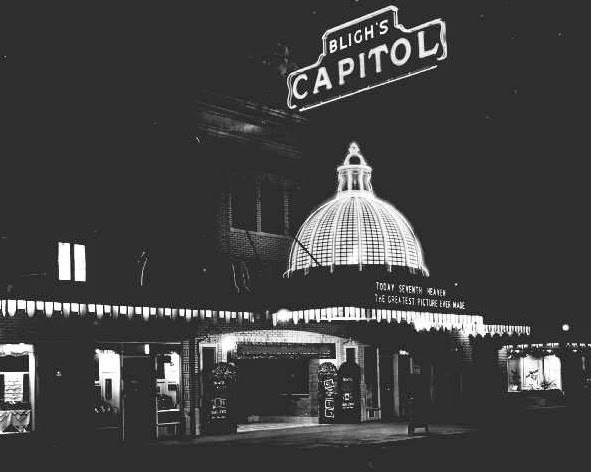
  •  Located on the southeast corner of High and State Streets, the Capitol Theater of the Bligh Building was constructed adjoining, to the east. Its distinctive dome feature over the entrance was even more attractive when it was lit at night. This building was demolished in 2000 and now is marked only by the outline of the rear wall as you pass the site, now a parking lot, on State Street.
  • Among the residences built near downtown this year: the David Eyre home on Summer Street, moved in 1939 for the construction of the North Capitol Mall, and now in the Gaiety Hill/Bush's Pasture Park Historic District at High and Mission Streets; the Baumgartner home on Winter Street, now on Summer Street after two previous moves; the Collins-Busick House on Court Street; and the Steeves House, a block to the east. The Court Street residences are in the Court-Chemeketa Historic Residential District of the NEN neighborhood.
  • The Shipley House on Washington Street, built this year, is now listed on the National Register of Historic Places. The gardens of the Shipley house were designed by well-known nurseryman Ernie Lufer. When the Depression forced the closing of the Shipley business, this English Cottage style residence was sold to Cora Kay, the widow of Thomas Kay, the mill owner. (Her home had been demolished for the construction of the Oregon State Library.) She lived here until her death in 1944. The landscaped grounds with the original underground watering system and rock gardens were restored in 1984 by Mrs. Kay’s grandson, W. K. Huntington for the present owners.
  • Across the Willamette River in West Salem, the First Methodist Church, after many years in construction, is finally completed. 
  • On Ferry Street at 19th, a beloved Congregational minister and civic leader is honored with the construction of Knight Memorial Church. Plutarch Knight's obituary of 1914 (excerpted here) lists an amazing number of accomplishments. He came to Salem in December of 1857 and attended Willamette University from 1857 to 1860.  He was reporter and editor of the Statesman from 1862 to 1864, was also state librarian and city recorder, read law, and was admitted to the bar in this same period of years. He was ordained a Congregational minister at Oregon City in 1866, and was pastor of the Congregational church of Salem from 1867 to 1883, sixteen years. He was superintendent of schools for Marion County from 1870 to 1872 and in charge of the Oregon school for deaf mutes from 1871 to 1892. The degree of Doctor of Philosophy was conferred upon him by Willamette university in 1890. He platted Knight's addition to Salem in 1888; bought Capital Park addition in 1889; Central addition and part of Capital Home addition in 1890; Simpson addition in 1891. Mr. Knight was the moving spirit and the largest original stockholder in the Capital City electric railway, started in 1890. As a minister, a writer, a public speaker, a public spirited and useful citizen, as a businessman, Mr. Knight has kept the esteem, respect and confidence of the people among whom he has led such a busy, active and useful life.

Tuesday, March 2, 2010

Salem in 1887

World Events
  • Queen Victoria celebrates her Golden Jubilee, marking her 50th year on the throne, with a banquet to which 50 kings and princes are invited. These might have included her son-in-law, the German Emperor Frederick, her son who would become Edward VII of her United Kingdom, and another son-in-law, Louis IV, Grand Duke of Hesse. These three would give her historic grandchildren of World War I: Wilhelm II of Germany, George V of England, and the Empress Alexandra of Russia who would be murdered with her husband, Nicholas II and their children.
  • The "Bayonet Constitution" disenfranchises most native Hawaiians, all Asians and the poor.
  • The Yellow River Flood begins in China, killing 900,000 to 2 million Chinese peasants.
  • The Rock Mountains Park Act creates Canada's first national park, Banff.
  • The U. S. allows the Navy to lease Pearl Harbor as a naval base.
  • Anne Sullivan begins teaching deaf and blind Helen Keller.
  • In London: The first Sherlock Holmes mystery, A Study in Scarlet, is published in London. Buffalo Bill's Wild West show opens in that city.

In Salem
This year, Holly A. Cornell designed the South First National Bank Block, the building shown above with awnings. At 241-247 Commercial Street, it is on the west side of the street, between Court and Chemeketa streets. The two-story building is of unreinforced brick, stucco covered and is of Italianate style. It was constructed during Salem's first period of private, downtown development, stimulated primarily by the desire to avoid fire by replacing wood building with brick. Changes were made to the building in 1923 when a stairway in the center divided the building, providing an entrance to second floor offices. The bank occupied the section to the north (to the right in the photograph) and Forstners Store was to the left. The adjacent Starkey-McCully building had been built in 1867 and the England Block on the Court Street corner in 1877. The entire block was a lively commercial center in the late 1800s.
Holly Cornell (1859-1911) practiced architecture in Salem for several years and is believed to have designed the Werner Breyman and Moody-Kay residences, both now gone. The South First National Bank Block and one residence are the only extant buildings designed by Cornell.When you visit
The first floor of the South First National Bank now serves commercial uses, but the second floor, much renovated, still has offices. This Commercial Street building anchors the northwest border of the Downtown Historic District.


The only Cornell residence remaining today is the Royal house on High Street. Rev. James H.B. Royal was elderly and blind when he bought the block for $800 and had the house built. He wished to provide his wife Emma a substantial property to use as a boarding house to support her and their family. The boarders were often teachers at the Liberty School across the street. (St. Paul's Church replaced the school in the 1950s.) This house is a private residence in the Gaiety Hill/Bush's Pasture Park Historic District. The present owners have an album recording the history of this well-preserved house and its changes over the years.
The former Werner Breyman residence stood at the present location of the Micah Building at the corner of State and Cottage Streets. For the construction of that building in 1925 (then the Elks Club), the large residence was moved to 249-253 Cottage Street and remodeled into the 20 Palace Apartments. It was demolished, possibly for the Willamette School of Law. The Moody-Kay residence was at the northeast corner of Court and Winter Streets. It was built for Governor Zenas Moody in this last year of his term. A frame house with a basement (where the kitchen was located), two full floors and a third with a corner garret decorated with arched windows. It became the home of several generations of the Thomas Kay family, owners of the woolen mill a few blocks away. It was the first building demolished when the state began the North Capitol Mall construction in 1937. The Oregon State Library stands in that location.

Other Events

  • East School, later renamed as Washington School, is built. The most ornate building in Salem at that time, it was designed for 9 grades with 600 students: it later became the first high school. The tallest building downtown, it was a favorite location for photographers. Demolished in 1949, the Safeway store is in that location.
  • The Gilbert house is built on Water Street. This early residential area, almost circling Marion Square Park and facing the Willamette River, was a favored location for homes of early prominent citizens. In addition to a period of urban neglect, many of the old houses were lost when the Marion Street Bridge was constructed. The Gilbert House, purchased by the city, now has a new life as a part of the A. C. Gilbert Discovery Village (Gilbert House Children's Museum).
  • George Collins builds a classic Queen Anne residence at 197 Court Street. In 1905, Dr. William Byrd moved it to 296 14th Street and gave it to his son as a wedding present.  It is a property in the Court-Chemeketa Historic Residential District of the NEN neighborhood.
  • The Mott/Brown House is built at 490 21st Street. This modest house has kept its integrity of design through many owners. This attractive Local Landmark in the NEN neighborhood was among a series of historic homes photographed by Bob Koval in 1978.

The Joshua Purvine House in Spring Valley
  • The Purvine family is established in the farmlands near Zena in Polk County. One of the brothers, Joshua, builds an Italianate-styled home on the present Spring Valley Road that remains almost unchanged in appearance more than 120 years later.
  • Urban free mail delivery is established from the Post Office at Ferry and Commercial Streets in the Nesmith Building. This building, now demolished, was also the original office of the Oregon governor.

  • A significant hotel fire occurred January 14, 1887, at the Bennett House. This hotel was built in 1852 by Charles Bennett, an 1845 settler who ventured to California and is credited with being the co-finder of the first gold nuggets at Sutter's Mill that sparked the famous "Forty-Niner" gold rush. It had a second-floor balcony built like a cabin deck, Bennett being a steamboat man. One socialite woman visitor wrote that the Bennett was "only a second-rate place" but "the best in the town." She complained: "The governor and officers sit down indiscriminately at the same table as the mechanic and the stableboy, and all are attended upon alike." As the years went by, the clientele changed from Legislators and the wealthy to working-class people. The hotel is memorialized in a Senate Chamber mural in the Oregon State Capital.